How to chose the right mobility scooter and accessories for your needs.
Zoe’s Winter Scooter Setup: Warm Hands, Better Control and a Cosy Ride

Cold hands make everything harder, and a scooter is all about your hands. Grandpa Frank says I fuss over gear, but when your fingers are numb you cannot work the throttle properly. Here is my simple winter setup.
1. Keep your hands warm and in control
Your scooter has a tiller, not a steering wheel, so this is about the grips and your gloves.
- Touchscreen-friendly gloves: Thin fleece gloves with grippy palms let you hold the tiller firmly and still use your phone or the Ride Finder app without taking them off.
- Grip covers or handlebar muffs: Soft covers that fit over the tiller grips keep wind off your hands. Make sure they do not block the throttle, brake or controls.
- Check the fit: If a cover or glove stops you moving the throttle smoothly, it is the wrong one.
2. Stay comfortable in the seat
A small lumbar cushion and a lap blanket make long rides far nicer. Tuck any blanket well away from the wheels and the tiller.
3. Layer up, but stay visible
Wear layers you can add or remove. Add a reflective vest or sash, and check your lights and reflectors. Winter dusk arrives early.
4. Add weather protection
- Light rain, short trips: a tiller and seat cover keeps the damp off the controls.
- A real step up: a canopy. The Pride hard-top canopy fits the Pursuit 2, PX4 and Baja Wrangler 2.
- All-weather cabin: the Shoprider Flagship is a fully enclosed option with a windshield and wiper.
5. What I skip
I skip anything that dangles near the wheels, anything that covers the controls, and riding on icy ground. For the safety side, read Bob’s winter safety guide, and for choosing a scooter, see the Buyer’s Guide.
Some links on this page are affiliate links. We may earn a commission at no extra cost to you.
Top 10 Heavy-Duty Mobility Scooters (300 lb+) for 2026

 This post contains affiliate links. If you use these links to buy something, we may earn a commission. Thanks.
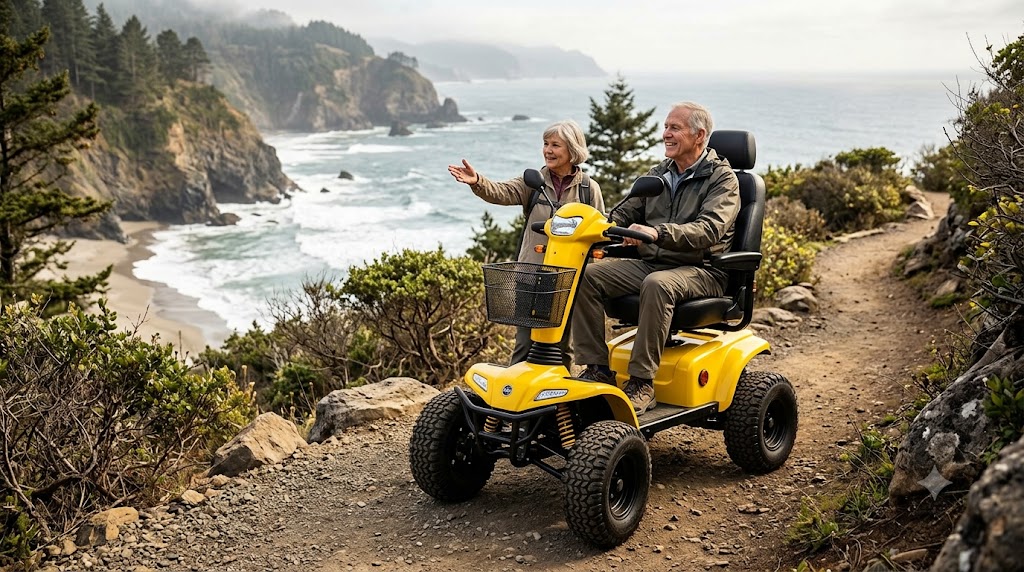
When your spirit calls you toward rugged coastal pathways, bustling city markets, and unpaved trails, standard compact travel scooters simply will not suffice. For those who require robust construction, superior weight capacity, and heavy-duty performance, finding the right machine is essential for maintaining total independence.
Before diving into our heavy-duty heavyweights, if you are transitioning from smaller models or just beginning your journey, you may want to review our foundational guide on choosing your very first travel scooter. Additionally, keeping these heavy-duty powerhouses in peak condition through every season requires proper care—be sure to consult our comprehensive Maintenance & Battery Guide for Coast-to-Coast Reliability to protect your investment.
For 2026, the engineering behind heavy-duty mobility has reached extraordinary new heights. After thorough research and testing, we have curated the definitive list of the top heavy-duty mobility scooters offering 300lb+ weight capacities.
What Makes a Heavy-Duty Mobility Scooter?
Heavy-duty mobility scooters are engineered for durability, power, and stability. Unlike lightweight or folding units, these titans feature:
-
Higher Weight Capacities: Ranging comfortably from 300 lbs up to 500 lbs and beyond.
-
Rugged Terrain Handling: Larger tires, high ground clearance, and powerful motors to conquer gravel, grass, and steep inclines.
-
Advanced Suspension Systems: Designed to absorb bumps and deliver a cloud-like ride on extended outdoor journeys.
Top Heavy-Duty Contenders for 2026
1. The Ultimate Powerhouse: Pride Mobility PX4
For those who refuse to let terrain dictate their schedule, the Pride PX4 stands as an undisputed champion. With massive high-traction tires and full suspension, it devours rough trails with grace.
-
Weight Capacity: Up to 500 lbs
-
Bob’s Take: “This is the steel-hearted machine I trust for our toughest outdoor expeditions. It inspires absolute confidence.”
Check the Pride PX4 at Electric Wheelchairs USA
2. The Comfort King: Drive Medical Panther
If you crave plush, all-day comfort paired with rugged muscle, the Drive Medical Panther is your ideal companion. It features an ergonomic captain’s seat and advanced lighting for safe evening strolls.
-
Weight Capacity: Up to 425 lbs
-
Janice’s Take: “It feels like riding on a cozy armchair while exploring scenic viewpoints! Pure luxury.”
See the Drive Medical Panther at Electric Wheelchairs USA
3. The Versatile Performer: Afiscooter S4
A masterpiece of modern engineering, the Afiscooter S4 balances heavy-duty performance with nimble urban maneuverability and sleek, head-turning style.
-
Weight Capacity: Up to 450 lbs
-
Bob & Janice’s Tip: “Strong enough for steep coastal hills, yet nimble enough for crowded boardwalks.”
See the Afikim Afiscooter S4 at Electric Wheelchairs USA
Quick Comparison Table
Final Thoughts & Where to Buy
Choosing a heavy-duty mobility scooter is an investment in your freedom and outdoor lifestyle. Whether you prioritize the raw power of the PX4, the luxurious embrace of the Panther, or the agile versatility of the S4, your next great adventure awaits just beyond your doorstep.
Before you set sail into the sunset, deepen your knowledge by exploring our detailed Pride Mobility Reviews and our expert guide on Senior Independence & Outdoor Accessibility.
Ready to upgrade your mobility? Find Your Perfect Scooter on Electric Wheelchairs USA today! Check out the full selection and get expert advice at our heavy-duty scooter collection.
May the wind always be at your back and your battery forever full… 🌊
– Bob & Janice
Compare prices: Browse heavy-duty mobility scooters or scooters rated for 400 lbs or more at our partner, Mobility Department. These models are also listed there: Pride PX4, Drive Medical Panther, Afikim Afiscooter S4.
Best Compact Scooters for Tight Indoor Spaces

This post contains affiliate links. If you use these links to buy something, we may earn a commission. Thanks.
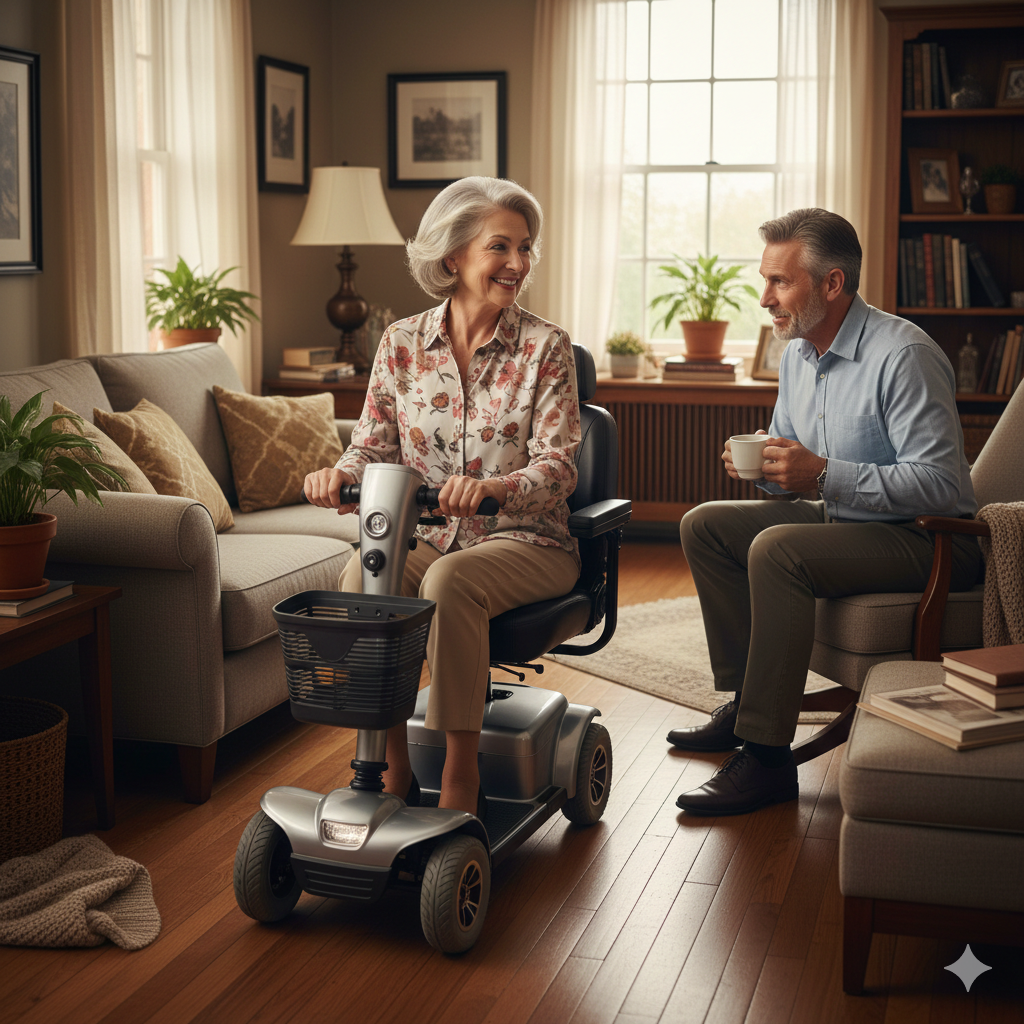
In cramped quarters — narrow hallways, cozy apartments, compact retail floors, or tight storage corners — the need for mobility doesn’t disappear. It just demands a different kind of machine. Enter the compact scooter: a lean, nimble, foldable solution engineered not for highways or open roads, but for tight indoor spaces where agility, portability, and subtlety matter much more than brute power.
In this guide, we’ll dive into what makes a scooter “ideal for indoor spaces,” highlight top picks on the market today, and walk you through how to choose the right model. By the end, you’ll have clarity — and maybe more mobility than you expected.
Why Compact Scooters Shine Indoors
Large scooters and bulky mobility devices often falter once you step into confined spaces: doorways become bottlenecks, furniture becomes obstacles, and storage becomes a headache. Compact scooters — by design — circumvent those hurdles. They bring several inherent advantages:
- Maneuverability & Tight Turning Radius. Scooters built for indoor use often feature three-wheel configurations or specialized steering mechanisms to allow quick, tight turns. That makes navigating narrow hallways, aisles, or corners far easier.
- Portability & Foldability. Many compact scooters can be folded, disassembled, or reduced to a more manageable size — a huge plus when you need to store them under beds, in closets, or corners, or when you want to transport them between rooms or buildings.
- Space Efficiency. Their slim frames often allow them to fit through standard doorways and move around furniture — making them ideal for homes, apartments, malls, offices, or other indoor environments.
- Convenience for Frequent Use. For people who need a scooter for short distances — maybe around a house, small building, or indoor public space — compact scooters offer a convenient, low-effort solution without the hassle of large, heavy vehicles.
Because of these traits, compact scooters have carved a niche in indoor mobility: for seniors, people with limited mobility, urban dwellers, and anyone who values space-saving design without sacrificing functionality.
What to Look For — Key Features & Specs
Before you commit to a model, it’s worth pausing to examine the essential attributes that make a compact scooter truly indoor-ready.
Maneuverability & Wheel Configuration
- Three-wheel vs. Four-wheel: Many indoor scooters employ a three-wheel design because it provides a tighter turning radius — ideal for navigating narrow doorways, corners, and hallways.
- Turning Radius: A smaller turning radius (often 30–36 inches or so for 3-wheelers) enhances agility in tight spaces.
- Tiller / Steering Design: Intuitive, easy-to-manage steering makes a big difference, especially in confined areas where oversteering can lead to collisions.
Size, Weight & Portability
- Compact Dimensions: A slim frame that fits through standard doors and navigates hallways is ideal.
- Weight: Lighter scooters (some as light as ~35–40 lbs) are easier to lift, fold, store, or transport.
- Disassemblable or Foldable Frames: Make storage and transport much easier for homes, apartments, or even cars.
Battery, Range & Performance (if electric)
- Sufficient Range for Intended Usage: For indoor use or short trips indoors/outdoors, a modest battery range (e.g., 6–12 miles) may suffice.
- Power vs. Space Trade-off: Indoor scooters often sacrifice long-range or high-speed motors for compact form factors.
Comfort & Safety Features
- Seat Comfort and Adjustability: Swivel seats, adjustable seats/armrests — these make for ease of getting on/off in tight quarters.
- Stability & Weight Capacity: The scooter must safely support the user’s weight. Typical indoor compact scooters support 250–300+ lbs.
- Ease of Use Controls: Simple, intuitive controls (steering, acceleration, braking) help reduce frustration and increase safety — especially important indoors where reaction time might be limited.
Recommended Compact Scooters for Tight Indoor Spaces
Here are several of the most recommended compact scooters, particularly suited for indoor environments or tight-space navigation. Their differences in size, construction, functionality, and cost provide plenty of options to suit various preferences.
Highlights & Why They Stand Out
- HandyScoot Small Mobility Scooter for Indoor Use — A folding, three-wheeled scooter that balances portability with practicality. Top speed up to 9 mph and a range of up to ~15 miles per charge. Its foldable design and manageable weight make it a suitable candidate for indoor and travel use.
- EV Rider Gypsy Small Indoor Mobility Scooter — Extremely lightweight (≈ 37 lbs), folds down easily, and ideal for indoor mobility or frequent transport (e.g., stairs, car trunks). Its compact build makes it a good everyday indoor companion.
- Go-Go Elite Traveller Compact Scooter — A well-rounded option with solid indoor maneuverability, relatively easy disassembly, and sufficient weight capacity for many users. It suits those who want portability without compromising too much on comfort and Stability.
- Pride i-Go 3-Wheel Folding Mobility Scooter — Compact, foldable, and built with indoor use in mind. Its foldable build allows for quick storage and hassle-free transport, and the three-wheel setup provides smoother handling in narrow or crowded areas.
- SmartScoot Foldable Mobility Scooter — Among the lightest foldable scooters on the market, making it highly portable and easy to store. Great for users living in apartments or small homes, or for frequent mobility without bulky equipment.
- Featherweight Mobility Scooter — Ultra-light design prioritizing portability and storage — ideal for very tight living spaces, frequent transport, or minimal-space lifestyles.
- eFOLDi Lite Mobility Scooter — Combines a lightweight frame with a respectable load capacity, and folds easily for storage or transport. Useful for users needing a balance of convenience, indoor mobility, and everyday reliability.
- Triaxe Sport Compact Mobility Scooter — A slightly sturdier compact scooter that still embraces a slim, space-efficient design. For those wanting a more durable build while staying within the compact-scooter category.
How to Choose — Matching Scooter to Your Needs
Selecting the “right” compact scooter depends heavily on how you intend to use it. Here’s a practical framework to guide your decision:
Usage Environment
Mostly within apartments, homes, offices, or indoor spaces → prioritize foldability, light weight, narrow width, and tight turning radius.
Expect occasional outdoor use (e.g., sidewalks, short errands) → opt for slightly more robust frames and better battery/range.
Mobility & Storage Constraints
Limited storage (closet, under bed, corner room) → choose foldable or disassemblable scooters like the Featherweight, SmartScoot, or EV Rider models.
Need portability (stairs, moving between rooms/buildings, transport in a car) → light scooters (under ~40–50 lbs) or foldable designs.
User’s Weight & Comfort Needs
Always check weight capacity — many compact scooters support 250–300+ lbs.
For frequent daily use, a comfortable seat, stable build, easy controls, and good maneuverability matter more than high speed.
Battery, Range & Frequency of Use
If the scooter will be used indoors or for short trips, a modest range (6–15 miles) may suffice.
For longer or more frequent trips, prioritize models with better battery life, even if they are slightly heavier.
Maneuverability Over Power
For indoor spaces, a tight turning radius and responsive steering trump high speed or outdoor power.
Potential Trade-offs: What You Might Sacrifice
No solution is perfect. Compact scooters — for all their space-efficient brilliance — come with trade-offs.
- Limited Comfort or Suspension: Because of their small frame and lighter build, many compact scooters offer only basic suspension (if any) and limited comfort features. This can make them less comfortable over longer rides or rougher indoor surfaces.
- Reduced Range or Power: Compact/foldable scooters often have smaller batteries and less powerful motors. Not ideal if you plan long rides or frequent outdoor use.
- Less Stability (on Rough Ground): While fine indoors or on smooth floors, compact scooters — exceptionally light three-wheel ones — may wobble or struggle on uneven terrain.
- Fewer Features: To keep size and weight down, manufacturers may sacrifice extras such as advanced suspension, large storage baskets, heavy-duty build, or high-end controls.
Accepting these trade-offs is part of embracing compact scooters: you gain range, portability, and indoor friendliness — but sacrifice some comfort or all-terrain robustness.
Who Benefits Most from Compact Indoor Scooters?
Compact scooters for tight indoor spaces tend to be especially beneficial for:
- Elderly or mobility-challenged individuals who need dependable, easy-to-use devices to navigate homes, apartments, or assisted-living facilities.
- Urban dwellers living in small apartments or condominiums, where storage is limited, and the transport of a regular scooter would be burdensome.
- People needing a portable mobility device for frequent transport (between rooms, buildings, or even vehicles), but still requiring Stability and comfort.
- Temporary use cases (e.g., injury recovery, short-term mobility assistance) where large, expensive devices are unnecessary.
- Space-conscious households or establishments like small shops, clinics, assisted-living homes, or indoor recreation centers, where maneuverability and compact storage are essential.
Maintenance, Safety, and Practical Use Tips
Owning a compact indoor scooter isn’t just about buying — it’s also about using it properly. Here are some tips to ensure longevity and safe use:
| Tip / Consideration | Reason / Benefit |
| Regularly inspect wheels / turning mechanisms | Frequent tight turns can stress wheels or bearings; early checks prevent accidents. |
| Keep battery charged; avoid deep discharge | For electric models, consistent charging prolongs battery life and ensures reliability. |
| Avoid rough surfaces or stairs if not designed for them | Compact scooters often lack suspension or a rugged build — rough terrain can tip or damage them. |
| Use indoors first — take time to get used to steering radius & braking | Indoor spaces leave little margin for error — practice helps build control and confidence. |
| Store in dry, dry-climate spaces | Prevent rust or battery damage from humidity, especially in tropical climates like Manila. |
| Check weight load regularly (especially with cargo or bags) | Overloading may stress the frame or degrade performance over time. |
Should You Use a Compact Scooter in Manila / Urban Asia Context?
Given your likely context — dense urban living, limited indoor space, perhaps shared living quarters — compact scooters make a compelling case. A few reasons:
- Housing in metro areas often means smaller apartments or condos; traditional large scooters become cumbersome to store or move.
- Narrow corridors, small elevators, and limited staircases — compact scooters navigate these with ease.
- For short errands, quick commutes within buildings, or trips to nearby destinations, compact scooters offer a practical alternative to cars or larger vehicles.
- Portability means you can carry them up staircases, into cars or public transport (if allowed), or store them in small corners when not in use.
As long as you choose a model matching your weight, mobility needs, and intended use — and follow safety/maintenance guidelines — compact scooters can transform mobility for urban dwellers.
Cost Breakdown: How Much Should You Expect to Spend on a Compact Indoor Scooter?
While compact scooters are smaller and more streamlined than their full-sized counterparts, their prices vary widely — often surprising buyers who assume “smaller” means “cheaper.” In reality, the cost reflects engineering trade-offs, specialized materials, battery technology, and whether the scooter is built for portability, durability, or all-day indoor use. Understanding these cost tiers can help you avoid overspending while ensuring you choose a model that aligns with your needs.
Entry-Level Compact Scooters ($450–$900)
These models offer the essentials: a basic three-wheel design, modest top speeds (usually 3–4 mph), and limited range. They’re ideal for those who need occasional indoor mobility — navigating a small apartment, moving from room to room, or performing light daily tasks. Foldability may be minimal, and materials tend toward lightweight plastics and simple foam seating.
- Best for: Budget-conscious shoppers, light users, temporary mobility needs.
- Trade-offs: Shorter battery life, minimal comfort features, and limited suspension.
Mid-Range Indoor Scooters ($900–$1,600)
This category represents the “sweet spot” for most users. These scooters typically include better seating, improved maneuverability, tighter turning radii, and more durable frames. Many mid-range compact scooters offer quick-disassembly systems or semi-folding mechanisms that still allow for easy storage in closets or small storage areas.
- Best for: Daily indoor users, seniors who need dependable home mobility, and small-space dwellers.
- Trade-offs: May still lack advanced cushioning or high-weight capacities.
Premium Ultra-Compact & Foldable Scooters ($1,600–$3,400+)
At the high end of the spectrum lie the featherweight and ultra-portable models — scooters engineered for seamless movement in tight indoor spaces and effortless transport outdoors. Many are aircraft-friendly, made with aluminum alloys or carbon-infused frames, and can fold in seconds. Despite their light footprint, some models still deliver impressive speed and range.
- Best for: Users prioritizing portability, travelers, and those with limited strength who need lightweight frames.
- Trade-offs: Higher price, sometimes smaller seating, and limited cushioning due to weight-saving designs.
Hidden Costs to Consider
Small scooters might look like low-maintenance machines, but ownership can introduce a few extra expenses that often catch new users off guard:
- Battery replacements (every 12–24 months) — Lithium-ion batteries last longer but cost more; sealed lead-acid alternatives are cheaper but heavier.
- Tire wear or replacements — Indoor environments can still create friction on non-marking tires.
- Seat upgrades — Cheaper models may benefit from cushioned add-ons for long-term comfort.
- Warranty extensions or servicing — Especially worthwhile if you rely on the scooter daily.
Depending on your needs, these extras could add $60 to $300 per year. However, for frequent users, these costs are often justified by the increased reliability and comfort they provide.
FAQs
Are compact scooters safe to use indoors?
Yes. Compact scooters are designed with tight turning radii and controlled speeds, making them safe for hallways, kitchens, bedrooms, and other indoor spaces when appropriately used.
Can these scooters fit through standard doorways?
Most compact scooters can pass through standard 28–32-inch doorways thanks to their slim frames. Always check the exact width before purchasing.
How long does the battery last?
Indoor-friendly models typically offer 6–15 miles per charge — more than enough for daily home use.
Can compact scooters be used outdoors too?
They can, but only on smooth surfaces like sidewalks or mall floors. They are not ideal for uneven terrain or rough outdoor conditions.
Do foldable scooters lose durability?
Not necessarily. High-quality folding mechanisms are engineered for repeated use, but ultra-lightweight frames may have lower comfort or load capacity.
Are compact scooters easy to store?
Yes. Most either fold or disassemble, allowing storage in small closets, corners, or even under furniture.
Conclusion
We often equate mobility with size: bigger wheels, heavier build, more power. But when it comes to indoor spaces or small-footprint living, that assumption becomes a liability. Compact scooters challenge that notion. They prove — gently, efficiently, and sometimes surprisingly elegantly — that freedom of movement doesn’t require bulk.
If you value agility over raw power, portability over long-haul range, and space-efficiency over ruggedness, compact scooters offer a liberating alternative.
Whether for seniors longing for independence, urban residents craving mobility without clutter, or anyone navigating tight indoor spaces, the right compact scooter can help you rediscover movement on your own terms.
Gear up for your ride: front basket · folding basket · scooter batteries and chargers · lithium scooter battery · all-weather scooter cover · scooter canopy.
Ready to shop? Browse lightweight folding scooters at our partner, Electric Wheelchairs USA.
Compare prices: Browse folding mobility scooters at our partner, Mobility Department. These models are also listed there: EV Rider Gypsy Q2, eFOLDi Lite.
Must-Have Mobility Scooter Accessories for Comfort & Safety

This post contains affiliate links. If you use these links to buy something, we may earn a commission. Thanks.

Mobility scooters have become more than just transportation devices; they’re freedom machines. They offer independence, confidence, and the ability to move through daily life with ease. But a mobility scooter on its own only meets the basics. The fundamental transformation—the leap from “functional” to “comfortable, safe, and truly personal”—comes from the accessories you pair with it. And this is where the world of mobility scooter add-ons gets surprisingly rich.
Whether you’re a long-distance rider who needs all-day comfort, a safety-first shopper preparing for unpredictable terrain, or someone who wants to make daily errands easier, there’s an accessory explicitly engineered for your lifestyle. In this guide, we’ll walk through the must-have mobility scooter accessories that elevate comfort, enhance safety, and create a riding experience tailored to your needs.
Quick links: Browse all scooter accessories at Electric Wheelchairs USA · Compare accessories and parts at Mobility Department
Why Accessories Matter More Than You Think
At first glance, accessories can seem like optional extras—nice to have, not essential. But here’s the twist: the right accessories can drastically change your experience. They can prevent discomfort, boost visibility, improve organization, and provide security during every ride. Think of them as the fine details that turn mobility into optimal mobility.
Without accessories, riders often deal with:
- Excess fatigue on longer trips
- Limited storage capacity
- Poor weather protection
- Reduced nighttime visibility
- Struggles carrying oxygen tanks, canes, or personal bags
- Difficulty navigating unfamiliar or crowded areas
With the right upgrades? Those challenges evaporate.
Top Must-Have Mobility Scooter Accessories for Comfort and Safety
Let’s dive into the accessories that make the most significant difference—practical, proven, and designed for real-world use.
Cushioned Seat Upgrades and Supportive Backrests
Comfort begins with the seat. Stock seats on mobility scooters, while functional, aren’t always engineered for long-journey comfort. For users who ride daily or for extended periods, pressure points can become uncomfortable, and discomfort can eventually turn into reluctance to travel.
Best Seat Accessories Include:
- Gel seat cushions: Soft yet supportive, they evenly distribute pressure.
- Memory foam cushions: Ideal for riders needing customized molding comfort.
- Orthopedic backrests: Provide additional lumbar support, reducing strain.
- Seat covers: Soft materials that add both comfort and style.
Why Seat Accessories Matter
A well-padded seat doesn’t just feel good—it reduces fatigue, increases endurance, and can significantly improve posture. For many riders, upgraded cushions become non-negotiable after just one use.
Shop seat comfort: eFoldi scooter seat cushion, ROHO Contour Select cushion, replacement seat cushion or a tiller and seat cover set. Need a better back? See the Journey Air backrest.
Weather Protection: Canopies, Covers, and Rain Gear
The weather is unpredictable, and nothing derails a trip like sudden rain, intense sunlight, or biting winds. Mobility scooter weather accessories extend your riding season and protect both you and your scooter from the elements.
Top Weather Accessories:
- Scooter canopies: Shield from rain, wind, and UV exposure.
- Rain ponchos designed for scooter riders: Longer fronts that cover your legs and handlebars.
- All-weather scooter covers: Protect the scooter when parked outside.
- Windshields: Reduce wind resistance and shield the face from debris.
How Weather Accessories Boost Safety
Visibility improves when you’re protected from rain and harsh sunlight. A canopy or windshield helps you see the road clearly, reduces distraction, and prevents accidents caused by environmental interference.
Shop weather protection: custom-fit all-weather scooter cover, rain side covers, travel protection cover or a scooter canopy.
Rear-View Mirrors for Awareness and Safety
Rear-view mirrors are often overlooked until you use one—and then you’ll wonder how you ever rode without one. Whether navigating sidewalks, crossing streets, or backing up, visibility is everything.
Types of Rear-View Mirrors:
- Handlebar-mounted mirrors
- Shatterproof safety mirrors
- Wide-angle mirrors for maximum field of view
Why Mirrors Are Essential
Mobility scooters sit lower to the ground, so you’re not always instantly visible to pedestrians, cyclists, or drivers. Mirrors enhance situational awareness, allowing you to spot approaching obstacles without turning your entire body—something that’s especially important for riders with limited neck mobility.
Shop mirrors: Z-4 custom-fit scooter mirrors (pair).
LED Headlights, Tail Lights, and Reflective Add-Ons
If there’s one accessory category that dramatically increases safety, it’s lighting. Many scooters come with basic lights, but “basic” may not be enough for nighttime or early-morning visibility.
Must-Have Lighting Accessories:
- High-intensity LED headlights
- Rear hazard lights
- Reflective tape for night visibility
- Side reflectors and underglow strips
- Flashing beacon lights for busy outdoor areas
How Lights Improve Safety
Good lighting prevents collisions, ensures you’re seen from all angles, and makes low-visibility conditions far safer. For evening riders, enhanced lighting is a non-negotiable upgrade.
Shop lighting: EZ-Mobility scooter light and horn or the ComfyGO headlight with USB connector.
Storage Accessories: Baskets, Bags, and Carry-Alls
Mobility scooters need storage solutions—after all, part of independence comes from being able to bring things with you. From groceries to personal items, these storage accessories keep belongings secure and accessible.
Popular Storage Add-Ons:
- Front baskets: Perfect for daily essentials.
- Rear lockable storage boxes: Secure valuables, medications, or electronics.
- Side saddlebags: Add extra storage without bulk.
- Armrest bags: Great for phones, keys, wallets, or snacks.
- Oxygen tank holders: Safely secure medical equipment.
Why Storage Matters
It decreases the chance of objects dropping off your lap, eliminates the need to juggle bags while driving, and promotes safety by keeping the scooter balanced and clutter-free.
Shop storage: Tzora front basket, folding basket, heavy-duty rear basket, armrest bag or a front tiller bag. Cane user? Try the ComfyGO cane holder.
Cup Holders, Phone Mounts, and Convenience Accessories
Sometimes it’s the small comforts that make a scooter ride feel easy and efficient. Convenience accessories help personalize your scooter to suit your lifestyle.
Useful Convenience Add-Ons:
- Sturdy cup holders for drinks on the go
- Phone or GPS mounts for hands-free navigation
- USB charging ports
- Keychain accessories for quick access
- Seatback organizers
Why These Extras Matter
They minimise distraction. A secure phone mount prevents dangerous fumbling. A cup holder keeps hydration within reach. And a charging port ensures your essential devices never run out of power on long trips.
Shop convenience add-ons: Cup Holder Deluxe (or the Transformer cup holder), universal phone mount and a bottle holder.
Safety Flags for Higher Visibility
Scooters sit below eye level for many drivers and cyclists, making visibility a top priority. Safety flags extend upward, making the scooter easier to spot from a distance.
Benefits of Safety Flags:
- Ideal for outdoor parks, parking lots, and busy sidewalks
- Come in bright colours for high visibility
- Lightweight and easy to install
- Often reflective for nighttime safety
Why Flags Are Essential
If you ride near traffic or crowded pedestrian areas, a tall flag dramatically reduces the chance of being overlooked.
Shop safety flags: EV Rider safety flag or a foldable safety flag.
Mobility Scooter Locks and Anti-Theft Devices
Mobility scooters—especially high-end models—can be expensive assets. Keeping them secure matters whether you’re at home or out shopping.
Top Security Accessories:
- U-locks: Strong, nearly impossible to cut.
- Alarm systems: Trigger loud alerts when the scooter is moved or tampered with.
- Electronic key fobs: Prevent unauthorized use.
- GPS trackers: Provide real-time location tracking.
Why Security Enhancers Are Important
Peace of mind. Knowing that your scooter is protected allows you to focus on your day without worry.
Shop security: universal brake handle lock.
All-Terrain Tires and Tire Accessories
For riders who navigate uneven sidewalks, gravel paths, or suburban roads, tire upgrades are game-changers.
Popular Tire Upgrades:
- Pneumatic (air-filled) tyres: Provide smoother rides.
- Solid tyres: Puncture-proof and maintenance-free.
- High-traction tyres: Improve control on loose or wet surfaces.
- Tire repair kits for quick fixes
Why Tires Matter
Better tyres mean better safety, more stability, and improved shock absorption—reducing strain on your back and joints.
Shop tyre care: tire inflator and replacement tires and parts.
Armrest, Footrest, and Handlebar Accessories
These components directly affect how your body interacts with the scooter every second you’re riding.
Comfort Enhancers Include:
- Ergonomic handlebar grips: Reduce hand fatigue.
- Padded armrests: Add comfort during longer rides.
- Adjustable footrests: Provide better leg support.
How These Upgrades Improve Comfort
Proper ergonomics prevent strain and promote better alignment, especially for riders who use their scooters extensively throughout the day.
Shop armrests and ergonomics: replacement armrests or iLiving armrests.
First-Aid and Emergency Kits
Safety isn’t just about prevention—it’s also about preparation. Having a compact emergency kit ensures you’re ready for unexpected minor injuries or health needs.
Useful Emergency Add-Ons:
- Compact first-aid kits
- Flashlights
- Whistles or personal alarms
- Portable battery banks
- Emergency ponchos
These are small items with a significant impact.
How to Choose the Right Accessories for Your Scooter
With countless accessory options out there, choosing the right ones can feel overwhelming. Here’s a strategy to narrow it down:
Start with Safety
Lighting, mirrors, flags, and locks come first. These offer immediate protection.
Evaluate Comfort
If you ride long distances or daily, prioritize seat cushions, canopies, and ergonomic accessories.
Consider Your Lifestyle
Do you shop often? Add storage.
Ride in unpredictable weather? Get rain gear.
Travel on rough terrain? Tire upgrades are key.
Set a Budget
You don’t need everything at once. Begin with essentials, then expand.
Check Compatibility
Not all accessories fit all scooters, so measure carefully and confirm specs before buying.
Weatherproof Mobility Scooter Clothing for Riders
While canopies and covers protect the scooter itself, riders often need enhanced protection from the elements. Weatherproof clothing designed specifically for mobility scooter use can make outdoor travel more manageable during colder months or rainy weather.
Top Clothing Accessories Include:
- Insulated mobility scooter coats: Longer in the front, designed to drape comfortably without restricting movement.
- Waterproof leg covers: Keep legs dry without bunching or slipping off during rides.
- Thermal gloves with touchscreen fingertips: allow riders to maintain control while still using phones or touchscreen displays.
- Weatherproof hats and scarves: Offer warmth without obstructing visibility or hearing.
Why Rider Clothing Matters
Comfort directly affects confidence. When riders feel warm, dry, and safe, they’re more willing to travel independently—even in challenging weather.
Portable Ramps for Easy Loading and Unloading
A mobility scooter is only helpful if you can access the places you want to go. Portable ramps fill the gap when facing steps, curbs, or uneven elevations.
Best Ramp Options:
- Folding suitcase ramps: Compact, lightweight, and ideal for vehicles or home doorways.
- Threshold ramps: Perfect for small elevation changes.
- Telescoping ramps: Extendable and adjustable for various heights.
Why Ramps Are Essential
They remove obstacles—literally. Ramps are one of the most empowering accessories because they expand where riders can go without assistance.
Shop ramps: portable ramps at Mobility Department.
Battery Enhancements and Charging Accessories
A mobility scooter is only as reliable as its battery. For frequent riders or long-distance travelers, battery-related accessories are crucial.
Popular Battery Accessories:
- Backup batteries: Ensure peace of mind during long trips.
- Fast chargers: Reduce waiting time and keep scooters ready to go.
- Portable power stations: Offer emergency charging capability anywhere.
- Battery cases: Protect batteries from heat, dust, and moisture.
Why Battery Accessories Matter
A powerful battery increases range, reduces anxiety, and enhances safety by preventing unexpected breakdowns far from home.
Shop batteries and chargers: scooter batteries and chargers, including the Free Rider 10.5Ah lithium battery, Ninja replacement battery and car charger adaptor.
Anti-Tip Wheels and Stability Accessories
Stability is a significant safety factor, especially for riders navigating inclines or uneven sidewalks. Anti-tip wheels and stability bars help prevent tipping accidents.
Common Stability Solutions:
- Rear anti-tip wheels: Small, but incredibly effective at preventing backward tipping.
- Wide-wheelbase kits: Increase stability on rough terrain.
- Center-of-gravity stabilizers: Improve balance and reduce wobbling.
Why Stability Enhancers Matter
They provide peace of mind—especially for seniors or riders with balance concerns. Stability accessories turn risky routes into comfortable, predictable rides.
Shop stability: replacement anti-tip wheels.
FAQs
What accessories are essential for mobility scooter safety?
The most essential safety accessories include lights, mirrors, safety flags, anti-tip wheels, and locks.
How can I make my mobility scooter more comfortable?
Add seat cushions, padded armrests, ergonomic grips, and weather protection, such as canopies or leg covers.
Are mobility scooter accessories universal?
Not always. Some accessories are universal, but others require compatibility with specific scooter models.
Do I need professional help to install accessories?
Most accessories—like baskets, mirrors, and seat cushions—can be installed without professional assistance.
What accessories help with long-distance rides?
Comfort cushions, extended-range batteries, cup holders, storage bags, and better suspension seats improve long-distance travel.
What’s the best accessory for riding in low light?
High-intensity LED headlights and reflective tape provide the best visibility at night.
Is it possible to utilize a mobility scooter in inclement weather?
Yes, with the right gear, like rain ponchos, canopies, windshields, and waterproof storage bags.
Conclusion
Mobility scooter accessories aren’t just extras. They’re enhancements that protect your safety, boost comfort, and make daily travel easier and more enjoyable. From upgraded seat cushions to safety lights and weather protection, each accessory plays a meaningful role in elevating the ride experience.
Whether you’re customizing your scooter for practical needs, personal comfort, or long-term independence, the right accessories turn a basic scooter into a personalized mobility companion—one that adapts to your environment, your routines, and your life.
Ready to shop? Browse scooter accessories at our partner, Electric Wheelchairs USA.
Compare prices: Browse scooter parts and accessories at our partner, Mobility Department.
Flying With a Mobility Scooter: TSA and Airline Rules 2026

This post contains affiliate links. If you use these links to buy something, we may earn a commission. Thanks.
 Introduction
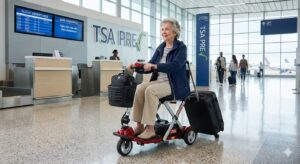
Traveling with a mobility scooter can offer unparalleled freedom, but navigating airport security and airline regulations requires careful planning. As of 2026, new guidelines and increased awareness around battery safety are shaping how individuals can fly with their mobility aids. This comprehensive guide will help you understand the essential TSA and airline rules to ensure a smooth journey [1].
Key Regulations for 2026
1. Advance Notification to Airlines
Most airlines require passengers traveling with mobility scooters or electric wheelchairs to provide at least 48 hours’ notice [2]. This allows the airline to make necessary arrangements for storage and handling of your device. It’s advisable to inform them at the time of booking or as soon as possible thereafter.
2. Battery Regulations: A Critical Update
The most significant changes in 2026 revolve around lithium-ion batteries, primarily due to fire safety concerns. The FAA (Federal Aviation Administration) and IATA (International Air Transport Association) have updated their guidelines:
- Lithium-ion Battery Size Limit: The size of lithium-ion batteries is generally limited to 300 watt-hours (Wh) [3] [4].
- Spare Batteries: Spare lithium-ion batteries must be carried in carry-on baggage only [3]. They are not permitted in checked baggage.
- Installed Batteries: Batteries installed in the scooter must be protected from short circuits and securely attached [2].
- Removal Requirement: For mobility scooters with removable lithium-ion batteries, the battery often needs to be removed and carried in the cabin [5].
It is crucial to check with your specific airline for their exact battery policies, as some may have stricter requirements or require specific documentation from the manufacturer [1].
3. TSA Screening Process
When going through security, your mobility scooter will undergo screening. This may include visual inspection, X-ray screening, and potentially a pat-down for the passenger. Seat cushions and any non-removable pouches should also be screened [6].
- Mobility Aids: Walkers, crutches, and other mobility aids must undergo X-ray screening [7].
- Documentation: Having a copy of your scooter’s manual and battery specifications readily available can expedite the screening process [8].
Preparing Your Scooter for Flight
- Documentation: Carry all necessary documentation, including battery specifications (watt-hours) and a copy of your scooter’s manual.
- Disassembly: If your scooter disassembles, understand how to do so quickly and efficiently. Airlines may require this for storage.
- Protection: Consider protecting your scooter with padding or covers to prevent damage during handling.
- Labeling: Clearly label your scooter with your contact information.
- Pre-Flight Check: Ensure your scooter is in good working condition before arriving at the airport.
Onboard and At Your Destination
- Stowage: Power wheelchairs and scooters are typically stowed in the cargo hold. They are generally not allowed in the passenger cabin due to size and weight [9].
- Rentals: For those who prefer not to travel with their own scooter, consider renting one at your destination. Rental companies at popular travel destinations offer convenient options, so book ahead.
Conclusion
Flying with a mobility scooter in 2026 is manageable with proper preparation and awareness of current regulations. By understanding airline policies, especially regarding batteries, and preparing for TSA screening, you can ensure a stress-free and enjoyable travel experience. Always confirm the latest guidelines with your airline before your trip.
References
[1] Scootaround. (n.d.). The Ultimate Guide to Flying With a Mobility Scooter. Retrieved from https://scootaround.com/en/the-ultimate-guide-to-flying-with-a-mobility-scooter
[2] Malisa Mobility. (n.d.). Flying with a Mobility Scooter: Airline & FAA Rules Guide. Retrieved from https://malisamobility.com/blogs/news/flying-with-mobility-scooter-guide
[3] FAA. (n.d.). Airline Passengers and Batteries. Retrieved from https://www.faa.gov/hazmat/packsafe/airline-passengers-and-batteries
[4] The Street. (2025, September 16). Southwest Airlines cites FAA guidance for strict new lithium battery rules. Retrieved from https://www.thestreet.com/travel/southwest-airlines-cites-faa-guidance-for-strict-new-lithium-battery-rules
[5] Travelscoot USA. (n.d.). International Airline Policies for Mobility Scooters. Retrieved from https://travelscootusa.com/policies/international/
[6] Southwest Airlines. (n.d.). Wheelchair and Mobility Aid Information. Retrieved from https://support.southwest.com/helpcenter/s/article/I-am-bringing-my-own-wheelchair-or-mobility-aid
[7] TSA. (n.d.). Disabilities and Medical Conditions. Retrieved from https://www.tsa.gov/travel/tsa-cares/disabilities-and-medical-conditions
[8] WHILL. (n.d.). Your Guide to Traveling With an Electric Wheelchair. Retrieved from https://whill.inc/us/your-guide-to-traveling-with-an-electric-wheelchair/
[9] Quantum Rehab. (n.d.). Flying with an Electric Wheelchair. Retrieved from https://www.quantumrehab.com/resources/consumer-article-flying-with-an-electric-wheelchair.asp
Gear up for your ride: scooter batteries and chargers · lithium scooter battery · front basket · folding basket.
Ready to shop? Browse folding travel scooters at our partner, Electric Wheelchairs USA.
Compare prices: Browse airline-approved mobility scooters at our partner, Mobility Department.
Plan the ride: try our free Ride Finder trail map for history trails, accessible stops and local weather.
Monthly Mobility Scooter Battery Care Tips
This post contains affiliate links. If you use these links to buy something, we may earn a commission. Thanks.
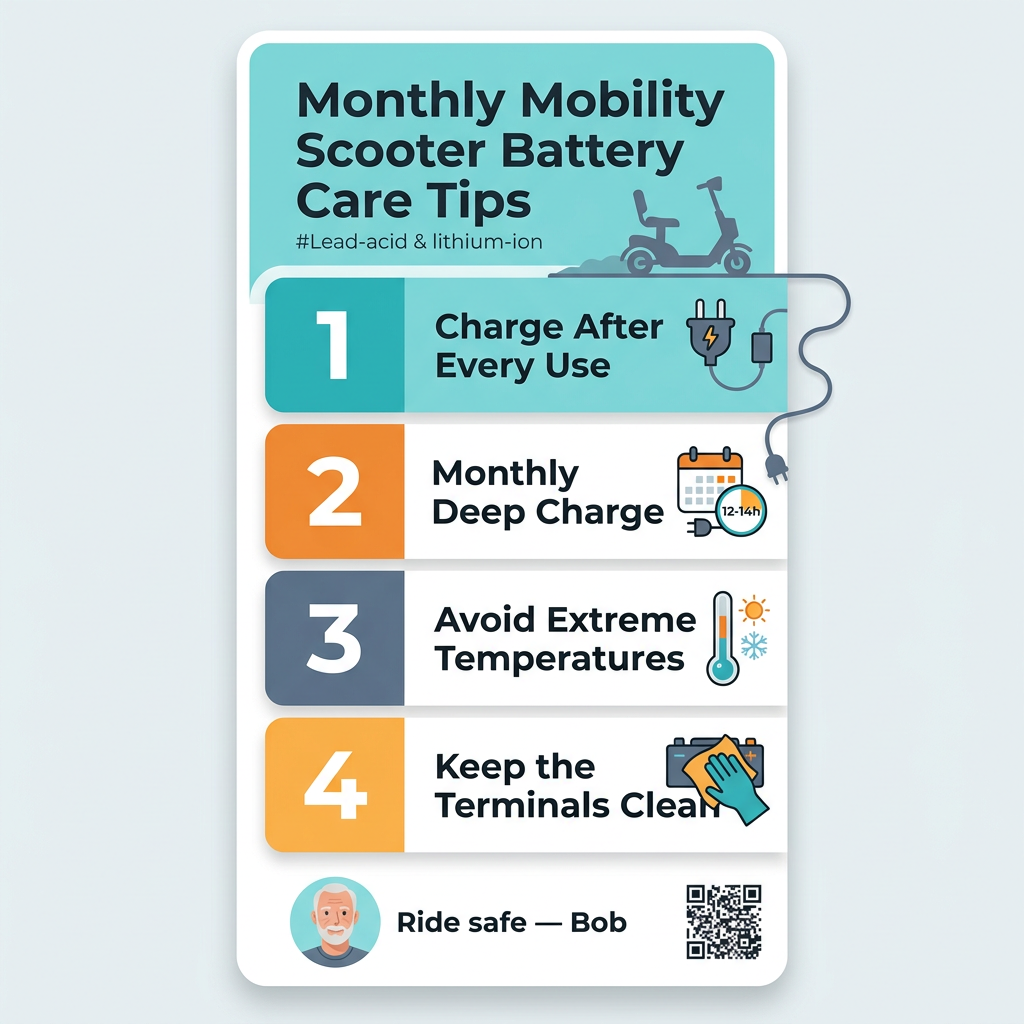
Simple monthly battery care tips to extend the life of your mobility scooter. Covers charging habits, temperature safety, and maintenance for both lead-acid and lithium-ion batteries.
By Bob Daniels | Mobility Scooters For You
Quick answer: The best way to care for a mobility scooter battery is to charge it after each use, avoid letting it sit completely drained, store it away from extreme heat or cold, keep the terminals clean, and check it monthly for weak performance. A few simple habits can add months — sometimes years — to your scooter battery’s life.
Hey everyone, Bob here.
If there’s one thing I’ve learned from years of using and studying mobility scooters, it’s this: a scooter is only as dependable as the battery underneath the seat. You can have the best frame, the comfiest seat, and the fanciest turning radius in the world — but if the battery gives up halfway across the parking lot, your day just got a lot more interesting than you wanted.
So let’s keep this simple. Below is my monthly mobility scooter battery care routine. It works for most seniors using sealed lead-acid batteries, AGM batteries, gel batteries, or lithium mobility scooter batteries. Always check your owner’s manual first, because manufacturers can have slightly different instructions. The manual is not exactly beach reading, but occasionally it earns its keep.
Bob’s Monthly Battery Care Checklist
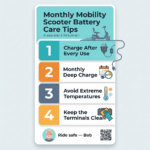
- Charge your scooter after each day of use.
- Do not let the battery sit completely drained.
- Give stored batteries a maintenance charge each month.
- Keep the scooter away from extreme heat and freezing cold.
- Check terminals for dust, corrosion, or loose connections.
- Watch for reduced range, slow charging, or sudden power drops.
1. Charge Your Mobility Scooter After Every Use
The easiest habit is also the most important: plug your mobility scooter in after you use it for the day. You do not need to run the battery all the way down before charging. In fact, regularly draining a scooter battery too low can shorten its life.
This is especially true for sealed lead-acid batteries, which are common in many mobility scooters. These batteries generally prefer to stay charged rather than sit in a low state. If you use your scooter daily, make charging part of your evening routine — right alongside locking the door and wondering where you left your reading glasses.
Bob’s rule: If the scooter worked for you today, reward it with a charge tonight.
2. Do a Monthly Maintenance Charge
If your scooter is used every day, normal charging may be enough. But if your scooter sits unused for long periods — maybe during winter, travel, illness, or because you have a backup scooter — the battery still needs attention.
Once a month, charge the battery fully according to your scooter manual. Many lead-acid scooter batteries benefit from a full overnight charge, often around 8 to 12 hours depending on the charger and battery type. Some lithium batteries may have different storage instructions, so check your manual carefully.
The key point is this: do not park a scooter for months and expect the battery to wake up cheerful. Batteries are not houseplants, but they do need a little scheduled care.
3. Avoid Extreme Heat and Cold
Temperature matters more than many scooter owners realize. A mobility scooter battery stored in a freezing garage or left in direct summer heat can lose performance faster.
Whenever possible, store your scooter in a dry, moderate-temperature space. A garage is usually fine if it does not get extremely hot or cold. If your scooter has a removable battery pack, consider bringing the battery indoors during long periods of storage, especially in winter.
Try to avoid:
- Leaving the scooter outside in direct sun for long periods
- Storing it in freezing temperatures
- Charging the battery in damp or unsafe areas
- Keeping it near heaters, furnaces, or open flames
4. Keep the Battery Terminals Clean
Once a month, take a quick look at the battery area if it is easy and safe to access. You are looking for dust, corrosion, loose connections, or anything that looks unusual.
If you see white, green, or crusty buildup around the terminals, that may be corrosion. Do not ignore it. Dirty or corroded terminals can interfere with charging and power delivery.
If you are not comfortable checking the battery yourself, ask a family member, local mobility dealer, or repair technician. There is no shame in getting help. There is, however, a small amount of shame in poking around electrical parts with a butter knife. Please do not do that.
5. Know the Signs of a Weak Mobility Scooter Battery
A battery usually gives warning signs before it fails completely. If you catch those signs early, you can avoid getting stranded at the grocery store, pharmacy, church, or halfway down the driveway with the mail in your lap.
Watch for these symptoms:
- Your scooter does not travel as far as it used to
- The battery gauge drops quickly after a full charge
- The scooter feels sluggish on hills or ramps
- The charger takes much longer than normal
- The battery will not hold a charge overnight
- The scooter suddenly cuts out under load
If you notice more than one of these signs, it may be time to test or replace the battery.
6. Use the Right Charger
Always use the charger designed for your mobility scooter or battery pack. Using the wrong charger can damage the battery, reduce battery life, or create a safety hazard.
If your charger is lost, damaged, overheating, or making unusual noises, stop using it and contact the scooter manufacturer, dealer, or a qualified repair shop. A replacement charger is usually cheaper than replacing a battery pack — and considerably cheaper than replacing a garage.
7. Do Not Ignore Storage Instructions
If you plan to store your mobility scooter for several weeks or months, prepare the battery first.
General storage tips:
- Charge the battery before storing the scooter.
- Store the scooter or battery in a cool, dry place.
- Recharge the battery periodically according to the manual.
- Do not leave the battery fully drained during storage.
- Inspect the scooter before using it again after storage.
Different battery types behave differently. Lead-acid batteries, lithium batteries, AGM batteries, and gel batteries may each have slightly different storage recommendations. When in doubt, the manual wins the argument.
How Long Should a Mobility Scooter Battery Last?
Most mobility scooter batteries last somewhere around 1 to 3 years, depending on battery type, scooter size, rider weight, terrain, charging habits, temperature, and how often the scooter is used.
A lightly used travel scooter stored indoors may get longer battery life than a heavy-duty scooter used daily on hills, grass, and rough sidewalks. That does not mean one scooter is better than the other — it simply means the battery is doing different work.
If your scooter is your main transportation, it is smart to budget for battery replacement before the old one fails. I call this the “don’t get stranded fund.” It is less exciting than a vacation fund, but more useful when you are sitting in a Walmart aisle with 3% battery.
Lead-Acid vs Lithium Mobility Scooter Batteries
Many traditional mobility scooters use sealed lead-acid batteries. These are dependable and common, but they are heavier and usually need regular charging habits to stay healthy.
Lithium mobility scooter batteries are often lighter and may charge faster, which makes them popular on newer portable and travel scooters. They can be excellent, but they still need proper care and should be charged and stored according to the manufacturer’s instructions.
| Battery Type | Common Benefit | Care Tip |
|---|---|---|
| Sealed Lead-Acid | Reliable and widely available | Charge after use and avoid deep discharge |
| AGM or Gel | Maintenance-friendly sealed design | Use the correct charger and store properly |
| Lithium | Lighter weight and often longer-lasting | Follow the manufacturer’s charging and storage rules |
Bob’s Simple Monthly Battery Routine
Here is the short version I recommend printing or saving:
- Week 1: Check that the charger is working normally.
- Week 2: Inspect the battery area for dust, corrosion, or loose cables.
- Week 3: Pay attention to range. Is the scooter going as far as usual?
- Week 4: Give stored scooters or spare batteries a proper maintenance charge.
That is it. You do not need to become an electrical engineer. You just need a monthly habit.
Need Help Choosing the Right Scooter?
If battery life, range, portability, or reliability are your biggest concerns, start with our free scooter guide. It helps match your daily routine to the right kind of mobility scooter.
Recommended next step: Get the free Mobility Scooters For You guide and compare travel, portable, and heavy-duty scooter options before you buy.
Related Guides
If you are planning your next scooter purchase or trying to avoid repair surprises, these related guides may help:
- Why I Switched to a 4-Wheel Scooter
- California Cruising: 2026 Pursuit 2 Review & New Scooter Laws
- Free Mobility Scooter Matchmaker Guide
Frequently Asked Questions
Should I charge my mobility scooter after every use?
Yes, in most cases you should charge your mobility scooter after each day of use. This helps keep the battery from sitting in a low state and can extend battery life, especially with sealed lead-acid batteries.
Can I leave my mobility scooter charging overnight?
Many mobility scooter chargers are designed for overnight charging, but you should always follow your scooter manufacturer’s instructions. Use only the correct charger and avoid charging in unsafe, damp, or extremely hot areas.
How often should I charge a mobility scooter in storage?
If your scooter is in storage, check the owner’s manual. As a general habit, many scooter owners give stored batteries a full maintenance charge about once a month, but battery type and manufacturer instructions matter.
How do I know when my mobility scooter battery needs replacing?
Common signs include reduced travel range, a battery gauge that drops quickly, sluggish power on hills, slow charging, or a battery that will not hold a charge. If these symptoms appear, have the battery tested.
Are lithium mobility scooter batteries better than lead-acid batteries?
Lithium batteries are usually lighter and may last longer, but they can cost more and need manufacturer-specific care. Lead-acid batteries are common, dependable, and widely available, but they are heavier and should be charged regularly.
Final Thought from Bob
A mobility scooter battery does not need complicated care. It needs consistency. Charge it after use, store it sensibly, keep an eye on performance, and do a monthly check before small problems turn into big ones.
Your scooter is there to keep you moving. A little battery care helps make sure it is ready when you are.
— Bob Daniels, Mobility Scooters For You
Gear up for your ride: lithium scooter battery · car charger adaptor · front basket · folding basket · all-weather scooter cover · scooter canopy.
Compare prices: Browse scooter batteries and chargers at our partner, Mobility Department.
This post contains affiliate links. If you use these links to buy something, we may earn a commission. Thanks.
 Frank always liked things built tough. After thirty years running a highly successful trucking empire, he expects machinery to handle whatever he throws at it without breaking a sweat, complaining, or stalling out. If it isn’t heavy-duty, Frank isn’t interested.
So, when his good friend Bob—a retired MD with an eagle eye for technical detail and microscopic precision—suggested they push the newest All-Terrain Mobility Scooters to their absolute limits down by the rugged Malibu coastline, Frank didn’t even hesitate. He just grabbed his jacket.
If you’re anything like Frank, you crave the absolute freedom to explore off the beaten path. You refuse to let a little uneven ground stop you. Whether it’s a sandy beach, a muddy forest trail, or navigating the treacherous, rocky Californian coves, an all-terrain mobility scooter is engineered precisely to give you back your power. In 2026, the outdoor mobility scooter market has introduced mind-blowing advancements in suspension and shock absorption, and Bob was eager to analyze every single spec.
What is the “Secret Sauce” of an All-Terrain Mobility Scooter?
“It’s all in the shock absorption architecture,” Bob noted, methodically checking the undercarriage with total focus. Unlike those flimsy, standard indoor scooters, true all-terrain models are forged with heavy-duty frames and massive pneumatic or solid knobby tires. This allows them to devour uneven surfaces like gravel, dirt, and even hard-packed sand—meaning you never get stuck, you never damage the motor, and you never have to turn back.
Bob & Frank’s Top 3 Powerhouse Picks for 2026!
1. The Trailblazer Heavy Duty: The Coast-Crusher
Equipped with a beastly dual-motor system, this design completely seduced Frank. The scooter absolutely thrives on steep inclines and terrifyingly rocky paths. The independent suspension ensures you won’t feel a single bump, leaving you perfectly comfortable. “It rides smoother than my old rig,” Frank laughed, revving the throttle.
2. The Coastline Cruiser: The Sand-Surfer
Perfect for beachgoers who refuse to be stuck on the boardwalk. Bob precisely analyzed the Coastline Cruiser’s specially engineered, ultra-wide tires that completely prevent sinking into deep sand. Even better? Its advanced anti-corrosion coating forms an invisible shield, protecting the essential mechanics from destructive, salty ocean air.
3. The Explorer Pro: The Marathon Champion
The Explorer boasts the longest battery range of the entire lineup. This is the absolute ideal choice for epic, full-day excursions along the coast without ever needing a recharge. Unstoppable, unyielding, and incredibly sleek.
Your Adventure Doesn’t Wait!
Don’t let rough terrain cage you in. Modern 21st-century accessibility means you no longer have to compromise, stay behind, or watch the fun from afar. With a premium all-terrain mobility scooter, you get the ridiculous power and insane durability you need to keep up with the gang.
Ready to Conquer the Wild? Browse our exclusive collection at Mobility Scooters For You and find the absolute perfect match for your fearless outdoor lifestyle!
Ready to shop? Browse all-terrain scooters at our partner, Electric Wheelchairs USA.
Compare prices: Browse all-terrain mobility scooters at our partner, Mobility Department.
Fold-in-10 Travel Challenge: Can Your Scooter Keep Up?

This post contains affiliate links. If you use these links to buy something, we may earn a commission. Thanks.

Taste the Freedom with the Fold in 10 challenge
Hi everyone! It’s Zoe again! If you haven’t met me yet, I’m the one with the super-blinged-out scooter that’s got more style than a Hollywood red carpet. Being disabled doesn’t mean you can’t have the most eye-catching ride in the neighborhood. Today, I want to take you on a little trip to the mall, but it’s not just for shopping—it’s for a challenge that will change the way you think about travel and freedom.
The Magic of the Mall and the Pacific Coast Lifestyle
Living near the Pacific Coast means we are always on the move. Whether we are heading down to the boardwalk or navigating the busy crowds at the local mall, speed and simplicity are everything. Grandad Bob—you might know him as the webmaster who runs mobilityscootersforyou.com—always says that if a plan isn’t simple enough for a 12-year-old, it’s too complicated.
That’s why I came up with the Fold-in-10 Challenge. I wanted to see if I could get my scooter from “Ready-to-Ride” to “Ready-to-Load” in just ten seconds. Why ten seconds? Because when the sun is out and the coast is calling, nobody wants to spend twenty minutes wrestling with heavy metal parts and confusing levers.
[GENTLE CTA] Are you ready to find the stability you deserve? Explore our curated selection of 4-Wheel Scooters and find the one that feels like it was made just for you.
How the Fold-in-10 Challenge Works
The challenge is so easy to understand. You start the timer, and you have exactly ten seconds to fold your scooter into its most compact shape. I did this right in the middle of the mall food court! People were stopping their snacks just to watch.
-
Step 1: Clear your basket and make sure your “bling” is secure.
-
Step 2: Hit the release lever or the remote button.
-
Step 3: Watch it fold like a piece of high-tech origami.
-
Step 4: Stop the clock!
If you want to see how I did it, you should check out my new “Vertical Video” on TikTok or see it as an Idea Pin on our Pinterest page. We call it The Pursuit Test for the bigger scooters, but for my travel ride, it’s all about the fold.
Why 4-Wheel Stability Matters in the Real World
While we were at the mall, I was thinking about why I love my 4-wheel ride so much. You might have seen our post on Why I Switched to a 4-Wheel Scooter (And You Should Too). In a crowded mall, you need to know that your scooter isn’t going to tip when you’re making a sharp turn around a shoe display.
A 4-wheel scooter gives me that “Coast-to-Coast Reliability” that Grandad Bob and his friend Frank always talk about. Frank and Betty live about 30 miles away and they have a pickup truck and scooters, so they know all about loading and unloading quickly. They always say that a scooter that is hard to fold is a scooter that stays in the garage. We don’t want that! We want to be out there, exploring and staying independent.
The 2026 Laws and Your Safety
Now, I know legal stuff sounds boring, but Grandad Bob and Grandma Janice have been spending a lot of time in the study looking at the 2026 California Scooter Laws. It turns out that having a scooter that is easy to manage isn’t just about fun—it’s about staying safe and following the rules.
When we do the Fold-in-10 Challenge, we are also making sure the battery is secure. The new laws are really strict about Battery Safety Standards and UL Certification. Because I use my scooter every day, I need to know it’s reliable from the “Coast-to-Coast” and everywhere in between. You can read all about Bob’s research in our California Cruising: 2026 Pursuit 2 Review & New Scooter Laws post.
Don’t let the clock stop your fun. Check out our Travel Scooter Guide to see which models pass Zoe’s challenge and get you back to what matters most.
Space Planning for Guests and Mobility
When Betty and Frank come over to stay at our large country house, we have to think about space. They often stay in our guest rooms which are a bit limited in space, so having an indoor scooter that can fold up is a total lifesaver. Even in a small guest house, a folding scooter means you don’t have to trip over wheels in the middle of the night.
Whether you are at the mall or staying with friends, simplicity is the key to a happy life. Grandad says that having a CPA office for now is enough since we don’t have the traffic of big manufacturers yet, but we always treat our customers like family.
Simple Maintenance for Maximum Reliability
If you want your scooter to pass the Fold-in-10 Challenge every time, you have to take care of it. Grandad Bob created a special Maintenance & Battery Guide for Bob’s “Coast-to-Coast” Reliability Tips.
Here are three things I do to keep my ride fast and snappy:
-
Keep it Clean: Dust from the mall or sand from the Pacific Coast can get into the folding joints.
-
Check the Battery: A strong battery means the automatic folding motor works every time.
-
Tighten the Bling: You don’t want your decorations getting caught in the gears!
Knowledge is the key to true freedom. Read Bob’s full breakdown of the 2026 California Laws so you can cruise with total peace of mind and complete reliability.
Join the Challenge and Stay Independent!
I want to see you do it! Whether you have a Pride Go-Go, a Golden Technologies model, or a heavy-duty Drive Medical scooter, give it a try. Can you beat my time?
Remember, the goal is Senior Independence & Accessibility. We want everyone to feel like they can go anywhere without needing a whole team of people to help them move their equipment. If I can do it at 12 years old, I promise you can do it too.
Grandad Bob and I are always updating the site with new guides, so keep an eye on mobilityscootersforyou.com. We are even learning Vietnamese together so we can help more people stay mobile!
We’re here to help you stay mobile on the Pacific Coast and beyond. Visit MobilityScootersForYou.com today and let us help you map out your next great escape.
Ready to shop? Browse folding travel scooters at our partner, Electric Wheelchairs USA.
Compare prices: Browse folding mobility scooters at our partner, Mobility Department.
Plan the ride: try our free Ride Finder trail map for history trails, accessible stops and local weather.
How to Choose the Best Mobility Scooter for Your Lifestyle

This post contains affiliate links. If you use these links to buy something, we may earn a commission. Thanks.
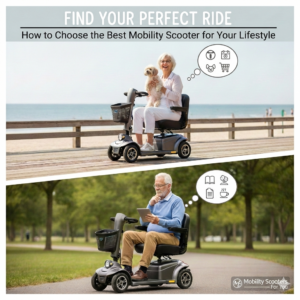
We chose the right Mobility Scooters for our needs.
### 1. Pride Go-Go: The Compact Companion
For those who value agility and ease of transport, the Pride Go-Go stands unparalleled. It is the quintessential choice for navigating tight indoor spaces. Its feather-touch disassembly ensures your journey is never hindered.
[Pride Go-Go – Best USA Price]
Manufacturer: Pride
[BUTTON: CHECK AVAILABILITY]
Regain Your Freedom: Finding the Perfect Mobility Scooter for You
Choosing a mobility scooter is a big step towards regaining independence and enjoying life to the fullest. Whether you’re looking for a way to navigate your home more easily, explore the outdoors, or travel with confidence, there’s a perfect scooter out there for you. This guide will help you understand the different types of scooters and what to consider when making your choice.
Understanding Different Types of Mobility Scooters
Mobility scooters come in various designs, each suited for different needs and environments. Knowing the main categories can help you narrow down your options.
1. Travel Scooters (Portable and Lightweight)
Ideal for: Individuals who need a scooter for occasional use, shopping trips, or travel. They are designed for easy disassembly and transport in a car trunk or on public transport.
Key Features:
- Lightweight: Often made with lighter materials for easy lifting.
- Disassembles: Breaks down into several smaller, manageable pieces.
- Compact: Designed to fit into tight spaces.
- Speed: Typically slower, focusing on maneuverability.
2. 3-Wheel Scooters (Maneuverability)
Ideal for: Indoor use or navigating tight spaces. The single front wheel allows for a tighter turning radius.
Key Features:
- High Maneuverability: Excellent for navigating hallways, stores, and crowded areas.
- Legroom: Often provides more legroom than 4-wheel models.
- Stability: Generally less stable than 4-wheel scooters, especially at higher speeds or on uneven terrain.
3. 4-Wheel Scooters (Stability and Outdoor Use)
24
Ideal for: Outdoor adventures, longer distances, and individuals who prioritize stability. They offer a more robust and stable ride.
Key Features:
- Superior Stability: Provides a secure ride on various terrains.
- Higher Weight Capacity: Often designed to support heavier users.
- Larger Batteries: Allows for longer travel ranges.
- Less Maneuverable: Wider turning radius compared to 3-wheel scooters.
4. Heavy-Duty Scooters (Power and Durability)
Ideal for: Larger individuals, rough terrain, or those who need a scooter for all-day use. These are the most powerful and durable options.
Key Features:
- High Weight Capacity: Built to support significant weight.
- Powerful Motors: Can handle inclines and rough surfaces with ease.
- Large Batteries: Extended range for all-day use.
- Robust Construction: Designed for maximum durability.
Your Mobility Scooter Checklist: What to Consider
To ensure you choose the best scooter for your unique needs, consider the following factors:
- Where will you use it most? (Indoors, outdoors, or both?)
- How far do you need to travel on a single charge? (Check battery range.)
- What is your weight? (Ensure the scooter’s weight capacity is sufficient.)
- Do you need to transport it? (Consider a travel scooter if you plan to put it in a car.)
- What kind of terrain will you encounter? (Smooth floors, sidewalks, grass, gravel?)
- Do you need extra features? (Storage, lights, adjustable seating, armrests?)
- What is your budget? (Scooters vary widely in price.)
Regain Your Independence Today!
Choosing the right mobility scooter can truly transform your daily life, offering renewed freedom and confidence. Take your time, consider your needs, and don’t hesitate to reach out if you have any questions. Your perfect ride is waiting!
Ready to shop? Browse best-selling scooters at our partner, Electric Wheelchairs USA.
Compare prices: Browse 4-wheel scooters at our partner, Mobility Department.
Best Lightweight Mobility Scooters for Effortless Daily Use

This post contains affiliate links. If you use these links to buy something, we may earn a commission. Thanks.

Why Portable Mobility Scooters are the best Choice for modern living
In a world where mobility is more than just movement — it’s independence — the right lightweight mobility scooter can transform daily routines into effortless, dignified journeys. Whether you’re navigating packed sidewalks, running errands, or simply enjoying a trip through the park, a well-designed, lightweight scooter offers portability, comfort, and independence. This guide dives deep into why lightweight mobility scooters matter, what to look for, and which models stand out in 2025.
Why Lightweight Mobility Scooters Matter
Mobility scooters aren’t just “gadgets” — for many users, they’re a bridge between limitation and autonomy. A lightweight scooter can help elders, those with restricted mobility, and anybody recovering from an injury regain the ability to move, interact with others, and live their own lives.
But “lightweight” isn’t just about less bulk. It’s about convenience: scooting into a car trunk, maneuvering through tight doorways, or carrying the folded unit up a few steps. This portability dramatically changes what “mobility aid” feels like — shifting from cumbersome and limiting to flexible and adaptable.
Some core benefits of lightweight mobility scooters:
- Portability and transport ease: Many models disassemble or fold, making them ideal for car trunks, travel, or compact storage.
- Enhanced maneuverability: Narrow paths, tight hallways, crowded spaces — lightweight scooters often excel where bulky ones struggle.
- Preserved independence: A lightweight scooter can restore mobility without needing constant help from others.
- Comfort and adaptability: Modern designs cater to both indoor and outdoor use, often balancing comfort, ease of use, and portability.
Hence, for daily errands, grocery runs, social outings, or just moving around your home and neighborhood, a lightweight scooter offers a compelling blend of independence, dignity, and practicality.
What to Look For — Key Features & Specs
Choosing the right lightweight mobility scooter isn’t just about price or aesthetics. Several technical and ergonomic factors will determine whether the scooter becomes a reliable daily companion or a constant source of frustration. Experts across mobility-aid guides recommend focusing on the following parameters.
Weight & Portability
- Ideally, a scooter should be light enough to lift/disassemble easily — particularly helpful if you need to store it in a car or move it frequently.
- Models that fold or disassemble into smaller pieces often offer the most excellent convenience.
Battery Life & Travel Range
- For errands, shopping, or short outings, a moderate battery range is sufficient. For longer trips, aim for scooters offering 10–20 miles (or more) per charge.
- Removable batteries or those with easy charging cycles improve flexibility and convenience.
Weight Capacity & Stability
- Ensure the scooter can comfortably support a weight above the user’s own, factoring in additional items (bags, groceries) if needed.
- Stability matters especially if you’ll use the scooter outdoors or on uneven terrain. Four-wheel designs often offer better balance, while three-wheel models may excel indoors where maneuverability is key.
Maneuverability & Ease of Use
- A tight turning radius, a compact frame, and intuitive controls make life much easier, especially indoors or in crowded areas.
Comfort & Safety Features
- Features like padded seats, back support, armrests, flat-free tires, anti-tip wheels, and storage baskets improve day-to-day usability.
- Safety — especially braking system, stability on uneven surfaces, and easy disassembly for emergency handling — should never be compromised.
Intended Use: Indoor vs Outdoor
- For mostly indoor/home use, compact size, tight turning radius, lighter weight, and good maneuverability matter more.
- For outdoor use, a sturdier frame, stable wheels or tires, a more extended battery range, and suspension or larger tires help.
Top Lightweight Mobility Scooters for Daily Use (2025 Picks)
Here are several lightweight mobility scooters that stand out for daily use — balancing portability, comfort, range, and ease of handling. These are ideal whether you’re running errands, commuting, or simply enjoying mobility with minimal fuss.
Quick Highlights
- Vive 3-Wheel Mobility Scooter — A balanced choice for daily errands and indoor/outdoor transitions. Compact, easy to maneuver through doorways, with a respectable travel range on a single charge.
- iLiving V8 Foldable Electric Mobility Scooter — Premium foldable option that’s ultra-portable and easy to store. Suitable for users who value convenience and expect frequent travel (car trunks, apartments, etc.).
- EV Rider Transport AF+ Mobility Scooter — Great budget-friendly pick that still offers portability and reliable performance; ideal for everyday indoor/outdoor use without a hefty investment.
- Malisa Powered Mobility Scooter — For those needing more extended travel range on a lightweight platform — this scooter balances portability with a solid per-charge distance, making it suitable for longer errands or outings.
- Metro 4-Wheel Travel Mobility Scooter — A stable 4-wheel configuration for those preferring more balance and comfort on mixed indoor/outdoor terrain.
- Pride Go-Go Elite Traveler 4 Wheel Scooter — Favorable for users who want portability plus reliability. Its modular design and ease of disassembly make it a dependable daily travel companion.
- Aotedor Ultra Lightweight Mobility Scooter — A lightweight and general-use option, suitable for occasional use, short errands, or as a secondary mobility aid.
- ZiiLIF R3b Lightweight Mobility Scooter — Among the top-rated ultra-light models with a good balance between portability and basic mobility needs, ideal for those prioritizing ease of handling and compactness.
Who Should Use a Lightweight Mobility Scooter — Use Cases & User Profiles
Lightweight mobility scooters shine in a variety of scenarios. Here are several user profiles and situations where they’re especially beneficial:
- Seniors or people with reduced mobility who want to maintain independence for shopping, social visits, or simply moving around the house.
- Urban dwellers or apartment residents — lightweight scooters fit in small spaces, elevators, and narrow corridors with ease.
- Frequent travelers or vehicle owners — portability makes them ideal for car trunks, public transport, or trips to markets, malls, or parks.
- Individuals with fluctuating mobility needs — e.g., recovering from surgery, or occasional mobility challenges — because scooters can be easily stored or moved when not in use.
- Interiors and outdoor mixed use — where flexibility, easy maneuvering indoors, or stable riding outdoors are all required.
How to Choose the Right One: Decision-Making Roadmap
Given the variety of models and specs, it helps to follow a structured decision process. Here’s a roadmap to choosing the best scooter for your lifestyle and needs.
Clarify your primary use case — indoor mobility, outdoor errands, travel, or a mix. This will guide which features matter most (e.g., portability vs stability).
Assess required weight capacity & your body profile — choose a scooter with a weight rating comfortably above your body weight to ensure safe functioning and durability.
Evaluate portability vs features trade-offs.
- If you need something you can easily carry, prioritize foldable/disassemblable scooters.
- If you need stability and comfort over portability — especially for outdoor use — prioritize 4-wheel models with stable tires and suspension.
Check battery range against your typical usage — for occasional errands, shorter ranges suffice; for daily long-distance outings, aim for a higher range per charge.
Inspect comfort and ergonomics — adjustable seat and armrests, easy controls, stable tires, anti-tip wheels, intuitive braking — crucial for safety and usability.
Think about maintenance and storage — removable batteries, easy disassembly, and manageable tire/part maintenance make long-term ownership easier and more reliable.
Price vs value balance — sometimes a mid-range scooter offers the best balance of portability, durability, and comfort. Don’t always chase the cheapest option; consider long-term usability and reliability.
Potential Drawbacks & What to Watch Out For
No solution is perfect. While lightweight mobility scooters offer substantial advantages, there are trade-offs to be aware of:
- Reduced stability on rough or uneven terrain — compact or lightweight models may struggle on gravel, grass, or bumpy sidewalks compared to heavier, more rugged scooters.
- Shorter battery range compared to full-size scooters — if you plan extensive outdoor use or long daily trips, a lightweight scooter may require frequent recharging.
- Smaller seating and comfort compromises — lighter or foldable models may trade seat size or back support for portability.
- Potentially lower top speed — most lightweight scooters prioritize ease and portability over high speed. For fast, long-distance commuting, they may be suboptimal.
Understanding these trade-offs helps set realistic expectations and choose a scooter that matches actual needs rather than idealized hopes.
Real-World Scenarios: How Lightweight Mobility Scooters Transform Daily Life
Lightweight mobility scooters often make the most significant difference in the small, mundane details of life — the ones that quietly chip away at independence when mobility becomes limited. Imagine being able to glide through a crowded farmers’ market without relying on someone’s arm, or rolling up to a favorite café without worrying about fatigue halfway there. These scooters shift the equation.
Many users report that the most significant benefit isn’t just physical mobility; it’s the renewed confidence that comes from being able to say “Yes” to spontaneous outings. Whether it’s a grandparent attending a child’s school play or someone recovering from surgery, rerunning simple errands, the emotional liberation is profound.
Lightweight vs. Standard Mobility Scooters: What’s the Real Difference?
While full-size mobility scooters offer more power and stability, they’re often too bulky for daily, indoor-heavy, or urban use. Lightweight scooters strike a different balance — one that prioritizes ease of transport, maneuverability, and versatility.
Lightweight Scooters Typically Offer:
- Lower overall weight (often 30–60 lbs)
- Foldable or disassemblable frames
- Tighter turning radiuses
- Easier storage in car trunks, closets, and hallways
- More travel-friendly design
Standard Scooters Offer:
- Larger battery ranges
- Heavier weight capacity
- Bigger, more cushioned seating
- Greater stability on rough terrain
This comparison helps readers understand why lightweight models are best for “effortless daily use,” while heavier models are better suited for extended outdoor trips or rugged terrain.
Traveling With a Lightweight Mobility Scooter: What You Need to Know
For frequent travelers — whether by car, bus, cruise, or airplane — lightweight scooters offer unprecedented convenience. Many foldable scooters meet TSA and airline-friendly guidelines due to lithium battery certifications.
Essential considerations when traveling:
- Check airline battery policies: Most allow lithium-ion batteries under specific watt-hour limits.
- Carry a travel charger: Some airports or hotels have limited outlet access.
- Protect the scooter during transport: A padded travel bag prevents scratches and protects the frame.
- Know folding/disassembly procedures: Quick-fold designs save time at airport security or cruise boarding.
Adding this travel-focused section boosts SEO for queries like “best mobility scooter for travel,”“airline-approved scooters,” and “foldable mobility scooter travel tips.”
Maintenance Tips to Extend the Life of Your Lightweight Mobility Scooter
Proper maintenance ensures consistent performance and helps avoid costly repairs. Lightweight scooters typically require less maintenance than full-sized models, but they still require regular care.
Key maintenance practices include:
- Battery care: Charge regularly, avoid complete drainage, and store in moderate temperatures.
- Tire inspection: Check for wear, cracks, or loss of traction.
- Frame cleaning: Use a mild cleaner to keep joints and folding mechanisms debris-free.
- Brake checks: Ensure consistent stopping power — especially on scooters used outdoors.
- Annual inspection: A mobility technician can tune up the scooter for optimal performance.
This section appeals to readers invested in long-term value and lowers bounce rate by adding practical content.
Accessibility Considerations: How Lightweight Scooters Fit Into Different Environments
Accessibility goes beyond using the scooter itself — it’s about how the scooter interacts with the environment.
- Homes & Apartments:
- Lightweight scooters excel in narrow hallways, small rooms, and tight kitchen layouts thanks to compact turning radii.
- Public Buildings:
- Many government buildings, malls, and hospitals have scooter-friendly ramps and automatic doors, making daily errands smoother.
- Outdoor Areas:
- Parks, sidewalks, and paved trails offer easy navigation, though extremely rough terrain may challenge ultra-light models.
This section broadens your target audience to include caregivers, seniors, people recovering from surgery, and individuals with medical conditions.
Frequently Asked Questions
Adding an FAQ section helps capture long-tail keywords and boosts Google People Also Ask visibility.
Are lightweight mobility scooters safe for outdoor use?
Yes, most are designed for paved and moderately uneven surfaces. Choose 4-wheel models for better stability outdoors.
Can lightweight scooters be taken on an airplane?
Many foldable models meet airline regulations, though lithium battery watt-hours must fall within allowed limits.
How long does the battery last?
Ranges vary from 5 to 20+ miles, depending on the model, load weight, and terrain.
What is the weight limit for lightweight scooters?
Most support 250–300 lbs, though ultra-light models may support slightly less.
How do I know if I need a lightweight or full-sized scooter?
If you value portability, car transport, or indoor maneuvering, go lightweight. If you need maximum stability outdoors, go full-sized.
Conclusion
Mobility is a right — and in 2025, lightweight mobility scooters offer a powerful way to reclaim it without compromise. They provide a delicate balance of independence, portability, comfort, and dignity.
For many, a lightweight scooter isn’t just a tool — it’s a companion, a bridge to freedom, a means to keep living on their own terms. Whether you’re traveling to the grocery store, visiting friends, or exploring the neighborhood, the perfect scooter converts the journey from a chore into a simple, comfortable act.
If you keep the core principles — portability, comfort, battery life, and stability — in mind, you’ll find a model that doesn’t just meet your needs — it aligns with your lifestyle.
Gear up for your ride: scooter batteries and chargers · lithium scooter battery · anti-tip wheels · front basket · folding basket.
Ready to shop? Browse lightweight folding scooters at our partner, Electric Wheelchairs USA.
Compare prices: Browse folding mobility scooters at our partner, Mobility Department. These models are also listed there: iLiving V8, Pride Go-Go Elite Traveller.