
Bob Daniels
Pride vs. Golden Travel Scooters: An In-Depth Comparison for 2026
Why Choose a Travel Mobility Scooter?

Travel scooters are designed for individuals who need mobility assistance on the go. Their compact size, lightweight construction, and easy disassembly or folding mechanisms make them ideal for vacations, shopping trips, or simply moving around your home with greater ease. They strike a perfect balance between portability and functionality, so you don’t have to compromise on mobility, no matter where your adventures take you.
## Pride Mobility: Innovation and Versatility
Pride Mobility is renowned for its diverse range of travel scooters, often characterised by advanced features and user-friendly designs. Their Go-Go series is particularly popular, offering models that are easy to transport and manoeuvre in tight spaces.
### Key Features of Pride Travel Scooters:
* **Feather-Touch Disassembly:** Many Pride models can be quickly disassembled into lightweight pieces for easy transport and storage.
* **Compact Design:** Excellent manoeuvrability
* **Comfort-Trac Suspension (CTS):** Available on select models, providing a smoother ride over varied terrains.
* **Delta Tiller:** Ergonomic wraparound handles make steering easier for those with limited dexterity.
### Popular Pride Travel Models:
* **Pride Go-Go Elite Traveller®:** A classic choice known for its compact design and easy portability.
* **Pride Go-Go Sport:** Offers increased weight capacity and a longer driving range.
* **Pride Go-Go LX with CTS Suspension:** Provides enhanced comfort with its advanced suspension system.
## Golden Technologies: Comfort and Durability
Golden Technologies focuses on delivering exceptional comfort, robust construction, and reliable performance. Their Buzzaround series is a favourite among users seeking a blend of durability and ease of use, often with slightly larger seats and more powerful motors than some competitors.
### Key Features of Golden Travel Scooters:
* **Easy Disassembly:** Similar to Pride, Golden scooters offer straightforward disassembly for transport.
* **Comfortable Seating:** Often feature larger, more padded seats for extended use.
* **Increased Ground Clearance:** Some models offer better ground clearance, making them suitable for slightly uneven surfaces.
* **Bright LED Lighting:** Enhanced visibility for safer operation, especially in low-light conditions.
### Popular Golden Travel Models:
* **Golden Buzzaround LT:** A lightweight and compact option for basic travel needs.
* **Golden Buzzaround XL:** Offers a larger deck and increased weight capacity for enhanced comfort.
* **Golden Buzzaround EX:** Known for its extended range and higher weight capacity, ideal for longer outings.
## Side-by-Side Comparison: Pride Go-Go Elite Traveller vs. Golden Buzzaround LT
| Feature | Pride Go-Go Elite Traveller® | Golden Buzzaround LT |
| :—————- | :—————————- | :——————- |
| **Top Speed** | Up to 4 mph | Up to 4 mph |
| **Range** | Up to 8 miles | Up to 8 miles |
| **Weight Capacity** | Up to 275 lbs | Up to 250 lbs |
| **Heaviest Piece**| 32.5 lbs | 33 lbs |
| **Turning Radius**| 33″ | 37″ |
| **Ground Clearance**| 2″ | 2.5″ |
| **Battery Options**| 12AH or 18AH | 12AH |
## Choosing Your Ideal Travel Scooter
When deciding between a Pride and Golden travel scooter, consider the following:
* **Portability:** How often will you be disassembling and transporting your scooter? Both brands excel here, but specific models may offer lighter components.
* **Comfort:** For longer rides, a Golden Buzzaround model with a larger seat and better suspension might be preferable.
* **Terrain:** If you anticipate navigating slightly uneven paths, look for models with better ground clearance and suspension.
* **Battery Life:** Consider the range you need for your typical outings. Both brands offer options with varying battery capacities.
* **Budget:** Both brands offer a range of price points, so consider your budget alongside your feature requirements.
Explore Purchase Options.
Ready to find your perfect travel companion? Explore a wide selection of Pride and Golden travel scooters, along with competitive pricing and financing options, at our trusted partners:
* **[Shop Pride and Golden Travel Scooters at ElectricWheelchairsUSA])
* **[Find the Latest Travel Scooter Deals at Mobility Department](https://mobilitydepartment.com)**
* **[Rent a Travel Scooter for Your Next Vacation with Walker Mobility](https://walkermobility.com)**
## Conclusion
Both brands offer exceptional travel scooters to enhance your independence. Choose the one that best fits your travel style and start your next adventure today!”
* **Portability:** How often will you be disassembling and transporting your scooter? Both brands excel here, but specific models may offer lighter components.
* **Comfort:** For longer rides, a Golden Buzzaround model with a larger seat and better suspension might be preferable.
* **Terrain:** If you anticipate navigating slightly uneven paths, look for models with better ground clearance and suspension.
* **Battery Life:** Consider the range you need for your typical outings. Both brands offer options with varying battery capacities.
* **Budget:** Both brands offer a range of price points, so consider your budget alongside your feature requirements.
## CPA Integration
Ready to find your perfect travel companion? Explore a wide selection of Pride and Golden travel scooters, along with competitive pricing and financing options, at our trusted partners:
* **[Shop Pride and Golden Travel Scooters at ElectricWheelchairsUSA](https://www.electricwheelchairsusa.com/?aff=406)**
* **[Find the Latest Travel Scooter Deals at Mobility Department](https://mobilitydepartment.com)**
* **[Rent a Travel Scooter for Your Next Vacation with Walker Mobility](https://walkermobility.com)**
## Conclusion
Both Pride Mobility and Golden Technologies offer exceptional travel mobility scooters that can significantly enhance your quality of life. By carefully considering your needs and each brand’s features, you can confidently choose a scooter that helps you travel farther and live more independently. Happy travels!
Monthly Mobility Scooter Battery Care Tips
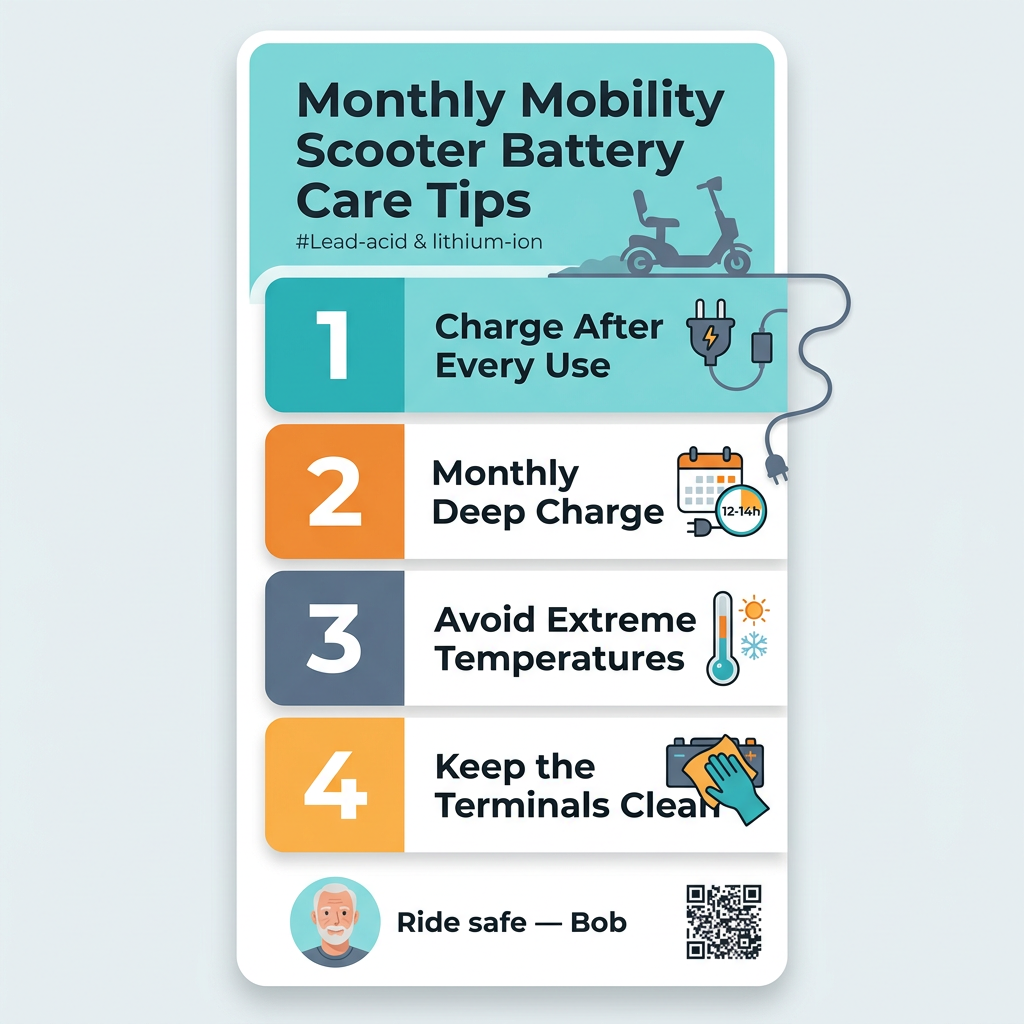
Simple monthly battery care tips to extend the life of your mobility scooter. Covers charging habits, temperature safety, and maintenance for both lead-acid and lithium-ion batteries.
By Bob Daniels | Mobility Scooters For You
Quick answer: The best way to care for a mobility scooter battery is to charge it after each use, avoid letting it sit completely drained, store it away from extreme heat or cold, keep the terminals clean, and check it monthly for weak performance. A few simple habits can add months — sometimes years — to your scooter battery’s life.
Hey everyone, Bob here.
If there’s one thing I’ve learned from years of using and studying mobility scooters, it’s this: a scooter is only as dependable as the battery underneath the seat. You can have the best frame, the comfiest seat, and the fanciest turning radius in the world — but if the battery gives up halfway across the parking lot, your day just got a lot more interesting than you wanted.
So let’s keep this simple. Below is my monthly mobility scooter battery care routine. It works for most seniors using sealed lead-acid batteries, AGM batteries, gel batteries, or lithium mobility scooter batteries. Always check your owner’s manual first, because manufacturers can have slightly different instructions. The manual is not exactly beach reading, but occasionally it earns its keep.
Bob’s Monthly Battery Care Checklist
- Charge your scooter after each day of use.
- Do not let the battery sit completely drained.
- Give stored batteries a maintenance charge each month.
- Keep the scooter away from extreme heat and freezing cold.
- Check terminals for dust, corrosion, or loose connections.
- Watch for reduced range, slow charging, or sudden power drops.
1. Charge Your Mobility Scooter After Every Use
The easiest habit is also the most important: plug your mobility scooter in after you use it for the day. You do not need to run the battery all the way down before charging. In fact, regularly draining a scooter battery too low can shorten its life.
This is especially true for sealed lead-acid batteries, which are common in many mobility scooters. These batteries generally prefer to stay charged rather than sit in a low state. If you use your scooter daily, make charging part of your evening routine — right alongside locking the door and wondering where you left your reading glasses.
Bob’s rule: If the scooter worked for you today, reward it with a charge tonight.
2. Do a Monthly Maintenance Charge
If your scooter is used every day, normal charging may be enough. But if your scooter sits unused for long periods — maybe during winter, travel, illness, or because you have a backup scooter — the battery still needs attention.
Once a month, charge the battery fully according to your scooter manual. Many lead-acid scooter batteries benefit from a full overnight charge, often around 8 to 12 hours depending on the charger and battery type. Some lithium batteries may have different storage instructions, so check your manual carefully.
The key point is this: do not park a scooter for months and expect the battery to wake up cheerful. Batteries are not houseplants, but they do need a little scheduled care.
3. Avoid Extreme Heat and Cold
Temperature matters more than many scooter owners realize. A mobility scooter battery stored in a freezing garage or left in direct summer heat can lose performance faster.
Whenever possible, store your scooter in a dry, moderate-temperature space. A garage is usually fine if it does not get extremely hot or cold. If your scooter has a removable battery pack, consider bringing the battery indoors during long periods of storage, especially in winter.
Try to avoid:
- Leaving the scooter outside in direct sun for long periods
- Storing it in freezing temperatures
- Charging the battery in damp or unsafe areas
- Keeping it near heaters, furnaces, or open flames
4. Keep the Battery Terminals Clean
Once a month, take a quick look at the battery area if it is easy and safe to access. You are looking for dust, corrosion, loose connections, or anything that looks unusual.
If you see white, green, or crusty buildup around the terminals, that may be corrosion. Do not ignore it. Dirty or corroded terminals can interfere with charging and power delivery.
If you are not comfortable checking the battery yourself, ask a family member, local mobility dealer, or repair technician. There is no shame in getting help. There is, however, a small amount of shame in poking around electrical parts with a butter knife. Please do not do that.
5. Know the Signs of a Weak Mobility Scooter Battery
A battery usually gives warning signs before it fails completely. If you catch those signs early, you can avoid getting stranded at the grocery store, pharmacy, church, or halfway down the driveway with the mail in your lap.
Watch for these symptoms:
- Your scooter does not travel as far as it used to
- The battery gauge drops quickly after a full charge
- The scooter feels sluggish on hills or ramps
- The charger takes much longer than normal
- The battery will not hold a charge overnight
- The scooter suddenly cuts out under load
If you notice more than one of these signs, it may be time to test or replace the battery.
6. Use the Right Charger
Always use the charger designed for your mobility scooter or battery pack. Using the wrong charger can damage the battery, reduce battery life, or create a safety hazard.
If your charger is lost, damaged, overheating, or making unusual noises, stop using it and contact the scooter manufacturer, dealer, or a qualified repair shop. A replacement charger is usually cheaper than replacing a battery pack — and considerably cheaper than replacing a garage.
7. Do Not Ignore Storage Instructions
If you plan to store your mobility scooter for several weeks or months, prepare the battery first.
General storage tips:
- Charge the battery before storing the scooter.
- Store the scooter or battery in a cool, dry place.
- Recharge the battery periodically according to the manual.
- Do not leave the battery fully drained during storage.
- Inspect the scooter before using it again after storage.
Different battery types behave differently. Lead-acid batteries, lithium batteries, AGM batteries, and gel batteries may each have slightly different storage recommendations. When in doubt, the manual wins the argument.
How Long Should a Mobility Scooter Battery Last?
Most mobility scooter batteries last somewhere around 1 to 3 years, depending on battery type, scooter size, rider weight, terrain, charging habits, temperature, and how often the scooter is used.
A lightly used travel scooter stored indoors may get longer battery life than a heavy-duty scooter used daily on hills, grass, and rough sidewalks. That does not mean one scooter is better than the other — it simply means the battery is doing different work.
If your scooter is your main transportation, it is smart to budget for battery replacement before the old one fails. I call this the “don’t get stranded fund.” It is less exciting than a vacation fund, but more useful when you are sitting in a Walmart aisle with 3% battery.
Lead-Acid vs Lithium Mobility Scooter Batteries
Many traditional mobility scooters use sealed lead-acid batteries. These are dependable and common, but they are heavier and usually need regular charging habits to stay healthy.
Lithium mobility scooter batteries are often lighter and may charge faster, which makes them popular on newer portable and travel scooters. They can be excellent, but they still need proper care and should be charged and stored according to the manufacturer’s instructions.
| Battery Type | Common Benefit | Care Tip |
|---|---|---|
| Sealed Lead-Acid | Reliable and widely available | Charge after use and avoid deep discharge |
| AGM or Gel | Maintenance-friendly sealed design | Use the correct charger and store properly |
| Lithium | Lighter weight and often longer-lasting | Follow the manufacturer’s charging and storage rules |
Bob’s Simple Monthly Battery Routine
Here is the short version I recommend printing or saving:
- Week 1: Check that the charger is working normally.
- Week 2: Inspect the battery area for dust, corrosion, or loose cables.
- Week 3: Pay attention to range. Is the scooter going as far as usual?
- Week 4: Give stored scooters or spare batteries a proper maintenance charge.
That is it. You do not need to become an electrical engineer. You just need a monthly habit.
Need Help Choosing the Right Scooter?
If battery life, range, portability, or reliability are your biggest concerns, start with our free scooter guide. It helps match your daily routine to the right kind of mobility scooter.
Recommended next step: Get the free Mobility Scooters For You guide and compare travel, portable, and heavy-duty scooter options before you buy.
Related Guides
If you are planning your next scooter purchase or trying to avoid repair surprises, these related guides may help:
- Why I Switched to a 4-Wheel Scooter
- California Cruising: 2026 Baja Raptor Review & New Scooter Laws
- Free Mobility Scooter Matchmaker Guide
Frequently Asked Questions
Should I charge my mobility scooter after every use?
Yes, in most cases you should charge your mobility scooter after each day of use. This helps keep the battery from sitting in a low state and can extend battery life, especially with sealed lead-acid batteries.
Can I leave my mobility scooter charging overnight?
Many mobility scooter chargers are designed for overnight charging, but you should always follow your scooter manufacturer’s instructions. Use only the correct charger and avoid charging in unsafe, damp, or extremely hot areas.
How often should I charge a mobility scooter in storage?
If your scooter is in storage, check the owner’s manual. As a general habit, many scooter owners give stored batteries a full maintenance charge about once a month, but battery type and manufacturer instructions matter.
How do I know when my mobility scooter battery needs replacing?
Common signs include reduced travel range, a battery gauge that drops quickly, sluggish power on hills, slow charging, or a battery that will not hold a charge. If these symptoms appear, have the battery tested.
Are lithium mobility scooter batteries better than lead-acid batteries?
Lithium batteries are usually lighter and may last longer, but they can cost more and need manufacturer-specific care. Lead-acid batteries are common, dependable, and widely available, but they are heavier and should be charged regularly.
Final Thought from Bob
A mobility scooter battery does not need complicated care. It needs consistency. Charge it after use, store it sensibly, keep an eye on performance, and do a monthly check before small problems turn into big ones.
Your scooter is there to keep you moving. A little battery care helps make sure it is ready when you are.
— Bob Daniels, Mobility Scooters For You
California Cruising: 2026 Baja Raptor Review & New Scooter Laws
Control+HomeEnd
By Dr. Bob Daniels | Mobility Scooters For You

Like Bob and Janice, we are deep into analyzing the new 2026 California safety regulations impacting scooter reliability.
Janice and I spent thirty-five years in medicine. When you’ve spent that long telling patients what they should do, retirement feels like finally getting permission to do what you want. For us, that meant California. The coast, the farmers’ markets, the community paths that wind through our retirement village like they were designed specifically for people who’ve earned the right to take things slowly.
What we needed was a scooter that could keep up with that life. Not a showroom piece. Not something that handles like a shopping trolley. A real machine.
After a good deal of research — old habits die hard — we landed on the Pride Mobility Baja Raptor 2. And I want to give you an honest account of what it’s like to actually own and ride one in California in 2026, including some important legal points most reviews completely gloss over.
What Is the Baja Raptor 2?
The Baja Raptor 2 is Pride Mobility’s flagship outdoor recreational scooter. It comes in both a 3-wheel and a 4-wheel configuration — we went with the 4-wheel for the stability, and I’ll explain why that mattered in a moment.
This is not a travel scooter. It is not designed to fold up and slide into your trunk. It weighs 341.8 lbs and is a full-sized machine built for outdoor use — think coastal paths, retirement community grounds, farmers markets, and neighbourhood streets. If you want something lighter and portable, the team here has a full guide to lightweight travel scooters worth reading first. But if you want a scooter that feels like it was built to go somewhere, the Raptor 2 is worth your attention. Mobility Masters
The Specs — What Actually Matters
Let me give you the numbers that count, without the marketing language.
Speed: Top cruising speed of 13 mph — genuinely fast for a mobility scooter, and in a class of its own for this category. ACG Medical Supply
Range: Up to 21.2 miles at 200 lbs rider weight, or up to 15.1 miles at the full 400 lb capacity. For most daily use — community paths, errands, social outings — that is more than sufficient on a single charge. ACG Medical Supply
Weight Capacity: 400 lbs, with a 20″x18″ memory foam captain’s seat with manual adjustment and angle/width adjustable armrests. Comfortable for extended riding. Janice, who has some lower back issues, found the seat genuinely supportive. Bajamobility
Lighting: A full LED package including brake lights, turn signals, and headlights for maximum visibility — important if you ride in the early evening. Bajamobility
Braking: A dual electromechanical and regenerative braking system, with a hand brake for additional safety and control. PageDownEndBajamobility
Wheels: Four large all-terrain wheels designed to handle gravel, grass, and uneven surfaces with confidence. Mobility Equipment Recyclers
Console: An integrated LCD display showing speed, battery life, and mileage — easy to read, no fussing around. Bajamobility
Want to see how the Raptor compares to other top Pride models? We’ve put together a full 2026 Pride Mobility lineup comparison covering which model suits which lifestyle. Worth reading before you commit.
How Does It Ride?
Here’s where I’ll be direct: this is the most confidence-inspiring scooter I’ve ridden.
The full suspension system absorbs surface variations in a way that cheaper models simply don’t. We live in a community with a mix of smooth path and packed gravel, and the Raptor 2 handled both without drama. At 13 mph on a long flat stretch of coastal path, it felt planted and controlled — not nervous, not bouncy.
The turning radius is 92.5 inches — competitive for a scooter of this size, and manageable in most open outdoor environments. I’ll be honest: this is not a scooter for tight indoor corridors. It’s built for outside. If you primarily need indoor use, look at something smaller — the team here can point you in the right direction. Just reach out and ask. Bajamobility
The thumb throttle takes a few minutes to get used to if you’ve previously ridden a tiller-style scooter. Within half an hour I’d forgotten it was different.
The California Laws You Actually Need to Know
This is the section most reviews skip. Don’t skip it.
California draws a clear legal distinction between electric scooters — the rental-style units you see on city footpaths — and mobility scooters used by seniors or people with physical disabilities. The rules are meaningfully different, and knowing them matters.
Speed: Mobility scooters operated by seniors or those with a physical disability can travel at up to 30 mph on California roads — compared to the 15 mph hard cap that applies to standard electric scooters. At 13 mph, the Raptor 2 sits comfortably inside those limits. ValuePenguin
Sidewalks: When using mobility scooters on sidewalks and crosswalks, you must yield to pedestrians and maintain a safe, controlled speed. Unlike standard electric scooters, California law does not prohibit mobility scooter use in bicycle lanes either. Mobility Nest
No Registration Required. <a></a>d. <a></a> <a></a>d. <></a> a/>You do not need to register your mobility scooter with the California DMV. No licence plates, no annual registration fees.
Local Variations Matter: Many cities are updating their local ordinances beyond state law — Dublin’s recent ordinance prohibitsalkd riding citywide effective late 2025, with enforcement beginning in early 2026. Cities including San Jose and Danville have additional restrictions near parks and downtown areas. Always check your local city rules before riding somewhere new. TopRiding
Fines: Basic violations start around $197–$200, with court costs often exceeding $300 on top of that. It pays to know the rules before you roll. Rental Awareness
Frank covered the California coastal experience on the Raptor from a different angle — including the all-terrain test. Read his take on the top 3 all-terrain scooters here.
Who Is the Baja Raptor 2 For?
After several months of use, here’s my honest clinical assessment — retired physician’s opinion, no charge.
The Raptor 2 is ideal if you:
- Live in a retirement community, coastal area, or anywhere with good outdoor paths
- Want a scooter you can ride with genuine confidence and speed
- Need a 400 lb weight capacity with proper seating support
- Prioritise stability, visibility, and all-terrain capability over portability
It is probably not right for you if you:
- Need something that folds into a car boot — look at the travel scooter options here instead
- Primarily use a scooter indoors
- Need something covered under Medicare’s DME pathway — the Raptor 2 is a recreational device, not a medical one. Read our Medicare coverage guide to understand what qualifies
A Word on the Bariatric Question
The 400 lb capacity on the Raptor 2 covers most riders comfortably. But if you need a higher capacity, or specifically need a scooter designed and certified for bariatric use, that’s a different conversation. We’ve covered the best bariatric mobility scooters of 2026 in detail — no fluff, just the models that actually deliver.
Bob’s Honest Verdict
The Baja Raptor 2 is the best outdoor mobility scooter we have personally used. At 13 mph, with genuine all-terrain capability, full LED lighting, and a seat Janice actually looks forward to sitting in — it has genuinely expanded what our retirement looks like day to day.
If you’re in California, the legal picture is favourable for mobility scooter users. Know your local city rules, stay aware of any updated ordinances in your area, and ride sensibly.
If you’re not sure whether the Raptor 2 is the right fit for your situation — or whether a different model would serve you better — the team at Mobility Scooters For You are worth a conversation. No pressure. Just straight answers from people who know this equipment properly.
Frequently Asked Questions
Is the Baja Raptor 2 street legal in California? Yes. As a mobility scooter operated by a senior or person with a physical disability, it falls under California’s specific mobility scooter rules — separate from standard electric scooter law. It can legally travel up to 30 mph on public roads, well above the Raptor 2’s 13 mph top speed.
Does the Baja Raptor 2 come in 3-wheel and 4-wheel versions? Yes. The 3-wheel version features a full suspension system and 400 lb capacity, with a tighter turning circle. The 4-wheel version adds lateral stability — our preference for outdoor use on varied surfaces. Bajamobility
Can I ride the Baja Raptor 2 on California bike paths? Generally yes, though local rules vary. Always check the specific rules for the trail or path you plan to use, as some municipalities restrict motorised devices on certain routes.
Does Medicare cover the Baja Raptor 2? No — it is classified as a recreational device, not a medical one. Read our full Medicare guide to understand what categories of scooter do qualify for coverage.
How does the Raptor 2 compare to a 4-wheel stability scooter for everyday use? Frank covers that comparison in detail in his 4-wheel mobility scooter review — the short answer is that they serve different purposes. The Raptor 2 is about outdoor range and speed; a standard 4-wheel scooter is about portability and everyday convenience.
— Dr Bob Daniels
Bob is a retired physician and contributor at Mobility Scooters For You. He and his wife, Janice, review mobility equipment with the same rigour they applied to clinical decisions — evidence first, opinions second.
PageDown
Baja Raptor 13mph Speed & Range Test
## Methodically Tested by Bob Daniels, MD
Precision. Performance. Pure adrenaline.
Imagine taking control of an absolute beast of a machine. Picture yourself gliding over rugged trails without a single bump.
Today, we are dissecting the **Pride Baja Raptor 2**. It is priced at exactly **$3,773**. Is it worth it? Let’s look at the data.
### The 13mph Speed Test
Most scooters crawl. The Raptor flies.
* **Instant Acceleration:** You feel the power the second you twist the throttle.
* **Unmatched Stability:** Even at top speed, the suspension absorbs every shock.
### The Range Test
How far can you go? We put it to the real test on the California coast.
* **Massive Battery Life:** It goes for miles and miles without losing a drop of performance.
* **Consistent Output:** The voltage stays rock steady from 100% down to zero.
If you demand the absolute best in speed, engineering, and reliability, the Pride Baja Raptor 2 is your machine. Experience the thrill yourself.
Bob & Janice’s Guide: Keeping Your Mobility Scooter Shipshape in Salt Air
**This post contains affiliate links. If you use these links to buy something, we may earn a commission. Thanks.**
Living on the Pacific Coast, Janice and I wouldn’t trade the ocean breeze and stunning views for anything. But there’s one thing about coastal living that can be tough on our mobility scooters: the salt air! That constant mist, even when you can’t see it, carries tiny salt particles that can wreak havoc on metal and electronics if you’re not careful.
We learned this the hard way with our first scooter. After a few months, we started noticing little rust spots and some electrical quirks. That’s when we realized that coastal scooter maintenance isn’t just a good idea—it’s essential! So, we put together our tried-and-true tips for keeping your mobility scooter shipshape, even when you’re surrounded by the sea.
> **[PLACEHOLDER: RUST_PREVENTION_KIT_BANNER]**
> *Protect your investment! Explore our top-rated rust prevention kits and weather-resistant covers for mobility scooters.*
## 1. The Daily Wipe-Down: Your First Line of Defense
This is the simplest, yet most effective step. After every outing, especially if you’ve been near the beach or on a particularly windy day, give your scooter a quick wipe-down.
* **What to use:** A soft, damp cloth (microfiber works best) with fresh water. Avoid harsh chemicals.
* **Focus areas:** All exposed metal parts, the joystick/control panel, battery terminals, and wheel hubs.
* **Why it works:** It removes the salt residue before it has a chance to settle and start corroding.
**Janice’s Take:** “It takes less than five minutes, and it’s saved us so much trouble. Think of it like rinsing off after a swim in the ocean—you wouldn’t let that salt dry on your skin, right?”
## 2. Protect Your Electronics: The Hidden Vulnerability
Salt air isn’t just about rust; it’s also a nightmare for electronics. The moisture and salt can corrode connections and lead to costly repairs.
* **What to do:** Regularly inspect all visible wiring and connections for any signs of corrosion. Use a dielectric grease on exposed terminals (like battery posts) to create a protective barrier.
* **Consider a Cover:** When not in use, especially if stored outdoors or in a garage, a waterproof and breathable scooter cover is invaluable. It protects against both moisture and dust.
**Bob’s Tip:** “Don’t forget the charging port! Keep it clean and dry. If you see any green or white powdery residue, gently clean it with a small brush and some electrical contact cleaner. A good quality **[PLACEHOLDER: SCOOTER_COVER_CPA_LINK]** is a small investment that pays off big time.”
## 3. Wheels and Tires: More Than Just a Smooth Ride
Your wheels and tires are constantly exposed to the elements. Salt, sand, and debris can accumulate and cause issues.
* **Regular Cleaning:** Use a stiff brush to remove sand and grit from tire treads and wheel spokes. Rinse with fresh water.
* **Tire Pressure:** Maintain proper tire pressure. This not only ensures a smoother ride but also helps prevent wear and tear that can expose vulnerable parts.
* **Bearings:** If your scooter has exposed wheel bearings, a light application of marine-grade grease can offer extra protection.
## 4. Battery Care: The Heart of Your Scooter
Salt air can accelerate battery terminal corrosion, reducing efficiency and lifespan.
* **Keep Terminals Clean:** As mentioned, use dielectric grease. Regularly check for and clean any corrosion.
* **Proper Charging:** Always follow the manufacturer’s charging instructions. A well-maintained battery is more resilient to environmental stressors.
—
### Bob & Janice’s Coastal Scooter Maintenance Kit Essentials
| Item | Purpose | Where to Get It |
| :— | :— | :— |
| **Microfiber Cleaning Cloths** | Gentle, effective for daily wipe-downs. | **[PLACEHOLDER: MICROFIBER_CLOTHS_CPA_LINK]** |
| **Dielectric Grease** | Protects electrical connections from corrosion. | **[PLACEHOLDER: DIELECTRIC_GREASE_CPA_LINK]** |
| **Waterproof Scooter Cover** | Essential for outdoor storage and protection. | **[PLACEHOLDER: WATERPROOF_SCOOTER_COVER_CPA_LINK]** |
| **Electrical Contact Cleaner** | Safely cleans corroded electrical parts. | **[PLACEHOLDER: ELECTRICAL_CLEANER_CPA_LINK]** |
—
**Our Advice:** Don’t let the beautiful salt air shorten the life of your mobility scooter. A little preventative maintenance goes a long way in ensuring your ride stays reliable and ready for every adventure. For all your maintenance needs and to find scooters built for durability, check out **[PLACEHOLDER: MOBILITY_SCOOTERS_DIRECT_MAINTENANCE_CPA_LINK]**.
Stay safe and keep exploring!
– Bob & Janice