
Frank Cannon
The Mobility Scooter Headline That Broke the Internet This Week

This week’s viral “100 mph mobility scooter” headline refers to a high-performance e-scooter — not the stable, senior-friendly mobility scooters built for real-world independence along coastlines like the Pacific Coast Highway.
If you’ve scrolled past a headline this week screaming that a “mobility scooter” just hit 100 mph, you’re not imagining it — and you’re not alone in doing a double-take. The vehicle in question is The Turbo, built by UK company Bo and engineered by a team of ex-Williams Formula One veterans, including CEO Oscar Morgan. The numbers read like a supercar spec sheet, not a sidewalk cruiser: a 24,000-watt dual-motor setup, an 1,800-watt-hour battery good for roughly 150 miles per charge, a top speed north of 100 mph, and a power-to-weight ratio the company claims beats a Bugatti Veyron. Bo is aiming to set a Guinness World Record with it at Bonneville Speed Week, and yes, it’s actually for sale — for $29,500, to qualified riders only (source: Bo Newsroom; Futurism).
We’re breaking down what’s real, what’s marketing spin, and — because we love a good analogy — what this story would look like if it played out along the Pacific Coast Highway instead of the Bonneville Salt Flats.
What’s Actually True in the Story
- The speed claim is real. The Turbo genuinely targets 100+ mph, verified by outlets like Futurism and The Autopian, and Bo is chasing an official Guinness World Record attempt.
- It’s built by serious engineers. The team includes veterans of Williams F1 and the Bloodhound Land Speed Rocket project — this isn’t a garage hack job.
- It’s a “personal mobility vehicle” only in the loosest regulatory sense. E-scooters like the Turbo exist in a largely unregulated category in many markets, which is precisely how a two-wheeled, stand-up scooter is legally allowed to carry a motor more powerful than most motorcycles.
- It is not a device designed for seniors, mobility-impaired riders, or anyone using it for actual accessibility needs. It requires balance, core strength, reflexes, and — per Bo’s own site — a rider profile closer to a motorsport enthusiast than a retiree running errands.
Why the Confusion Happens (and Why It Matters to You)
The Pacific Coast Analogy
Picture two riders heading out on the same stretch of Highway 1 on a clear morning.
What Actually Matters When Choosing a Real Mobility Scooter
If the Bo Turbo story has you newly curious (or newly worried) about scooter safety in general, here’s the checklist that actually applies to you or a loved one:
- Stability over speed. Look for a low center of gravity, a wide wheel track, and — for anyone riding on hills or uneven coastal terrain — four wheels rather than three. Our guide to 4-wheel scooter reliability covers exactly what to look for in a heavy-duty build.
- Battery range you can trust. Confusingly, this is one area where the Turbo story overlaps with real mobility scooter shopping — range anxiety is real either way. See our breakdown on avoiding battery failure mid-trip in Bob’s battery care guide.
- Insurance and Medicare eligibility. A $29,500 e-scooter has zero path to Medicare reimbursement. A properly classified mobility scooter might — and that’s a conversation worth having before you buy. Start with our Medicare Mobility Scooter Guide to see if you could qualify for assistance.
- Terrain-matched tyres and suspension. Pacific Coast riders dealing with boardwalks, sand-adjacent paths, and hilly neighbourhoods need pneumatic tyres and real suspension travel — not a skateboard deck.
- A realistic top speed for your environment. Faster isn’t safer. For sidewalk and neighbourhood use, 4–5 mph travel scooters are plenty; for longer outdoor range, look at 8 mph-class scooters, never anything positioning itself as a “speed demon.”
The Bottom Line


 +9
+914:47
Do You Need a Stairlift or a Mobility Scooter? The Complete 2026 Guide to Staying Safe on Every Staircase
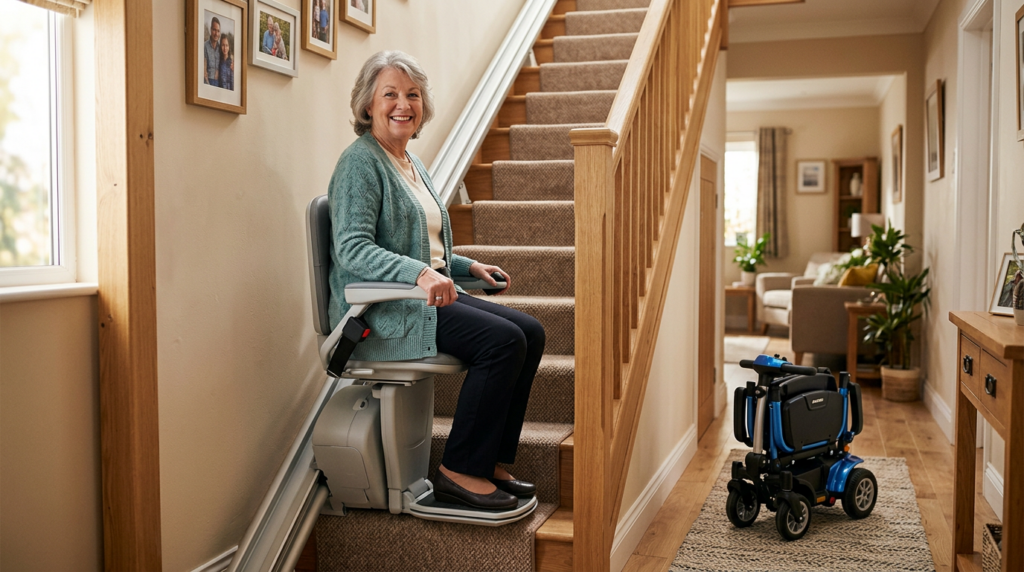
Two devices, one goal: never let stairs — or distance — slow you down.
By Frank Cannon | Updated July 2026
This guide breaks down exactly when each device matters, how they work together in a real home, and — critically — how to avoid overpaying for either one.
Mobility Scooter vs. Stairlift: They’re Not Competing, They’re Teammates
The 5 Warning Signs You Need a Stairlift (Not Just a Scooter)
- You’ve started sitting down partway up the stairs to rest. This is the single biggest predictor cited by home-safety assessors — if you’re pausing mid-staircase more than occasionally, a fall risk is already forming.
- You avoid the second floor of your own house. If you’ve unofficially “moved” your bedroom downstairs to skip the stairs, that’s not a lifestyle choice — that’s your body telling you the stairs have become the obstacle.
- A caregiver or family member has started walking behind you on stairs “just in case.” If someone else has noticed this risk before you have, it’s usually further along than it feels.
- You’ve had a stair-related near-miss — a stumble, a missed step, a grab for the railing that worked but scared you. This is the point most stairlift buyers finally act, but the ideal window to act is before this happens, not after.
- You already rely on a mobility scooter for outdoor and level-ground movement, per our guide on the top signs you’re ready to upgrade your mobility scooter — if you’ve already accepted assistance for flat-ground mobility, stairs are very often the next fall risk to address, not a separate issue to ignore.
What a Stairlift Actually Costs in 2026 (And Why the List Price Isn’t the Real Number)
Does Medicare Pay for a Stairlift?
- Medicaid HCBS waivers cover stairlifts in many states when medically necessary and tied to a home-care plan.
- VA grants (HISA, SAH, SHA) can fund stairlifts for eligible veterans.
- Long-term care insurance frequently includes home modification riders that cover part or all of the cost.
- Some installers offer their own in-house financing at 0% for 12–24 months.
If you haven’t already checked whether your mobility scooter itself qualifies for reimbursement, do that first — it’s usually the faster win:
👉 Find Out If Medicare Will Help Pay for Your Mobility Scooter — Even If You Were Denied Before
How a Stairlift and a Mobility Scooter Work Together in the Same Home
The most common real-world setup we see described by readers looks like this:
- Outdoors and around the block: a lightweight or long-range mobility scooter — see our comparisons of best lightweight mobility scooters and long-range models that keep you moving all day.
- Indoors, tight spaces: a compact scooter built for tight indoor spaces, since full-size scooters rarely fit through interior doorways or hallways.
- Between floors: the stairlift, closing the one gap neither scooter type can touch.
Straight vs. Curved Stairlifts: Why This Distinction Changes Everything
- Straight rail: Installs in as little as a few hours, often without any wall modification, and is the cheaper of the two by a wide margin.
- Curved rail: Custom-measured and fabricated per staircase — expect a 2–6 week lead time and a meaningfully higher price tag.
If your staircase has a landing, a turn, or a spiral, budget for the curved category and get multiple quotes — pricing variance between installers is enormous on curved units specifically, far more than on straight rails.
Safety Features Worth Paying Extra For
- Swivel seat at the top landing — reduces the twisting motion that causes most stairlift-adjacent falls (getting on/off, not riding).
- Seatbelt and sensor obstruction detection — stops the lift automatically if something is on the track.
- Battery backup operation — critical if you lose power; a stairlift that only runs on mains power is a liability during outages.
- Remote call/send controls at both the top and bottom of the stairs, so a spouse or caregiver can summon it without you climbing to fetch it.
A Simple Decision Framework
Ask yourself these three questions in order:
- Is the mobility issue mainly about distance/endurance on flat ground? → A mobility scooter alone likely solves it. Revisit our guide to choosing the right scooter for your lifestyle.
- Is the mobility issue mainly about stairs specifically — going up/down safely? → A stairlift is the direct fix, independent of whether you own a scooter.
- Is it both? → This is the most common answer among readers over 70, and it simply means budgeting for both across your household — not choosing one over the other.
Frequently Asked Questions
 Frank always liked things built tough. After thirty years running a highly successful trucking empire, he expects machinery to handle whatever he throws at it without breaking a sweat, complaining, or stalling out. If it isn’t heavy-duty, Frank isn’t interested.
So, when his good friend Bob—a retired MD with an eagle eye for technical detail and microscopic precision—suggested they push the newest All-Terrain Mobility Scooters to their absolute limits down by the rugged Malibu coastline, Frank didn’t even hesitate. He just grabbed his jacket.
If you’re anything like Frank, you crave the absolute freedom to explore off the beaten path. You refuse to let a little uneven ground stop you. Whether it’s a sandy beach, a muddy forest trail, or navigating the treacherous, rocky Californian coves, an all-terrain mobility scooter is engineered precisely to give you back your power. In 2026, the outdoor mobility scooter market has introduced mind-blowing advancements in suspension and shock absorption, and Bob was eager to analyze every single spec.
## What is the “Secret Sauce” of an All-Terrain Mobility Scooter?
“It’s all in the shock absorption architecture,” Bob noted, methodically checking the undercarriage with total focus. Unlike those flimsy, standard indoor scooters, true all-terrain models are forged with heavy-duty frames and massive pneumatic or solid knobby tires. This allows them to devour uneven surfaces like gravel, dirt, and even hard-packed sand—meaning you never get stuck, you never damage the motor, and you never have to turn back.
## Bob & Frank’s Top 3 Powerhouse Picks for 2026!
### 1. The Trailblazer Heavy Duty: The Coast-Crusher
Equipped with a beastly dual-motor system, this design completely seduced Frank. The scooter absolutely thrives on steep inclines and terrifyingly rocky paths. The independent suspension ensures you won’t feel a single bump, leaving you perfectly comfortable. “It rides smoother than my old rig,” Frank laughed, revving the throttle.
### 2. The Coastline Cruiser: The Sand-Surfer
Perfect for beachgoers who refuse to be stuck on the boardwalk. Bob precisely analyzed the Coastline Cruiser’s specially engineered, ultra-wide tires that completely prevent sinking into deep sand. Even better? Its advanced anti-corrosion coating forms an invisible shield, protecting the essential mechanics from destructive, salty ocean air.
### 3. The Explorer Pro: The Marathon Champion
The Explorer boasts the longest battery range of the entire lineup. This is the absolute ideal choice for epic, full-day excursions along the coast without ever needing a recharge. Unstoppable, unyielding, and incredibly sleek.
## Your Adventure Doesn’t Wait!
Don’t let rough terrain cage you in. Modern 21st-century accessibility means you no longer have to compromise, stay behind, or watch the fun from afar. With a premium all-terrain mobility scooter, you get the ridiculous power and insane durability you need to keep up with the gang.
**Ready to Conquer the Wild?** Browse our exclusive collection at **Mobility Scooters For You** and find the absolute perfect match for your fearless outdoor lifestyle!