The Mobility Scooter Headline That Broke the Internet This Week
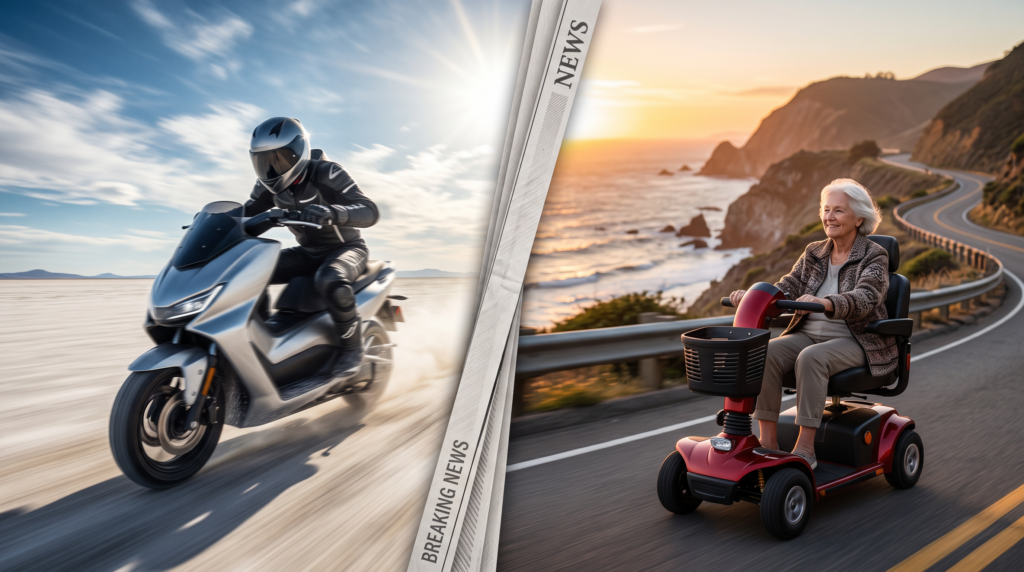
This week’s viral “100 mph mobility scooter” headline refers to a high-performance e-scooter — not the stable, senior-friendly mobility scooters built for real-world independence along coastlines like the Pacific Coast Highway.
If you’ve scrolled past a headline this week screaming that a “mobility scooter” just hit 100 mph, you’re not imagining it — and you’re not alone in doing a double-take. The vehicle in question is The Turbo, built by UK company Bo and engineered by a team of ex-Williams Formula One veterans, including CEO Oscar Morgan. The numbers read like a supercar spec sheet, not a sidewalk cruiser: a 24,000-watt dual-motor setup, an 1,800-watt-hour battery good for roughly 150 miles per charge, a top speed north of 100 mph, and a power-to-weight ratio the company claims beats a Bugatti Veyron. Bo is aiming to set a Guinness World Record with it at Bonneville Speed Week, and yes, it’s actually for sale — for $29,500, to qualified riders only (source: Bo Newsroom; Futurism).
We’re breaking down what’s real, what’s marketing spin, and — because we love a good analogy — what this story would look like if it played out along the Pacific Coast Highway instead of the Bonneville Salt Flats.
What’s Actually True in the Story
- The speed claim is real. The Turbo genuinely targets 100+ mph, verified by outlets like Futurism and The Autopian, and Bo is chasing an official Guinness World Record attempt.
- It’s built by serious engineers. The team includes veterans of Williams F1 and the Bloodhound Land Speed Rocket project — this isn’t a garage hack job.
- It’s a “personal mobility vehicle” only in the loosest regulatory sense. E-scooters like the Turbo exist in a largely unregulated category in many markets, which is precisely how a two-wheeled, stand-up scooter is legally allowed to carry a motor more powerful than most motorcycles.
- It is not a device designed for seniors, mobility-impaired riders, or anyone using it for actual accessibility needs. It requires balance, core strength, reflexes, and — per Bo’s own site — a rider profile closer to a motorsport enthusiast than a retiree running errands.
Why the Confusion Happens (and Why It Matters to You)
The Pacific Coast Analogy
Picture two riders heading out on the same stretch of Highway 1 on a clear morning.
What Actually Matters When Choosing a Real Mobility Scooter
If the Bo Turbo story has you newly curious (or newly worried) about scooter safety in general, here’s the checklist that actually applies to you or a loved one:
- Stability over speed. Look for a low center of gravity, a wide wheel track, and — for anyone riding on hills or uneven coastal terrain — four wheels rather than three. Our guide to 4-wheel scooter reliability covers exactly what to look for in a heavy-duty build.
- Battery range you can trust. Confusingly, this is one area where the Turbo story overlaps with real mobility scooter shopping — range anxiety is real either way. See our breakdown on avoiding battery failure mid-trip in Bob’s battery care guide.
- Insurance and Medicare eligibility. A $29,500 e-scooter has zero path to Medicare reimbursement. A properly classified mobility scooter might — and that’s a conversation worth having before you buy. Start with our Medicare Mobility Scooter Guide to see if you could qualify for assistance.
- Terrain-matched tyres and suspension. Pacific Coast riders dealing with boardwalks, sand-adjacent paths, and hilly neighbourhoods need pneumatic tyres and real suspension travel — not a skateboard deck.
- A realistic top speed for your environment. Faster isn’t safer. For sidewalk and neighbourhood use, 4–5 mph travel scooters are plenty; for longer outdoor range, look at 8 mph-class scooters, never anything positioning itself as a “speed demon.”
The Bottom Line


 +9
+914:47
Ready to upgrade your mobility? Find Your Perfect Scooter on Electric Wheelchairs USA today!
Leave a Reply