Mobility Scooters For You
Stairlift or Mobility Scooter? 2026 Staircase Safety Guide
This post contains affiliate links. If you use these links to buy something, we may earn a commission. Thanks.
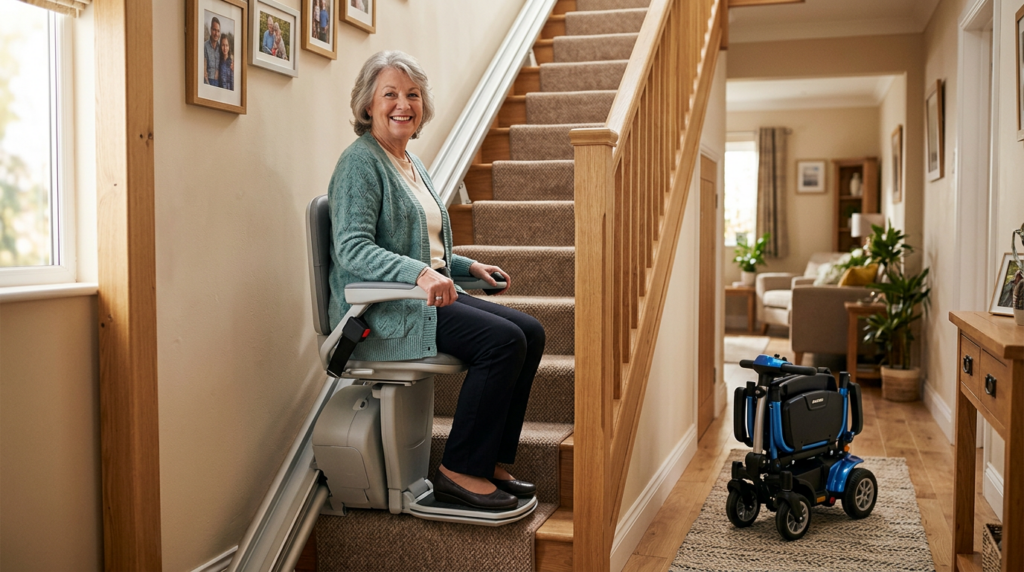
Two devices, one goal: never let stairs — or distance — slow you down.
By Frank Cannon | Updated July 2026
This guide breaks down exactly when each device matters, how they work together in a real home, and — critically — how to avoid overpaying for either one.
Mobility Scooter vs. Stairlift: They’re Not Competing, They’re Teammates
The 5 Warning Signs You Need a Stairlift (Not Just a Scooter)
- You’ve started sitting down partway up the stairs to rest. This is the single biggest predictor cited by home-safety assessors — if you’re pausing mid-staircase more than occasionally, a fall risk is already forming.
- You avoid the second floor of your own house. If you’ve unofficially “moved” your bedroom downstairs to skip the stairs, that’s not a lifestyle choice — that’s your body telling you the stairs have become the obstacle.
- A caregiver or family member has started walking behind you on stairs “just in case.” If someone else has noticed this risk before you have, it’s usually further along than it feels.
- You’ve had a stair-related near-miss — a stumble, a missed step, a grab for the railing that worked but scared you. This is the point most stairlift buyers finally act, but the ideal window to act is before this happens, not after.
- You already rely on a mobility scooter for outdoor and level-ground movement, per our guide on the top signs you’re ready to upgrade your mobility scooter — if you’ve already accepted assistance for flat-ground mobility, stairs are very often the next fall risk to address, not a separate issue to ignore.
What a Stairlift Actually Costs in 2026 (And Why the List Price Isn’t the Real Number)
Does Medicare Pay for a Stairlift?
- Medicaid HCBS waivers cover stairlifts in many states when medically necessary and tied to a home-care plan.
- VA grants (HISA, SAH, SHA) can fund stairlifts for eligible veterans.
- Long-term care insurance frequently includes home modification riders that cover part or all of the cost.
- Some installers offer their own in-house financing at 0% for 12–24 months.
If you haven’t already checked whether your mobility scooter itself qualifies for reimbursement, do that first — it’s usually the faster win:
👉 Find Out If Medicare Will Help Pay for Your Mobility Scooter — Even If You Were Denied Before
How a Stairlift and a Mobility Scooter Work Together in the Same Home
The most common real-world setup we see described by readers looks like this:
- Outdoors and around the block: a lightweight or long-range mobility scooter — see our comparisons of best lightweight mobility scooters and long-range models that keep you moving all day.
- Indoors, tight spaces: a compact scooter built for tight indoor spaces, since full-size scooters rarely fit through interior doorways or hallways.
- Between floors: the stairlift, closing the one gap neither scooter type can touch.
Straight vs. Curved Stairlifts: Why This Distinction Changes Everything
- Straight rail: Installs in as little as a few hours, often without any wall modification, and is the cheaper of the two by a wide margin.
- Curved rail: Custom-measured and fabricated per staircase — expect a 2–6 week lead time and a meaningfully higher price tag.
If your staircase has a landing, a turn, or a spiral, budget for the curved category and get multiple quotes — pricing variance between installers is enormous on curved units specifically, far more than on straight rails.
Safety Features Worth Paying Extra For
- Swivel seat at the top landing — reduces the twisting motion that causes most stairlift-adjacent falls (getting on/off, not riding).
- Seatbelt and sensor obstruction detection — stops the lift automatically if something is on the track.
- Battery backup operation — critical if you lose power; a stairlift that only runs on mains power is a liability during outages.
- Remote call/send controls at both the top and bottom of the stairs, so a spouse or caregiver can summon it without you climbing to fetch it.
A Simple Decision Framework
Ask yourself these three questions in order:
- Is the mobility issue mainly about distance/endurance on flat ground? → A mobility scooter alone likely solves it. Revisit our guide to choosing the right scooter for your lifestyle.
- Is the mobility issue mainly about stairs specifically — going up/down safely? → A stairlift is the direct fix, independent of whether you own a scooter.
- Is it both? → This is the most common answer among readers over 70, and it simply means budgeting for both across your household — not choosing one over the other.
Frequently Asked Questions
Does Medicare Cover a Mobility Scooter? 2026 Guide

This post contains affiliate links. If you use these links to buy something, we may earn a commission. Thanks.
Free tool: Print or tick off our free Medicare scooter checklist before you talk to your doctor or supplier.

Understanding how Medicare Part B covers your new mobility scooter in 2026.
Understanding Your Mobility and Medicare
Navigating the world of Medicare can be confusing, especially when it comes to getting the durable medical equipment (DME) you need to maintain your independence. One of the most common questions we hear is: “Will Medicare help me pay for a mobility scooter?”
The short answer is yes, but under specific conditions. Medicare Part B can cover a significant portion of the cost for a power-operated vehicle (POV), which includes mobility scooters, but only when it is deemed medically necessary by your doctor.
This guide will walk you through the exact steps you need to take to see if you qualify and what to do if you don’t.
The 5-Step Checklist to Qualify for Medicare Coverage
To get your mobility scooter covered, you and your doctor must demonstrate to Medicare that it is essential for your daily life. Here is a simple checklist of what Medicare needs to see:
- A Health Condition That Requires It: You must have a health condition that makes it very difficult to move around in your home.
- Limited Mobility in Your Home: You must have significant difficulty with daily activities like getting to the bathroom, kitchen, or bedroom, even with the help of a cane or walker.
- Ability to Safely Operate the Scooter: You must be able to safely get on and off the scooter and operate it in your home environment.
- Doctor’s Prescription: Your doctor must complete a detailed prescription and a face-to-face examination, stating that a scooter is necessary for you to carry out your daily activities at home.
- Approved Supplier: You must get your scooter from a Medicare-approved supplier. This is a critical step!
Important Note: Medicare’s primary focus is on helping you with mobility inside your home. If you only need a scooter for getting around outdoors, Medicare will likely not cover the cost.
What if Medicare Says No? Alternative Financing Options
If Medicare denies your request, don’t lose hope! Many people who don’t meet the strict in-home criteria still have great options to afford a scooter:
- Secondary Insurance: If you have a supplemental insurance plan, it may cover some or all of the remaining costs.
- Affordable Financing Plans: Many reputable dealers offer flexible monthly payment plans that can make a new scooter very affordable. Some plans have 0% interest for a promotional period.
- Private Sales & Refurbished Models: You can often find high-quality, pre-owned or refurbished scooters at a significant discount.
- Veterans Affairs (VA): If you are a veteran, the VA may provide a mobility scooter or other mobility aids.
Taking the Next Step Towards Freedom
Regaining your mobility is one of the most important investments you can make in your quality of life. Whether you qualify for Medicare coverage or explore other financing options, there is a path to getting the scooter you need.
Start by having an open conversation with your doctor about your mobility challenges. From there, you can confidently explore your options and get back to enjoying the freedom you deserve.
Compare prices: Browse mobility scooters at our partner, Mobility Department.