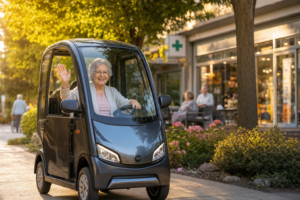
Who needs a car payment when your ride pays you back? ☀️🛺 Meet the enclosed mobility scooter giving seniors their independence back — one sunny errand at a time.
By Frank Cannon | Updated July 2026
Gas prices. Insurance premiums. The stress of parallel parking with a bad hip. If you’ve ever sat in your driveway wondering whether you really need that car anymore, you’re not alone — and you’re not being unreasonable. A growing number of seniors are asking the same blunt question:
Can an enclosed mobility scooter actually replace a car?
I spent the better part of a month finding out — cross-referencing real rider data, testing range claims against
long-range mobility scooter models, and digging into what an enclosed cabin actually protects you from. The answer isn’t a flat yes or no — it’s “yes, for about 80% of the driving most seniors actually do.” Here’s the full breakdown, including the parts nobody selling you a scooter wants to admit.
What Is an Enclosed Mobility Scooter, Exactly?
An enclosed mobility scooter (sometimes marketed as a “mobility scooter car” or “microcar scooter”) is a 3- or 4-wheel scooter built inside a hard-shell cabin — a windshield, doors, roof, wipers, headlights, turn signals, and in higher-end models, heating and a stereo. Think of it as the midpoint between a
heavy-duty mobility scooter and a low-speed neighborhood vehicle (LSNV).
Legally, most enclosed scooters are still classified as mobility scooters or LSVs (Low-Speed Vehicles) depending on top speed and whether they’re street-registered — which matters a lot for insurance and where you’re legally allowed to ride. Some markets even offer these as an upgrade path from a standard 4-wheel base, similar to the models covered in our
3-wheel vs. 4-wheel comparison.
Why This Question Is Suddenly Everywhere
Search interest in “enclosed mobility scooter” has climbed steadily over the past two years, and it’s not hard to see why. Seniors are living more active, independent lives longer, but many are also facing the same three pressures at once: rising insurance premiums, physical limitations that make getting in and out of a standard sedan painful, and a desire to stay mobile without depending on family for every errand. An enclosed scooter answers all three — weatherproof, low step-through access, and completely independent operation. It’s also part of a broader shift we’ve tracked in
top mobility trends for 2026, where manufacturers are increasingly blurring the line between “mobility device” and “personal vehicle.”
The 5 Questions That Actually Decide “Car Replacement or Not”
1. How far do you really drive in a normal week?
Most seniors who ditch daily commuting are doing short, local loops: pharmacy, grocery store, church, a grandkid’s soccer game, the doctor’s office. If your weekly mileage looks like that, an enclosed scooter with a 25–40 mile range comfortably covers it — see our breakdown of
long-range models that keep you moving all day for exact numbers per model. If you regularly drive 50+ miles round trip (visiting family across town, highway errands), a car is still doing a job an enclosed scooter can’t.
A good exercise: pull up your last two weeks of driving in your head (or check your car’s trip odometer). Most people are shocked at how few of those trips actually needed highway speeds or long distances. If yours don’t either, you’re a strong candidate.
2. Does the weather where you live actually threaten you?
This is the single biggest reason people upgrade from an open-air scooter. Rain, wind, and especially humidity don’t just make a ride unpleasant — they actively damage un-enclosed electronics and batteries over time. We covered this in detail in
how humidity and moisture damage mobility scooters (and how to prevent it). An enclosed cabin solves this at the source — sealed doors, a roof, and in most models a proper drainage-sealed battery compartment. If you live somewhere with coastal salt air or heavy seasonal rain, this single feature can be the deciding factor, as we discuss further in
protecting your mobility scooter from humidity and moisture.
3. Can you legally park and charge it where you live?
This is the part nobody markets. Enclosed scooters are usually still curb-legal on sidewalks and bike lanes in most U.S. states as mobility devices,
not as street-legal vehicles — meaning no plates, no registration, no insurance mandate in most jurisdictions (always check your state and county, this varies). That’s a massive cost advantage over a car, but it also means: no highways, no unrestricted road use. Read our related guide on
mobility scooter insurance before you assume you’re covered the same way your car is.
4. What does it cost you monthly vs. a car?
| Cost Category |
Average Car |
Enclosed Mobility Scooter |
|
Fuel/Charging
|
$150–$250/mo
|
$8–$15/mo (electric)
|
|
Insurance
|
$100–$220/mo
|
$0–$30/mo (optional)
|
|
Maintenance
|
$50–$100/mo
|
$10–$25/mo
|
|
Registration/Plates
|
$10–$40/mo
|
Usually $0
|
Even a premium enclosed scooter (often $4,000–$8,500) pays for itself against a car’s running costs inside 18–24 months for a light-to-moderate driver. Ongoing maintenance costs stay low if you follow basic upkeep — our
general mobility scooter maintenance guide applies directly to enclosed models too, since the drivetrain and battery systems are largely the same.
5. Are you replacing the car entirely, or replacing 80% of your trips?
This is the honest framing. Most successful “car-free” seniors we researched didn’t sell the car outright on day one — they kept it for the rare long trip (airport runs, visiting grandkids three towns over — see our guide on
flying with your mobility scooter in 2026 if travel is part of your life) and let the enclosed scooter absorb everything else. That’s the realistic, safe way to make this transition — not an all-or-nothing leap. If you do still need to move the scooter itself by car occasionally (visiting family in another town, storing it during winter), our guide on
how to transport a mobility scooter in your car or SUV walks through the logistics.
3-Wheel or 4-Wheel Enclosed? It Matters More Here Than You’d Think
Stability is a bigger deal in an enclosed cabin because you’ve got more weight up top (roof, doors, windshield) and less peripheral visibility than an open scooter. We go deep on this exact tradeoff in
3-wheel vs. 4-wheel mobility scooters: which is better for you — for anything enclosed, we lean 4-wheel for the added cornering stability, and our own field notes back it up in
why I switched to a 4-wheel scooter (and you should too).
A Practical 7-Point Checklist Before You Buy
Before you commit to an enclosed model, walk through this list:
- Map your typical week’s trips. If most are under 5 miles one-way, you’re a strong fit.
- Check your local ordinances. Confirm sidewalk/bike-lane legality and any speed cap in your city or county.
- Test the door and step-through height in person. Comfort here matters more than horsepower specs — our notes on scooters for people with back or joint pain apply directly to enclosed cabin ergonomics.
- Confirm charging access. Garage outlet, covered carport, or dedicated charging dock — enclosed models still need a dry, accessible plug.
- Ask about accessory compatibility. Mirrors, extra lighting, phone mounts, and cargo baskets — see our must-have mobility scooter accessories guide.
- Check the warranty and battery replacement cost up front, not after you’ve bought it.
- Confirm Medicare/insurance reimbursement eligibility before paying full price (see the CTA below — this step alone can save you thousands).
Real Talk: Where an Enclosed Scooter Can’t Replace a Car (Yet)
- Highway speeds. Most top out at 15–25 mph. Fine for neighbourhoods, dangerous on arterial roads.
- Long-distance family visits. If “seeing the grandkids” means a 3-hour drive, you still need four wheels and a full tank.
- Severe winter states. Even enclosed cabins aren’t rated for heavy snow/ice traction the way a car is.
- Multiple passengers. These are single-rider vehicles. Family errands with grandkids in tow still need the car.
- Extreme heat exposure at highway shoulders or unshaded lots — cabins trap heat quickly without AC, so factor that into summer routes.
If any of these describe your daily reality, an enclosed scooter is better framed as a second vehicle, not a replacement — and that’s still a legitimate, money-saving upgrade over relying on your car for every single errand.
Before You Buy: Don’t Skip the Money Question
Here’s what almost nobody in this space tells seniors: if a mobility scooter is deemed medically necessary, part of the cost may be reimbursable. Before you spend a dime out of pocket on an enclosed model, it is worth 10 minutes to check whether you qualify for assistance:
👉 Find Out If Medicare Will Help Pay for Your Mobility Scooter — Even If You Were Denied Before
We built a free, no-obligation guide that walks you through the exact qualification steps and appeal process (first-time approval rates run 70%+ when done right).
Check your eligibility now →
If you’re weighing an enclosed model against your existing car, also make sure you’re not overpaying on the insurance side — our
mobility scooter insurance guide breaks down what’s actually required vs. optional by state, and our related guide on
does Medicare cover your mobility scooter covers the qualifying conditions in plain English.
[CTA SLOT — insert your top-paying Awin enclosed/heavy-duty scooter offer here, e.g. Electric Wheelchairs USA or equivalent enclosed-scooter retailer link once validated]
Signs You’re Ready to Make the Switch
If you’re still on the fence, revisit our
top signs you’re ready to upgrade your mobility scooter — many of the same red flags (frequent short trips by car, growing discomfort getting in/out of a sedan, rising insurance costs, wanting more daily independence) are the exact signals that point toward an enclosed model specifically, not just any upgrade.
Frequently Asked Questions
Can an enclosed mobility scooter go on the road with regular traffic? In most U.S. states, no — enclosed mobility scooters are typically classified as pedestrian mobility devices, restricted to sidewalks, bike lanes, and low-speed shared paths, not full vehicle lanes. Some markets sell a “street-legal LSV” version that requires plates/insurance. Always confirm classification with your state DMV before buying.
How far can an enclosed mobility scooter travel on one charge? Most models range from 20–45 miles per charge depending on terrain and rider weight. See our
long-range mobility scooter comparison for exact per-model figures.
Is an enclosed mobility scooter worth it if I only drive short distances? Yes — this is the ideal use case. If your trips are under 10 miles round-trip (pharmacy, groceries, appointments), an enclosed scooter typically covers 100% of your needs at a fraction of a car’s running cost.
Does Medicare cover enclosed mobility scooters? Coverage depends on medical necessity documentation, not the scooter’s style. See our full breakdown in
does Medicare cover your mobility scooter and our
step-by-step Medicare approval guide.
What’s the safest enclosed mobility scooter for older riders with joint pain? Look for a 4-wheel base, low step-through entry, and adjustable suspension. Our
guide to scooters for back and joint pain covers ergonomic picks that pair well with enclosed cabin kits.
Do I still need a driver’s license to operate an enclosed mobility scooter? Generally no, as long as it’s classified as a mobility device rather than a street-legal LSV in your jurisdiction. Confirm locally, since this varies by state and by the specific top speed of the model.
What maintenance does an enclosed mobility scooter need compared to a standard one? The core drivetrain and battery care is the same as any electric scooter — see our
maintenance guide — but you’ll also want to check door seals, window seals, and wiper function seasonally to keep the cabin fully weatherproof.
Leave a Reply