senior independence
The Mobility Scooter Headline That Broke the Internet This Week

This post contains affiliate links. If you use these links to buy something, we may earn a commission. Thanks.

This week’s viral “100 mph mobility scooter” headline refers to a high-performance e-scooter — not the stable, senior-friendly mobility scooters built for real-world independence along coastlines like the Pacific Coast Highway.
If you’ve scrolled past a headline this week screaming that a “mobility scooter” just hit 100 mph, you’re not imagining it — and you’re not alone in doing a double-take. The vehicle in question is The Turbo, built by UK company Bo and engineered by a team of ex-Williams Formula One veterans, including CEO Oscar Morgan. The numbers read like a supercar spec sheet, not a sidewalk cruiser: a 24,000-watt dual-motor setup, an 1,800-watt-hour battery good for roughly 150 miles per charge, a top speed north of 100 mph, and a power-to-weight ratio the company claims beats a Bugatti Veyron. Bo is aiming to set a Guinness World Record with it at Bonneville Speed Week, and yes, it’s actually for sale — for $29,500, to qualified riders only (source: Bo Newsroom; Futurism).
We’re breaking down what’s real, what’s marketing spin, and — because we love a good analogy — what this story would look like if it played out along the Pacific Coast Highway instead of the Bonneville Salt Flats.
What’s Actually True in the Story
- The speed claim is real. The Turbo genuinely targets 100+ mph, verified by outlets like Futurism and The Autopian, and Bo is chasing an official Guinness World Record attempt.
- It’s built by serious engineers. The team includes veterans of Williams F1 and the Bloodhound Land Speed Rocket project — this isn’t a garage hack job.
- It’s a “personal mobility vehicle” only in the loosest regulatory sense. E-scooters like the Turbo exist in a largely unregulated category in many markets, which is precisely how a two-wheeled, stand-up scooter is legally allowed to carry a motor more powerful than most motorcycles.
- It is not a device designed for seniors, mobility-impaired riders, or anyone using it for actual accessibility needs. It requires balance, core strength, reflexes, and — per Bo’s own site — a rider profile closer to a motorsport enthusiast than a retiree running errands.
Why the Confusion Happens (and Why It Matters to You)
The Pacific Coast Analogy
Picture two riders heading out on the same stretch of Highway 1 on a clear morning.
What Actually Matters When Choosing a Real Mobility Scooter
If the Bo Turbo story has you newly curious (or newly worried) about scooter safety in general, here’s the checklist that actually applies to you or a loved one:
- Stability over speed. Look for a low center of gravity, a wide wheel track, and — for anyone riding on hills or uneven coastal terrain — four wheels rather than three. Our guide to 4-wheel scooter reliability covers exactly what to look for in a heavy-duty build.
- Battery range you can trust. Confusingly, this is one area where the Turbo story overlaps with real mobility scooter shopping — range anxiety is real either way. See our breakdown on avoiding battery failure mid-trip in Bob’s battery care guide.
- Insurance and Medicare eligibility. A $29,500 e-scooter has zero path to Medicare reimbursement. A properly classified mobility scooter might — and that’s a conversation worth having before you buy. Start with our Medicare Mobility Scooter Guide to see if you could qualify for assistance.
- Terrain-matched tyres and suspension. Pacific Coast riders dealing with boardwalks, sand-adjacent paths, and hilly neighbourhoods need pneumatic tyres and real suspension travel — not a skateboard deck.
- A realistic top speed for your environment. Faster isn’t safer. For sidewalk and neighbourhood use, 4–5 mph travel scooters are plenty; for longer outdoor range, look at 8 mph-class scooters, never anything positioning itself as a “speed demon.”
The Bottom Line


 +9
14:47
Compare prices: Browse heavy-duty mobility scooters at our partner, Mobility Department.
Mobility Scooter Battery Maintenance Guide 2026

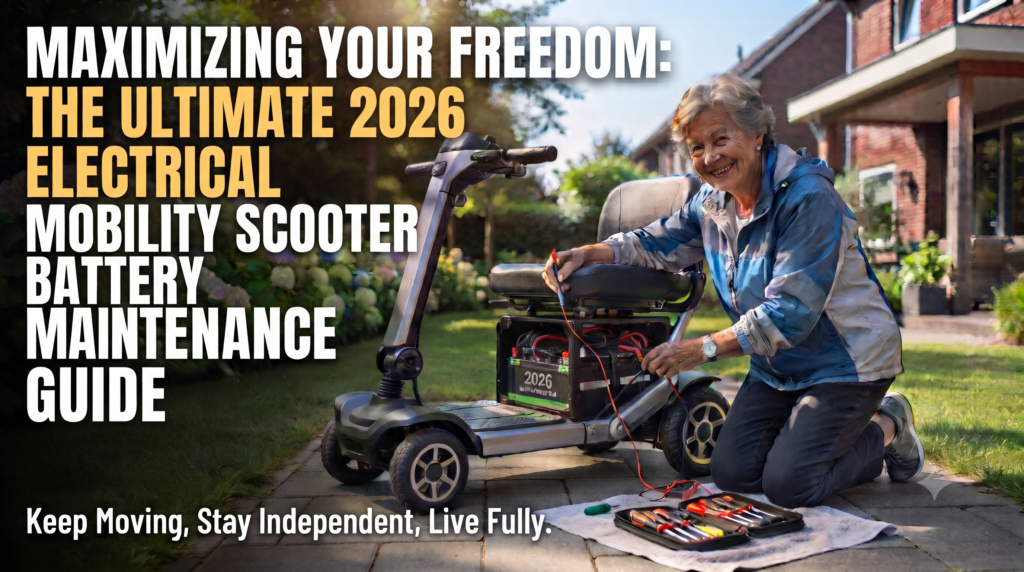
Feel the gentle breeze of absolute freedom wash over you… 🌊 Let a deep wave of calm reassurance fill your mind, knowing your journey is fully powered and completely supported. ✨ Breathe in, relax, and keep moving forward in perfect independence! 🔋🦽
Are you getting the full range your mobility scooter promised? For many seniors and travelers, the battery is the heart of their independence. Whether you’re cruising through a theme park or navigating your local neighborhood, a well-maintained battery ensures you’re never left stranded.
In 2026, battery technology has advanced, but the core principles of care remain the same. This guide covers everything you need to know to extend your battery life and maximize your daily range.
1. The “Break-In” Period
Many users don’t realize that new mobility scooter batteries require a break-in period. For the first 5-10 charging cycles, it’s essential to fully charge your battery and then use it until it’s at about 50% capacity. This helps the battery reach its full potential.
2. Consistency is Key
Don’t wait until your scooter is completely dead to charge it. Lead-acid and even newer lithium-ion batteries prefer consistent top-offs. If you’ve used your scooter for more than 30 minutes, plug it in when you get home.
3. Storage Matters
If you’re planning a trip and leaving your scooter behind, or if you’re a seasonal user, never store your batteries in a discharged state. Store them in a cool, dry place and ensure they are charged to at least 70% before long-term storage.
4. Temperature Awareness
Extreme heat and cold are the enemies of battery efficiency. In 2026, we see more “smart” chargers that adjust for temperature, but it’s still best to charge your scooter in a climate-controlled environment.
Recommended Upgrade: High-Capacity Lithium Batteries
If you find yourself constantly worrying about range, it might be time for an upgrade. High-capacity lithium batteries offer longer life cycles and faster charging times.
Find the Perfect High-Capacity Scooter at Mobility Department
*Affiliate Disclosure: This post contains affiliate links to trusted partners like Mobility Department and ElectricWheelchairsUSA. We may earn a commission if you make a purchase through these links, at no extra cost to you.*
Gear up for your ride: lithium scooter battery · car charger adaptor.
Compare prices: Browse scooter batteries and chargers at our partner, Mobility Department.