Assistive Devices
Do You Need a Stairlift or a Mobility Scooter? The Complete 2026 Guide to Staying Safe on Every Staircase
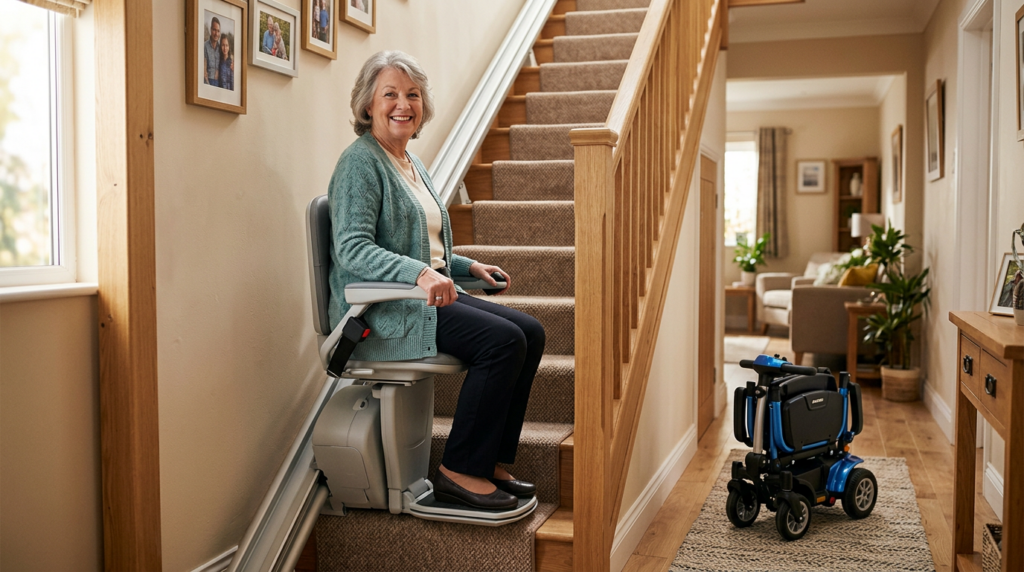
Two devices, one goal: never let stairs — or distance — slow you down.
By Frank Cannon | Updated July 2026
This guide breaks down exactly when each device matters, how they work together in a real home, and — critically — how to avoid overpaying for either one.
Mobility Scooter vs. Stairlift: They’re Not Competing, They’re Teammates
The 5 Warning Signs You Need a Stairlift (Not Just a Scooter)
- You’ve started sitting down partway up the stairs to rest. This is the single biggest predictor cited by home-safety assessors — if you’re pausing mid-staircase more than occasionally, a fall risk is already forming.
- You avoid the second floor of your own house. If you’ve unofficially “moved” your bedroom downstairs to skip the stairs, that’s not a lifestyle choice — that’s your body telling you the stairs have become the obstacle.
- A caregiver or family member has started walking behind you on stairs “just in case.” If someone else has noticed this risk before you have, it’s usually further along than it feels.
- You’ve had a stair-related near-miss — a stumble, a missed step, a grab for the railing that worked but scared you. This is the point most stairlift buyers finally act, but the ideal window to act is before this happens, not after.
- You already rely on a mobility scooter for outdoor and level-ground movement, per our guide on the top signs you’re ready to upgrade your mobility scooter — if you’ve already accepted assistance for flat-ground mobility, stairs are very often the next fall risk to address, not a separate issue to ignore.
What a Stairlift Actually Costs in 2026 (And Why the List Price Isn’t the Real Number)
Does Medicare Pay for a Stairlift?
- Medicaid HCBS waivers cover stairlifts in many states when medically necessary and tied to a home-care plan.
- VA grants (HISA, SAH, SHA) can fund stairlifts for eligible veterans.
- Long-term care insurance frequently includes home modification riders that cover part or all of the cost.
- Some installers offer their own in-house financing at 0% for 12–24 months.
If you haven’t already checked whether your mobility scooter itself qualifies for reimbursement, do that first — it’s usually the faster win:
👉 Find Out If Medicare Will Help Pay for Your Mobility Scooter — Even If You Were Denied Before
How a Stairlift and a Mobility Scooter Work Together in the Same Home
The most common real-world setup we see described by readers looks like this:
- Outdoors and around the block: a lightweight or long-range mobility scooter — see our comparisons of best lightweight mobility scooters and long-range models that keep you moving all day.
- Indoors, tight spaces: a compact scooter built for tight indoor spaces, since full-size scooters rarely fit through interior doorways or hallways.
- Between floors: the stairlift, closing the one gap neither scooter type can touch.
Straight vs. Curved Stairlifts: Why This Distinction Changes Everything
- Straight rail: Installs in as little as a few hours, often without any wall modification, and is the cheaper of the two by a wide margin.
- Curved rail: Custom-measured and fabricated per staircase — expect a 2–6 week lead time and a meaningfully higher price tag.
If your staircase has a landing, a turn, or a spiral, budget for the curved category and get multiple quotes — pricing variance between installers is enormous on curved units specifically, far more than on straight rails.
Safety Features Worth Paying Extra For
- Swivel seat at the top landing — reduces the twisting motion that causes most stairlift-adjacent falls (getting on/off, not riding).
- Seatbelt and sensor obstruction detection — stops the lift automatically if something is on the track.
- Battery backup operation — critical if you lose power; a stairlift that only runs on mains power is a liability during outages.
- Remote call/send controls at both the top and bottom of the stairs, so a spouse or caregiver can summon it without you climbing to fetch it.
A Simple Decision Framework
Ask yourself these three questions in order:
- Is the mobility issue mainly about distance/endurance on flat ground? → A mobility scooter alone likely solves it. Revisit our guide to choosing the right scooter for your lifestyle.
- Is the mobility issue mainly about stairs specifically — going up/down safely? → A stairlift is the direct fix, independent of whether you own a scooter.
- Is it both? → This is the most common answer among readers over 70, and it simply means budgeting for both across your household — not choosing one over the other.
Frequently Asked Questions
Top Mobility Trends for 2026: What’s New in Wheelchairs, Scooters, and Accessibility Technology
**Introduction**

Exploring the intersection of high-tech AI and personal mobility in 2026.
The year 2026 is shaping up to be a transformative one for the mobility industry. From smarter power wheelchairs to ultra-lightweight materials, the latest advancements are designed with one goal in mind: your independence. Whether you’re looking to upgrade your current ride or are just starting your journey, these trends will redefine how you move through the world.**1. Smarter Power Wheelchairs and Scooters**
We’re seeing a massive shift toward “smart” mobility. This includes features like obstacle avoidance sensors, smartphone-integrated diagnostics, and even remote-control parking. These technologies not only enhance safety but also provide peace of mind for both users and their families.
**2. Lighter and Stronger Materials**
The days of heavy, cumbersome scooters are fading. Manufacturers like Pride and Golden are increasingly using aerospace-grade aluminum and carbon fiber. This makes travel scooters easier to lift into car trunks and more durable for daily use.
**3. Enhanced Battery Performance and Charging**
Battery technology is finally catching up to our needs. In 2026, we’re seeing the widespread adoption of lithium-ion batteries that offer longer ranges and significantly faster charging times. Some models can now reach an 80% charge in under two hours!
**4. Increased Home Accessibility Technology**
Mobility isn’t just about the scooter; it’s about the environment. New smart-home integrations allow users to control lights, doors, and even appliances directly from their scooter’s tiller or a connected app, creating a truly seamless living experience.
**5. Customization and Modular Design**
Your mobility solution should be as unique as you are. Modular designs now allow users to easily swap out seating systems, armrests, and even drive wheels to better suit their specific physical needs and lifestyle preferences.
**Conclusion**
The future of mobility is bright, and it’s all about empowering you to live life on your terms. To explore the latest models featuring these 2026 trends, visit our partners at [Electric Wheelchairs USA](https://www.electricwheelchairsusa.com/?aff=406). They have the newest releases from top brands ready for you to browse today!
—
**Affiliate Integration:**
– [Shop the Latest 2026 Mobility Models at Electric Wheelchairs USA](https://www.electricwheelchairsusa.com/?aff=406)
– [Upgrade Your Accessories at Mobility Department](https://mobilitydepartment.com)
– [Planning a Trip? Rent the Newest Models at Walker Mobility](https://walkermobility.com)