Mobility Scooter Maitainance
How to Break In Mobility Scooter Batteries for Maximum Range in 2026
# How to Break In Mobility Scooter Batteries (So You Actually Get the Range You Paid For)
## Introduction
*Looking for the perfect travel companion? Check out the latest [Electric Wheelchairs and Scooters at ElectricWheelchairsUSA](https://www.electricwheelchairsusa.com/?aff=406) for exclusive 2026 deals!*
Are you the proud new owner of a mobility scooter, perhaps a reliable Pride, a comfortable Golden, or a versatile Travel model? You’ve made a significant investment in your independence and mobility. Now, you’re likely eager to hit the road and experience the freedom your new scooter offers. However, before you embark on your first long journey, there’s a crucial step many new owners overlook: **properly breaking in your mobility scooter batteries**. This initial conditioning process is not just a recommendation; it’s the foundation for ensuring you get the maximum range, optimal performance, and the longest possible lifespan from your battery investment. Neglecting this step can lead to disappointing range and premature battery wear, leaving you wondering why your scooter isn’t living up to its potential. In this comprehensive guide, we’ll walk you through the essential steps to properly break in your mobility scooter batteries, ensuring you truly get the range you paid for.
## What Does “Breaking In” a Battery Mean?
The term “breaking in” a battery might sound like something reserved for a new car engine, but it applies equally to the power source of your mobility scooter. Essentially, it refers to the initial period of use and charging that allows the battery to reach its full capacity and optimize its internal chemistry. Most mobility scooters, including popular models from **Pride**, **Golden**, and **Travel**, utilize sealed lead-acid (SLA) batteries, which can be either Absorbent Glass Mat (AGM) or Gel Cell. These battery types benefit significantly from a proper break-in period. During manufacturing and storage, the chemical components within the battery may not be fully active or evenly distributed. The initial charge and subsequent discharge cycles help to activate these chemicals, form stable plates, and ensure the battery can hold and deliver its maximum rated capacity. Think of it like training a muscle: you wouldn’t expect peak performance on the first day. Similarly, your new mobility scooter battery needs a few cycles to get into top shape. This conditioning is vital for achieving the advertised range and extending the overall life of your battery.
## The Crucial First Charge: Your Foundation for Range
The most critical step in breaking in your mobility scooter batteries is the **initial charge**. This isn’t just about topping it off; it’s about establishing the battery’s baseline for future performance. Many manufacturers, including those for **Pride**, **Golden**, and **Travel** scooters, recommend an extended first charge. Here’s how to do it correctly:
1. **Read Your Manual:** Always start by consulting your mobility scooter’s owner’s manual. While general guidelines apply, specific models might have unique recommendations.
2. **Connect the Charger:** Use only the charger provided by the manufacturer. Aftermarket or incorrect chargers can damage your batteries and void your warranty. Ensure the charger is plugged into a standard wall outlet and then connected securely to your scooter’s charging port.
3. **The Extended Charge:** For the very first charge, it is highly recommended to charge your batteries for a minimum of **10 to 14 hours**, regardless of whether the charger’s indicator light turns green earlier. This extended period allows the battery cells to fully equalize and reach their maximum potential. Interrupting this first charge prematurely can permanently limit the battery’s capacity.
4. **Avoid Immediate Discharge:** Resist the urge to take your new scooter for a long ride immediately after the indicator light turns green. Allow the battery to complete its full initial charge cycle. Deeply discharging a brand-new battery before it has been properly conditioned can be detrimental to its long-term health.
5. **Charge in a Well-Ventilated Area:** While modern SLA batteries are sealed, it’s always good practice to charge them in a well-ventilated area, away from direct sunlight or extreme temperatures.
This initial, thorough charge is the single most important step you can take to ensure your mobility scooter batteries deliver the range and reliability you expect.
## The First Few Cycles: Building Battery Memory (or Conditioning)
After the crucial initial charge, the next phase involves the first few charge and discharge cycles. This process further conditions the battery and helps it to in the same way as older nickel-cadmium batteries, these initial cycles are still vital for optimal performance. Aim for approximately **3 to 5 full charge/discharge cycles** during this break-in period.
1. **Partial Discharges:** For these initial cycles, it’s best to use your scooter until the battery charge indicator shows it’s around **20-30% remaining** before recharging. Avoid running the batteries completely flat during this period. Deep discharges can stress new batteries and hinder their conditioning process.
2. **Full Recharges:** After each partial discharge, fully recharge your batteries. Again, allow for an extended charge, ideally overnight (8-10 hours), even if the charger light indicates a full charge sooner. This ensures the battery cells are balanced and fully topped up.
3. **Consistent Use:** Regular, consistent use during this period is more beneficial than sporadic, heavy use. Short trips followed by full recharges will help the battery adapt and build its capacity more effectively.
By carefully managing these first few cycles, you’re actively contributing to the long-term health and efficiency of your mobility scooter batteries, setting them up for reliable performance for years to come.
## Ongoing Battery Care for Maximum Lifespan and Range
Once your mobility scooter batteries are properly broken in, maintaining their health is key to enjoying consistent range and extending their overall lifespan. This involves adopting good charging habits and being mindful of environmental factors. These tips apply universally to most mobility scooter batteries, including those found in **Pride**, **Golden**, and **Travel** models.
* **Charge After Every Use:** The golden rule for lead-acid batteries is to charge them after every use, regardless of how short the trip was. This prevents sulfation, a common cause of capacity loss and premature battery failure. Think of it as topping off a gas tank – you wouldn’t wait until it’s completely empty every time.
* **Avoid Deep Discharges:** While occasional deep discharges won’t immediately ruin your battery, consistently running your batteries until they are completely depleted significantly shortens their lifespan. Aim to recharge when the battery indicator shows around 20-30% remaining.
* **Don’t Overcharge or Undercharge:** Modern mobility scooter chargers are designed to prevent overcharging. However, using an old or faulty charger can be detrimental. Similarly, consistently undercharging (not allowing a full charge cycle) can lead to reduced capacity over time. Always use the manufacturer-recommended charger and ensure it’s functioning correctly.
* **Storage Best Practices:** If you plan to store your mobility scooter for an extended period (more than a few weeks), ensure the batteries are fully charged before storage. Then, recharge them every 3-4 weeks to maintain their charge and prevent self-discharge from causing damage. Store the scooter in a cool, dry place, away from direct sunlight or extreme temperatures.
* **Temperature Matters:** Extreme temperatures, both hot and cold, can negatively impact battery performance and lifespan. Batteries perform optimally at room temperature. Avoid charging or storing your scooter in very hot garages or freezing outdoor conditions.
* **Regular Checks:** Periodically inspect your battery terminals for corrosion and ensure all connections are tight. Keep the battery compartment clean and free of debris.
## Specific Considerations for Pride, Golden, and Travel Scooters
While the general principles of battery break-in and maintenance apply across the board, it’s worth noting that leading brands like **Pride Mobility**, **Golden Technologies**, and **Travel Scooter** manufacturers design their products with specific battery systems in mind. Always refer to the owner’s manual provided with your specific model for any brand-specific recommendations regarding charging times, battery types, and maintenance schedules. For instance, some newer models might incorporate more advanced battery management systems that optimize charging. However, the fundamental need for proper initial conditioning and consistent charging remains paramount for all quality mobility scooters.
## Troubleshooting Common Battery Issues
Even with the best care, you might encounter battery-related issues. Here are some common problems and what to consider:
* **Poor Range Despite Proper Break-In:** If your scooter isn’t achieving the expected range even after proper break-in and consistent charging, first check your charger. A faulty charger might not be fully charging the batteries. Also, consider the age of your batteries; even well-maintained batteries have a finite lifespan, typically 1-2 years for daily users, or 3-5 years for occasional users. Environmental factors like cold weather can also temporarily reduce range.
* **Scooter Dies Suddenly:** This often indicates a battery that is no longer holding a charge effectively. It could be one or both batteries failing. A professional battery test can confirm this.
* **When to Consider Battery Replacement:** If your batteries are old, not holding a charge, or consistently providing significantly reduced range, it’s likely time for a replacement. Always replace both batteries at the same time, and ensure they are of the same type, size, and amp-hour (Ah) rating as the originals. Consult with a reputable dealer like MobilityScootersForYou.com for advice on compatible and high-quality replacement batteries.
## Conclusion
Properly breaking in and maintaining your mobility scooter batteries is not a chore; it’s an investment in your freedom and independence. By following the simple yet crucial steps outlined in this guide – especially the extended initial charge and the careful management of the first few cycles – you can significantly enhance your battery’s performance, maximize your scooter’s range, and extend its overall lifespan. Whether you own a **Pride**, **Golden**, or **Travel** mobility scooter, these practices will ensure you get the most out of your valuable equipment. Don’t let a neglected battery limit your adventures. Take charge of your battery care today and enjoy the full range and reliability your mobility scooter was designed to deliver. For more tips on mobility scooter care, accessories, or to explore our range of high-quality scooters and replacement batteries, visit MobilityScootersForYou.com.
## Plan Your Next Adventure
If you’re planning a trip to Orlando or a cruise, don’t forget to arrange your mobility rental in advance. We recommend [Walker Mobility](https://walkermobility.com/) for reliable and high-quality scooter rentals that make your vacation stress-free.
Maximizing Your Freedom: The Ultimate 2026 Mobility Scooter Battery Maintenance Guide


Feel the gentle breeze of absolute freedom wash over you… 🌊 Let a deep wave of calm reassurance fill your mind, knowing your journey is fully powered and completely supported. ✨ Breathe in, relax, and keep moving forward in perfect independence! 🔋🦽
Are you getting the full range your mobility scooter promised? For many seniors and travelers, the battery is the heart of their independence. Whether you’re cruising through a theme park or navigating your local neighborhood, a well-maintained battery ensures you’re never left stranded.
In 2026, battery technology has advanced, but the core principles of care remain the same. This guide covers everything you need to know to extend your battery life and maximize your daily range.
## 1. The “Break-In” Period
Many users don’t realize that new mobility scooter batteries require a break-in period. For the first 5-10 charging cycles, it’s essential to fully charge your battery and then use it until it’s at about 50% capacity. This helps the battery reach its full potential.
## 2. Consistency is Key
Don’t wait until your scooter is completely dead to charge it. Lead-acid and even newer lithium-ion batteries prefer consistent top-offs. If you’ve used your scooter for more than 30 minutes, plug it in when you get home.
## 3. Storage Matters
If you’re planning a trip and leaving your scooter behind, or if you’re a seasonal user, never store your batteries in a discharged state. Store them in a cool, dry place and ensure they are charged to at least 70% before long-term storage.
## 4. Temperature Awareness
Extreme heat and cold are the enemies of battery efficiency. In 2026, we see more “smart” chargers that adjust for temperature, but it’s still best to charge your scooter in a climate-controlled environment.
## Recommended Upgrade: High-Capacity Lithium Batteries
If you find yourself constantly worrying about range, it might be time for an upgrade. High-capacity lithium batteries offer longer life cycles and faster charging times.
**[Find the Perfect High-Capacity Scooter on Senior.com](https://senior.com/collections/bariatric-mobility-scooters)**
—
*Affiliate Disclosure: This post contains affiliate links to trusted partners like Senior.com and [ElectricWheelchairsUSA](https://www.electricwheelchairsusa.com/?aff=406). We may earn a commission if you make a purchase through these links, at no extra cost to you.*
Monthly Mobility Scooter Battery Care Tips
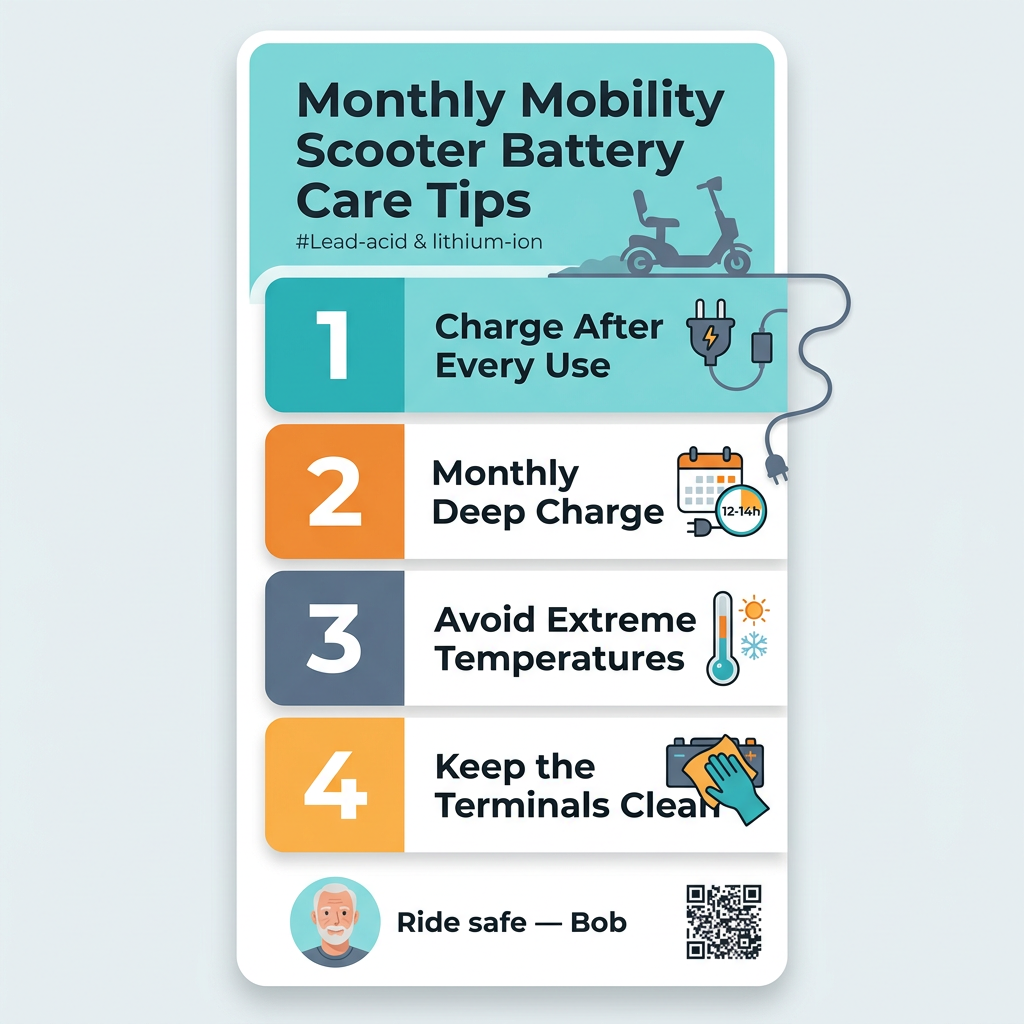
Simple monthly battery care tips to extend the life of your mobility scooter. Covers charging habits, temperature safety, and maintenance for both lead-acid and lithium-ion batteries.
By Bob Daniels | Mobility Scooters For You
Quick answer: The best way to care for a mobility scooter battery is to charge it after each use, avoid letting it sit completely drained, store it away from extreme heat or cold, keep the terminals clean, and check it monthly for weak performance. A few simple habits can add months — sometimes years — to your scooter battery’s life.
Hey everyone, Bob here.
If there’s one thing I’ve learned from years of using and studying mobility scooters, it’s this: a scooter is only as dependable as the battery underneath the seat. You can have the best frame, the comfiest seat, and the fanciest turning radius in the world — but if the battery gives up halfway across the parking lot, your day just got a lot more interesting than you wanted.
So let’s keep this simple. Below is my monthly mobility scooter battery care routine. It works for most seniors using sealed lead-acid batteries, AGM batteries, gel batteries, or lithium mobility scooter batteries. Always check your owner’s manual first, because manufacturers can have slightly different instructions. The manual is not exactly beach reading, but occasionally it earns its keep.
Bob’s Monthly Battery Care Checklist
- Charge your scooter after each day of use.
- Do not let the battery sit completely drained.
- Give stored batteries a maintenance charge each month.
- Keep the scooter away from extreme heat and freezing cold.
- Check terminals for dust, corrosion, or loose connections.
- Watch for reduced range, slow charging, or sudden power drops.
1. Charge Your Mobility Scooter After Every Use
The easiest habit is also the most important: plug your mobility scooter in after you use it for the day. You do not need to run the battery all the way down before charging. In fact, regularly draining a scooter battery too low can shorten its life.
This is especially true for sealed lead-acid batteries, which are common in many mobility scooters. These batteries generally prefer to stay charged rather than sit in a low state. If you use your scooter daily, make charging part of your evening routine — right alongside locking the door and wondering where you left your reading glasses.
Bob’s rule: If the scooter worked for you today, reward it with a charge tonight.
2. Do a Monthly Maintenance Charge
If your scooter is used every day, normal charging may be enough. But if your scooter sits unused for long periods — maybe during winter, travel, illness, or because you have a backup scooter — the battery still needs attention.
Once a month, charge the battery fully according to your scooter manual. Many lead-acid scooter batteries benefit from a full overnight charge, often around 8 to 12 hours depending on the charger and battery type. Some lithium batteries may have different storage instructions, so check your manual carefully.
The key point is this: do not park a scooter for months and expect the battery to wake up cheerful. Batteries are not houseplants, but they do need a little scheduled care.
3. Avoid Extreme Heat and Cold
Temperature matters more than many scooter owners realize. A mobility scooter battery stored in a freezing garage or left in direct summer heat can lose performance faster.
Whenever possible, store your scooter in a dry, moderate-temperature space. A garage is usually fine if it does not get extremely hot or cold. If your scooter has a removable battery pack, consider bringing the battery indoors during long periods of storage, especially in winter.
Try to avoid:
- Leaving the scooter outside in direct sun for long periods
- Storing it in freezing temperatures
- Charging the battery in damp or unsafe areas
- Keeping it near heaters, furnaces, or open flames
4. Keep the Battery Terminals Clean
Once a month, take a quick look at the battery area if it is easy and safe to access. You are looking for dust, corrosion, loose connections, or anything that looks unusual.
If you see white, green, or crusty buildup around the terminals, that may be corrosion. Do not ignore it. Dirty or corroded terminals can interfere with charging and power delivery.
If you are not comfortable checking the battery yourself, ask a family member, local mobility dealer, or repair technician. There is no shame in getting help. There is, however, a small amount of shame in poking around electrical parts with a butter knife. Please do not do that.
5. Know the Signs of a Weak Mobility Scooter Battery
A battery usually gives warning signs before it fails completely. If you catch those signs early, you can avoid getting stranded at the grocery store, pharmacy, church, or halfway down the driveway with the mail in your lap.
Watch for these symptoms:
- Your scooter does not travel as far as it used to
- The battery gauge drops quickly after a full charge
- The scooter feels sluggish on hills or ramps
- The charger takes much longer than normal
- The battery will not hold a charge overnight
- The scooter suddenly cuts out under load
If you notice more than one of these signs, it may be time to test or replace the battery.
6. Use the Right Charger
Always use the charger designed for your mobility scooter or battery pack. Using the wrong charger can damage the battery, reduce battery life, or create a safety hazard.
If your charger is lost, damaged, overheating, or making unusual noises, stop using it and contact the scooter manufacturer, dealer, or a qualified repair shop. A replacement charger is usually cheaper than replacing a battery pack — and considerably cheaper than replacing a garage.
7. Do Not Ignore Storage Instructions
If you plan to store your mobility scooter for several weeks or months, prepare the battery first.
General storage tips:
- Charge the battery before storing the scooter.
- Store the scooter or battery in a cool, dry place.
- Recharge the battery periodically according to the manual.
- Do not leave the battery fully drained during storage.
- Inspect the scooter before using it again after storage.
Different battery types behave differently. Lead-acid batteries, lithium batteries, AGM batteries, and gel batteries may each have slightly different storage recommendations. When in doubt, the manual wins the argument.
How Long Should a Mobility Scooter Battery Last?
Most mobility scooter batteries last somewhere around 1 to 3 years, depending on battery type, scooter size, rider weight, terrain, charging habits, temperature, and how often the scooter is used.
A lightly used travel scooter stored indoors may get longer battery life than a heavy-duty scooter used daily on hills, grass, and rough sidewalks. That does not mean one scooter is better than the other — it simply means the battery is doing different work.
If your scooter is your main transportation, it is smart to budget for battery replacement before the old one fails. I call this the “don’t get stranded fund.” It is less exciting than a vacation fund, but more useful when you are sitting in a Walmart aisle with 3% battery.
Lead-Acid vs Lithium Mobility Scooter Batteries
Many traditional mobility scooters use sealed lead-acid batteries. These are dependable and common, but they are heavier and usually need regular charging habits to stay healthy.
Lithium mobility scooter batteries are often lighter and may charge faster, which makes them popular on newer portable and travel scooters. They can be excellent, but they still need proper care and should be charged and stored according to the manufacturer’s instructions.
| Battery Type | Common Benefit | Care Tip |
|---|---|---|
| Sealed Lead-Acid | Reliable and widely available | Charge after use and avoid deep discharge |
| AGM or Gel | Maintenance-friendly sealed design | Use the correct charger and store properly |
| Lithium | Lighter weight and often longer-lasting | Follow the manufacturer’s charging and storage rules |
Bob’s Simple Monthly Battery Routine
Here is the short version I recommend printing or saving:
- Week 1: Check that the charger is working normally.
- Week 2: Inspect the battery area for dust, corrosion, or loose cables.
- Week 3: Pay attention to range. Is the scooter going as far as usual?
- Week 4: Give stored scooters or spare batteries a proper maintenance charge.
That is it. You do not need to become an electrical engineer. You just need a monthly habit.
Need Help Choosing the Right Scooter?
If battery life, range, portability, or reliability are your biggest concerns, start with our free scooter guide. It helps match your daily routine to the right kind of mobility scooter.
Recommended next step: Get the free Mobility Scooters For You guide and compare travel, portable, and heavy-duty scooter options before you buy.
Related Guides
If you are planning your next scooter purchase or trying to avoid repair surprises, these related guides may help:
- Why I Switched to a 4-Wheel Scooter
- California Cruising: 2026 Baja Raptor Review & New Scooter Laws
- Free Mobility Scooter Matchmaker Guide
Frequently Asked Questions
Should I charge my mobility scooter after every use?
Yes, in most cases you should charge your mobility scooter after each day of use. This helps keep the battery from sitting in a low state and can extend battery life, especially with sealed lead-acid batteries.
Can I leave my mobility scooter charging overnight?
Many mobility scooter chargers are designed for overnight charging, but you should always follow your scooter manufacturer’s instructions. Use only the correct charger and avoid charging in unsafe, damp, or extremely hot areas.
How often should I charge a mobility scooter in storage?
If your scooter is in storage, check the owner’s manual. As a general habit, many scooter owners give stored batteries a full maintenance charge about once a month, but battery type and manufacturer instructions matter.
How do I know when my mobility scooter battery needs replacing?
Common signs include reduced travel range, a battery gauge that drops quickly, sluggish power on hills, slow charging, or a battery that will not hold a charge. If these symptoms appear, have the battery tested.
Are lithium mobility scooter batteries better than lead-acid batteries?
Lithium batteries are usually lighter and may last longer, but they can cost more and need manufacturer-specific care. Lead-acid batteries are common, dependable, and widely available, but they are heavier and should be charged regularly.
Final Thought from Bob
A mobility scooter battery does not need complicated care. It needs consistency. Charge it after use, store it sensibly, keep an eye on performance, and do a monthly check before small problems turn into big ones.
Your scooter is there to keep you moving. A little battery care helps make sure it is ready when you are.
— Bob Daniels, Mobility Scooters For You