Mobility Scooter Legal Requierments
The Mobility Scooter Headline That Broke the Internet This Week

This week’s viral “100 mph mobility scooter” headline refers to a high-performance e-scooter — not the stable, senior-friendly mobility scooters built for real-world independence along coastlines like the Pacific Coast Highway.
If you’ve scrolled past a headline this week screaming that a “mobility scooter” just hit 100 mph, you’re not imagining it — and you’re not alone in doing a double-take. The vehicle in question is The Turbo, built by UK company Bo and engineered by a team of ex-Williams Formula One veterans, including CEO Oscar Morgan. The numbers read like a supercar spec sheet, not a sidewalk cruiser: a 24,000-watt dual-motor setup, an 1,800-watt-hour battery good for roughly 150 miles per charge, a top speed north of 100 mph, and a power-to-weight ratio the company claims beats a Bugatti Veyron. Bo is aiming to set a Guinness World Record with it at Bonneville Speed Week, and yes, it’s actually for sale — for $29,500, to qualified riders only (source: Bo Newsroom; Futurism).
We’re breaking down what’s real, what’s marketing spin, and — because we love a good analogy — what this story would look like if it played out along the Pacific Coast Highway instead of the Bonneville Salt Flats.
What’s Actually True in the Story
- The speed claim is real. The Turbo genuinely targets 100+ mph, verified by outlets like Futurism and The Autopian, and Bo is chasing an official Guinness World Record attempt.
- It’s built by serious engineers. The team includes veterans of Williams F1 and the Bloodhound Land Speed Rocket project — this isn’t a garage hack job.
- It’s a “personal mobility vehicle” only in the loosest regulatory sense. E-scooters like the Turbo exist in a largely unregulated category in many markets, which is precisely how a two-wheeled, stand-up scooter is legally allowed to carry a motor more powerful than most motorcycles.
- It is not a device designed for seniors, mobility-impaired riders, or anyone using it for actual accessibility needs. It requires balance, core strength, reflexes, and — per Bo’s own site — a rider profile closer to a motorsport enthusiast than a retiree running errands.
Why the Confusion Happens (and Why It Matters to You)
The Pacific Coast Analogy
Picture two riders heading out on the same stretch of Highway 1 on a clear morning.
What Actually Matters When Choosing a Real Mobility Scooter
If the Bo Turbo story has you newly curious (or newly worried) about scooter safety in general, here’s the checklist that actually applies to you or a loved one:
- Stability over speed. Look for a low center of gravity, a wide wheel track, and — for anyone riding on hills or uneven coastal terrain — four wheels rather than three. Our guide to 4-wheel scooter reliability covers exactly what to look for in a heavy-duty build.
- Battery range you can trust. Confusingly, this is one area where the Turbo story overlaps with real mobility scooter shopping — range anxiety is real either way. See our breakdown on avoiding battery failure mid-trip in Bob’s battery care guide.
- Insurance and Medicare eligibility. A $29,500 e-scooter has zero path to Medicare reimbursement. A properly classified mobility scooter might — and that’s a conversation worth having before you buy. Start with our Medicare Mobility Scooter Guide to see if you could qualify for assistance.
- Terrain-matched tyres and suspension. Pacific Coast riders dealing with boardwalks, sand-adjacent paths, and hilly neighbourhoods need pneumatic tyres and real suspension travel — not a skateboard deck.
- A realistic top speed for your environment. Faster isn’t safer. For sidewalk and neighbourhood use, 4–5 mph travel scooters are plenty; for longer outdoor range, look at 8 mph-class scooters, never anything positioning itself as a “speed demon.”
The Bottom Line


 +9
+914:47
Why I Switched to a 4-Wheel Scooter (And You Should Too) Coast to Coast Reliability Guide.
By Frank Cannon
Experience the unwavering stability of a 4-wheel scooter as you explore the breath taking Pacific Coast.
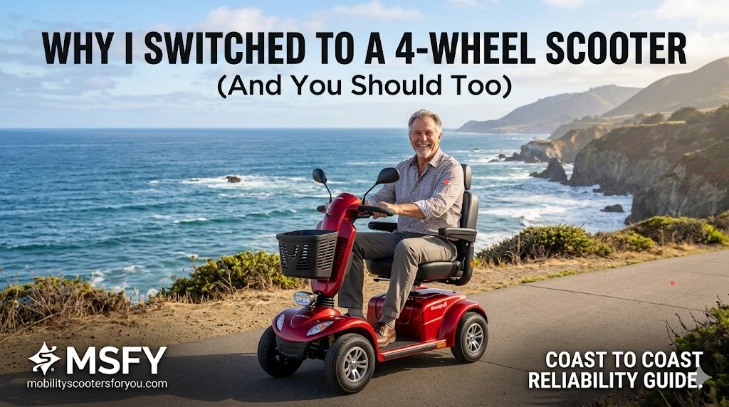
Experience the unwavering stability of a 4-wheel scooter as you explore the breath taking Pacific Coast.
Listen, I’ve been in this business long enough to know what keeps folks up at night. You’re not just buying a mobility scooter—you’re investing in your freedom. And when you’re thinking about taking that freedom coast to coast, you want answers. Real answers. Not some corporate fluff.
So let me tell you what I tell everyone who walks through my door: reliability isn’t just a feature. It’s everything.
The Questions Everyone Asks (And the Answers You Actually Need)
Can I Really Take My Mobility Scooter Cross-Country?
Absolutely. And here’s why that matters more than you might think.
Picture this: You’re visiting your grandkids in Florida. Or maybe you’re finally taking that trip to see the Grand Canyon. The last thing you need is wondering whether your scooter will hold up.
The truth? A quality 4-wheel mobility scooter is built for exactly this kind of journey. We’re talking about machines engineered with the same reliability standards as medical equipment. Because that’s what they are—medical-grade mobility devices.
When you choose a heavy-duty model, you’re choosing:
- Reinforced frames that laugh at bumpy roads
- Industrial-grade motors designed for thousands of miles
- Battery systems that won’t quit halfway through your adventure
- Suspension systems that smooth out everything from hotel parking lots to boardwalks
What Makes a Scooter “Travel-Ready”?
Now, this is where most people get confused. They think “travel-ready” means “fits in a car.”
Wrong.
A truly travel-ready scooter needs to check every single one of these boxes:
1. Airline-Compliant Batteries Your scooter needs lithium-ion batteries that meet TSA and FAA regulations. No exceptions. The last thing you want is getting to the airport and hearing “Sorry, can’t take that on board.”
2. Easy Disassembly (Without a PhD in Engineering) You should be able to break down your scooter in under 60 seconds. If it takes longer, you’re going to hate traveling with it. Trust me on this.
3. Manageable Weight Here’s where it gets interesting. The Buzzaround CarryOn weighs exactly 47.5 lbs—light enough to handle, heavy enough to feel stable. That’s the sweet spot.
4. Durable Construction Cheap plastic parts? They’ll crack in your trunk before you hit the state line. You need metal frames, reinforced joints, and components that can handle being loaded and unloaded dozens of times.
Is Weight Really That Important?
Let me answer that with a story.
Last month, a gentleman came in looking at scooters. Nice guy. He picked the heaviest model we had because he thought “heavier means better quality.”
Three weeks later, he’s back. Why? Because he couldn’t lift it into his trunk. His wife couldn’t help him. And suddenly, that “quality” scooter was sitting in his garage, unused.
Weight matters because mobility matters.
The Golden CarryOn at just $2,080 gives you the perfect balance—light enough to manage (47.5 lbs), sturdy enough to trust. That’s not marketing talk. That’s physics.
When you’re looking at weight, think about:
- Can you lift it yourself, or will you always need help?
- Does it fit in your vehicle without a special lift?
- Can you maneuver it when it’s folded?
What About Stability? I Don’t Want to Feel Wobbly.
Here’s something nobody talks about enough: your scooter should feel like an extension of your own two feet.
That’s not poetic nonsense. That’s the standard.
4-wheel scooters give you that rock-solid stability because of simple geometry. Four points of contact with the ground means:
- Better weight distribution across all surfaces
- Reduced tipping risk on inclines and turns
- Confident cornering even on uneven terrain
- Medical-grade peace of mind every single time you ride
You know that feeling when you stand up and your legs lock beneath you? That’s what a quality 4-wheel scooter gives you. Feel the ground lock beneath you. That’s not just safety—that’s confidence.
How Far Can I Actually Go on a Single Charge?
This is the million-dollar question, isn’t it?
Most heavy-duty scooters will give you 15-25 miles per charge under normal conditions. But here’s what “normal conditions” actually means:
- Flat terrain (not San Francisco hills)
- Average rider weight (check your model’s specs)
- Moderate speed (not racing your grandkids)
- Proper battery maintenance (more on this in a second)
For cross-country travel, here’s my advice: Plan for the lower end of that range. If your scooter says 20 miles, plan your day around 15. Why? Because:
- Hotel carpets drain more battery than you’d think
- You’ll want to explore, not worry about range anxiety
- Batteries perform differently in extreme heat or cold
Pro tip: Carry a portable charger and know where outlets are on your route. Most restaurants, rest stops, and hotels are incredibly accommodating when you explain the situation.
If you want to get the most out of your battery, Bob put together a simple guide that’s helped hundreds of folks extend their range. Check out Bob’s Battery Survival Guide when you have a minute.
What Happens If Something Breaks While I’m Traveling?
Smart question. And here’s the honest answer: It depends on what you bought.
Cheap scooters from big-box stores? Good luck finding parts in Albuquerque.
Quality brands with nationwide service networks? You’re covered.
When you invest in a reputable mobility scooter, you’re also investing in:
- Nationwide warranty coverage that follows you anywhere
- Common replacement parts available at medical supply stores
- 24/7 customer support that actually answers the phone
- Dealer networks in every major city
I always tell people: Buy from a company that’s been around longer than your last car. There’s a reason some brands have survived decades—they stand behind their products.
Can I Take My Scooter on a Plane?
Yes, but with conditions.
Airlines are required by law to accommodate mobility devices, but you need to:
Before You Book:
- Call the airline directly (don’t just book online)
- Confirm your battery type is approved (lithium-ion under 300Wh is usually fine)
- Ask about their specific boarding procedures
- Request gate-check if possible
At the Airport:
- Arrive 90 minutes early (minimum)
- Bring your scooter’s battery specifications in writing
- Have your doctor’s note handy (not always required, but helpful)
- Take photos of your scooter before checking it
Reality check: Airlines can be difficult. But thousands of people fly with mobility scooters every single day. You just need to know the rules and stand your ground politely.
What’s the Real Difference Between 3-Wheel and 4-Wheel Scooters for Travel?
I get this question at least three times a week.
3-wheel scooters:
- Tighter turning radius (great for indoor spaces)
- Slightly lighter weight
- Better for smooth, flat surfaces
- Less stable on uneven terrain
4-wheel scooters:
- Superior stability (especially outdoors)
- Better for varied terrain
- More weight capacity
- Confidence-inspiring on slopes and curbs
For coast-to-coast travel? 4-wheel wins every time. You’ll encounter parking lots, sidewalks, hotel lobbies, and outdoor attractions. You need that extra stability.
Zoe wrote a helpful comparison if you’re still deciding between lightweight 3-wheel and heavy-duty 4-wheel models.
How Do I Maintain My Scooter for Long-Distance Reliability?
This is where most people drop the ball. They buy a great scooter and then… nothing. No maintenance. No care.
Here’s your simple maintenance checklist:
Weekly:
- Check tire pressure (yes, even on solid tires—look for wear)
- Wipe down the frame and seat
- Test all lights and signals
Monthly:
- Inspect battery connections for corrosion
- Tighten any loose bolts or screws
- Clean the battery terminals
- Check brake function
Before Any Trip:
- Fully charge your battery (and test it)
- Inspect tires for damage or excessive wear
- Test all controls and features
- Pack your charger and any tools you might need
The secret? Treat your scooter like you’d treat your car. Regular attention prevents big problems.
What Should I Look for in a “Heavy-Duty” Scooter?
Not all heavy-duty scooters are created equal. Here’s what actually matters:
Weight Capacity: Look for at least 300 lbs, preferably 350-400 lbs. This isn’t just about your weight—it’s about stability and durability.
Motor Power: Minimum 500W for hills and inclines. Anything less and you’ll struggle on ramps.
Frame Construction: Steel or reinforced aluminum. Plastic components should be minimal.
Wheel Size: Larger wheels (9-12 inches) handle obstacles better and provide a smoother ride.
Seat Quality: High-back seats with armrests aren’t luxury—they’re necessity for long-distance comfort.
Is $2,080 a Good Price for a Quality Travel Scooter?
Let me put this in perspective.
A cheap scooter might cost $800-$1,200. Sounds like a deal, right? Until it breaks down in six months. Or won’t hold a charge. Or feels unstable every time you ride it.
The Golden CarryOn at $2,080 represents something different: value that lasts.
You’re getting:
- Medical-grade construction
- Airline-compliant batteries
- Proven reliability over thousands of miles
- Warranty coverage that actually means something
- A scooter that holds its resale value
Think about it this way: That’s less than $6 per day over one year. For your independence. For your freedom to travel. For peace of mind.
Can you really put a price on that?
Does Medicare Cover Travel Scooters?
Here’s the short answer: Sometimes, but it’s complicated.
Medicare Part B may cover a portion of your scooter if your doctor prescribes it as “durable medical equipment” and you meet specific criteria. But travel-specific features? Those usually aren’t covered.
Janice knows Medicare inside and out—she’s helped dozens of folks navigate the paperwork. Her Medicare coverage guide breaks it down in plain English.
What About Insurance for My Scooter?
Good question. Your homeowner’s or renter’s insurance might cover your scooter, but policies vary wildly.
For travel, consider:
- Damage coverage during transport
- Theft protection (especially in hotels)
- Liability coverage if someone trips over your scooter
Betty specializes in insurance options for mobility equipment. If you’re planning a big trip, her insurance checklist is worth a look.
What’s the Most Important Thing to Remember About Scooter Reliability?
Here’s what I want you to take away from this entire article:
Reliability isn’t about the scooter never having issues. It’s about choosing a scooter that’s built to handle whatever you throw at it—and backed by a company that stands behind it when you need help.
You’re not just buying a machine. You’re buying:
- The confidence to visit family across the country
- The freedom to explore new places
- The independence to live life on your terms
- The peace of mind that comes from knowing you’re covered
This is about taking control of your mobility.
Ready to Find Your Perfect Travel Companion?
Look, I’ve given you the facts. I’ve answered the questions. Now it’s time for you to make a decision.
You deserve a ride as steady as your own two feet. You deserve to travel without worry. You deserve equipment that works as hard as you do.
The Buzzaround CarryOn and Golden CarryOn aren’t just scooters—they’re your ticket to coast-to-coast freedom.
Don’t let another season pass you by. Don’t miss another family gathering because you’re worried about mobility. Don’t put off that dream trip because you’re not sure your equipment can handle it.
Your adventure is waiting. Your scooter should be ready.
—Frank Cannon
Heavy-Duty Mobility Specialist
California Cruising: 2026 Baja Raptor Review & New Scooter Laws
Control+HomeEnd
By Dr. Bob Daniels | Mobility Scooters For You

Like Bob and Janice, we are deep into analyzing the new 2026 California safety regulations impacting scooter reliability.
Janice and I spent thirty-five years in medicine. When you’ve spent that long telling patients what they should do, retirement feels like finally getting permission to do what you want. For us, that meant California. The coast, the farmers’ markets, the community paths that wind through our retirement village like they were designed specifically for people who’ve earned the right to take things slowly.
What we needed was a scooter that could keep up with that life. Not a showroom piece. Not something that handles like a shopping trolley. A real machine.
After a good deal of research — old habits die hard — we landed on the Pride Mobility Baja Raptor 2. And I want to give you an honest account of what it’s like to actually own and ride one in California in 2026, including some important legal points most reviews completely gloss over.
What Is the Baja Raptor 2?
The Baja Raptor 2 is Pride Mobility’s flagship outdoor recreational scooter. It comes in both a 3-wheel and a 4-wheel configuration — we went with the 4-wheel for the stability, and I’ll explain why that mattered in a moment.
This is not a travel scooter. It is not designed to fold up and slide into your trunk. It weighs 341.8 lbs and is a full-sized machine built for outdoor use — think coastal paths, retirement community grounds, farmers markets, and neighbourhood streets. If you want something lighter and portable, the team here has a full guide to lightweight travel scooters worth reading first. But if you want a scooter that feels like it was built to go somewhere, the Raptor 2 is worth your attention. Mobility Masters
The Specs — What Actually Matters
Let me give you the numbers that count, without the marketing language.
Speed: Top cruising speed of 13 mph — genuinely fast for a mobility scooter, and in a class of its own for this category. ACG Medical Supply
Range: Up to 21.2 miles at 200 lbs rider weight, or up to 15.1 miles at the full 400 lb capacity. For most daily use — community paths, errands, social outings — that is more than sufficient on a single charge. ACG Medical Supply
Weight Capacity: 400 lbs, with a 20″x18″ memory foam captain’s seat with manual adjustment and angle/width adjustable armrests. Comfortable for extended riding. Janice, who has some lower back issues, found the seat genuinely supportive. Bajamobility
Lighting: A full LED package including brake lights, turn signals, and headlights for maximum visibility — important if you ride in the early evening. Bajamobility
Braking: A dual electromechanical and regenerative braking system, with a hand brake for additional safety and control. PageDownEndBajamobility
Wheels: Four large all-terrain wheels designed to handle gravel, grass, and uneven surfaces with confidence. Mobility Equipment Recyclers
Console: An integrated LCD display showing speed, battery life, and mileage — easy to read, no fussing around. Bajamobility
Want to see how the Raptor compares to other top Pride models? We’ve put together a full 2026 Pride Mobility lineup comparison covering which model suits which lifestyle. Worth reading before you commit.
How Does It Ride?
Here’s where I’ll be direct: this is the most confidence-inspiring scooter I’ve ridden.
The full suspension system absorbs surface variations in a way that cheaper models simply don’t. We live in a community with a mix of smooth path and packed gravel, and the Raptor 2 handled both without drama. At 13 mph on a long flat stretch of coastal path, it felt planted and controlled — not nervous, not bouncy.
The turning radius is 92.5 inches — competitive for a scooter of this size, and manageable in most open outdoor environments. I’ll be honest: this is not a scooter for tight indoor corridors. It’s built for outside. If you primarily need indoor use, look at something smaller — the team here can point you in the right direction. Just reach out and ask. Bajamobility
The thumb throttle takes a few minutes to get used to if you’ve previously ridden a tiller-style scooter. Within half an hour I’d forgotten it was different.
The California Laws You Actually Need to Know
This is the section most reviews skip. Don’t skip it.
California draws a clear legal distinction between electric scooters — the rental-style units you see on city footpaths — and mobility scooters used by seniors or people with physical disabilities. The rules are meaningfully different, and knowing them matters.
Speed: Mobility scooters operated by seniors or those with a physical disability can travel at up to 30 mph on California roads — compared to the 15 mph hard cap that applies to standard electric scooters. At 13 mph, the Raptor 2 sits comfortably inside those limits. ValuePenguin
Sidewalks: When using mobility scooters on sidewalks and crosswalks, you must yield to pedestrians and maintain a safe, controlled speed. Unlike standard electric scooters, California law does not prohibit mobility scooter use in bicycle lanes either. Mobility Nest
No Registration Required. <a></a>d. <a></a> <a></a>d. <></a> a/>You do not need to register your mobility scooter with the California DMV. No licence plates, no annual registration fees.
Local Variations Matter: Many cities are updating their local ordinances beyond state law — Dublin’s recent ordinance prohibitsalkd riding citywide effective late 2025, with enforcement beginning in early 2026. Cities including San Jose and Danville have additional restrictions near parks and downtown areas. Always check your local city rules before riding somewhere new. TopRiding
Fines: Basic violations start around $197–$200, with court costs often exceeding $300 on top of that. It pays to know the rules before you roll. Rental Awareness
Frank covered the California coastal experience on the Raptor from a different angle — including the all-terrain test. Read his take on the top 3 all-terrain scooters here.
Who Is the Baja Raptor 2 For?
After several months of use, here’s my honest clinical assessment — retired physician’s opinion, no charge.
The Raptor 2 is ideal if you:
- Live in a retirement community, coastal area, or anywhere with good outdoor paths
- Want a scooter you can ride with genuine confidence and speed
- Need a 400 lb weight capacity with proper seating support
- Prioritise stability, visibility, and all-terrain capability over portability
It is probably not right for you if you:
- Need something that folds into a car boot — look at the travel scooter options here instead
- Primarily use a scooter indoors
- Need something covered under Medicare’s DME pathway — the Raptor 2 is a recreational device, not a medical one. Read our Medicare coverage guide to understand what qualifies
A Word on the Bariatric Question
The 400 lb capacity on the Raptor 2 covers most riders comfortably. But if you need a higher capacity, or specifically need a scooter designed and certified for bariatric use, that’s a different conversation. We’ve covered the best bariatric mobility scooters of 2026 in detail — no fluff, just the models that actually deliver.
Bob’s Honest Verdict
The Baja Raptor 2 is the best outdoor mobility scooter we have personally used. At 13 mph, with genuine all-terrain capability, full LED lighting, and a seat Janice actually looks forward to sitting in — it has genuinely expanded what our retirement looks like day to day.
If you’re in California, the legal picture is favourable for mobility scooter users. Know your local city rules, stay aware of any updated ordinances in your area, and ride sensibly.
If you’re not sure whether the Raptor 2 is the right fit for your situation — or whether a different model would serve you better — the team at Mobility Scooters For You are worth a conversation. No pressure. Just straight answers from people who know this equipment properly.
Frequently Asked Questions
Is the Baja Raptor 2 street legal in California? Yes. As a mobility scooter operated by a senior or person with a physical disability, it falls under California’s specific mobility scooter rules — separate from standard electric scooter law. It can legally travel up to 30 mph on public roads, well above the Raptor 2’s 13 mph top speed.
Does the Baja Raptor 2 come in 3-wheel and 4-wheel versions? Yes. The 3-wheel version features a full suspension system and 400 lb capacity, with a tighter turning circle. The 4-wheel version adds lateral stability — our preference for outdoor use on varied surfaces. Bajamobility
Can I ride the Baja Raptor 2 on California bike paths? Generally yes, though local rules vary. Always check the specific rules for the trail or path you plan to use, as some municipalities restrict motorised devices on certain routes.
Does Medicare cover the Baja Raptor 2? No — it is classified as a recreational device, not a medical one. Read our full Medicare guide to understand what categories of scooter do qualify for coverage.
How does the Raptor 2 compare to a 4-wheel stability scooter for everyday use? Frank covers that comparison in detail in his 4-wheel mobility scooter review — the short answer is that they serve different purposes. The Raptor 2 is about outdoor range and speed; a standard 4-wheel scooter is about portability and everyday convenience.
— Dr Bob Daniels
Bob is a retired physician and contributor at Mobility Scooters For You. He and his wife, Janice, review mobility equipment with the same rigour they applied to clinical decisions — evidence first, opinions second.
PageDown