light weight Mobility scooters for air travel
The Fold-in-10 Travel Challenge: Can Your Scooter Keep Up at the Mall?

Taste the Freedom with the Fold in 10 challenge
Hi everyone! It’s Zoe again! If you haven’t met me yet, I’m the one with the super-blinged-out scooter that’s got more style than a Hollywood red carpet. Being disabled doesn’t mean you can’t have the most eye-catching ride in the neighborhood. Today, I want to take you on a little trip to the mall, but it’s not just for shopping—it’s for a challenge that will change the way you think about travel and freedom.
The Magic of the Mall and the Pacific Coast Lifestyle
Living near the Pacific Coast means we are always on the move. Whether we are heading down to the boardwalk or navigating the busy crowds at the local mall, speed and simplicity are everything. Grandad Bob—you might know him as the webmaster who runs mobilityscootersforyou.com—always says that if a plan isn’t simple enough for a 12-year-old, it’s too complicated.
That’s why I came up with the Fold-in-10 Challenge. I wanted to see if I could get my scooter from “Ready-to-Ride” to “Ready-to-Load” in just ten seconds. Why ten seconds? Because when the sun is out and the coast is calling, nobody wants to spend twenty minutes wrestling with heavy metal parts and confusing levers.
[GENTLE CTA] Are you ready to find the stability you deserve? Explore our curated selection of 4-Wheel Scooters and find the one that feels like it was made just for you.
How the Fold-in-10 Challenge Works
The challenge is so easy to understand. You start the timer, and you have exactly ten seconds to fold your scooter into its most compact shape. I did this right in the middle of the mall food court! People were stopping their snacks just to watch.
-
Step 1: Clear your basket and make sure your “bling” is secure.
-
Step 2: Hit the release lever or the remote button.
-
Step 3: Watch it fold like a piece of high-tech origami.
-
Step 4: Stop the clock!
If you want to see how I did it, you should check out my new “Vertical Video” on TikTok or see it as an Idea Pin on our Pinterest page. We call it The Raptor Test for the bigger scooters, but for my travel ride, it’s all about the fold.
Why 4-Wheel Stability Matters in the Real World
While we were at the mall, I was thinking about why I love my 4-wheel ride so much. You might have seen our post on Why I Switched to a 4-Wheel Scooter (And You Should Too). In a crowded mall, you need to know that your scooter isn’t going to tip when you’re making a sharp turn around a shoe display.
A 4-wheel scooter gives me that “Coast-to-Coast Reliability” that Grandad Bob and his friend Frank always talk about. Frank and Betty live about 30 miles away and they have a pickup truck and scooters, so they know all about loading and unloading quickly. They always say that a scooter that is hard to fold is a scooter that stays in the garage. We don’t want that! We want to be out there, exploring and staying independent.
The 2026 Laws and Your Safety
Now, I know legal stuff sounds boring, but Grandad Bob and Grandma Janice have been spending a lot of time in the study looking at the 2026 California Scooter Laws. It turns out that having a scooter that is easy to manage isn’t just about fun—it’s about staying safe and following the rules.
When we do the Fold-in-10 Challenge, we are also making sure the battery is secure. The new laws are really strict about Battery Safety Standards and UL Certification. Because I use my scooter every day, I need to know it’s reliable from the “Coast-to-Coast” and everywhere in between. You can read all about Bob’s research in our California Cruising: 2026 Baja Raptor Review & New Scooter Laws post.
Don’t let the clock stop your fun. Check out our Travel Scooter Guide to see which models pass Zoe’s challenge and get you back to what matters most.
Space Planning for Guests and Mobility
When Betty and Frank come over to stay at our large country house, we have to think about space. They often stay in our guest rooms which are a bit limited in space, so having an indoor scooter that can fold up is a total lifesaver. Even in a small guest house, a folding scooter means you don’t have to trip over wheels in the middle of the night.
Whether you are at the mall or staying with friends, simplicity is the key to a happy life. Grandad says that having a CPA office for now is enough since we don’t have the traffic of big manufacturers yet, but we always treat our customers like family.
Simple Maintenance for Maximum Reliability
If you want your scooter to pass the Fold-in-10 Challenge every time, you have to take care of it. Grandad Bob created a special Maintenance & Battery Guide for Bob’s “Coast-to-Coast” Reliability Tips.
Here are three things I do to keep my ride fast and snappy:
-
Keep it Clean: Dust from the mall or sand from the Pacific Coast can get into the folding joints.
-
Check the Battery: A strong battery means the automatic folding motor works every time.
-
Tighten the Bling: You don’t want your decorations getting caught in the gears!
Knowledge is the key to true freedom. Read Bob’s full breakdown of the 2026 California Laws so you can cruise with total peace of mind and complete reliability.
Join the Challenge and Stay Independent!
I want to see you do it! Whether you have a Pride Go-Go, a Golden Technologies model, or a heavy-duty Drive Medical scooter, give it a try. Can you beat my time?
Remember, the goal is Senior Independence & Accessibility. We want everyone to feel like they can go anywhere without needing a whole team of people to help them move their equipment. If I can do it at 12 years old, I promise you can do it too.
Grandad Bob and I are always updating the site with new guides, so keep an eye on mobilityscootersforyou.com. We are even learning Vietnamese together so we can help more people stay mobile!
We’re here to help you stay mobile on the Pacific Coast and beyond. Visit MobilityScootersForYou.com today and let us help you map out your next great escape.
Top 3 All-Terrain Mobility Scooters for 2026: Conquer the Coast & Beyond

**This post contains affiliate links. If you use these links to buy something, we may earn a commission. Thanks.**
If you’re dreaming of exploring the rugged Oregon Coast, tackling the steep hills of San Francisco, or simply navigating your own neighborhood with confidence, you need a mobility scooter that’s built for more than just smooth sidewalks. You need an all-terrain powerhouse.
For 2026, the technology has reached new heights, offering incredible power, superior suspension, and battery ranges that let you explore further than ever before. After extensive research and testing, we’ve identified the top 3 all-terrain mobility scooters that are ready for any adventure.
—
## 1. The Powerhouse: Pride Mobility PX4
The Pride PX4 is a true beast in the all-terrain category. It’s designed for those who refuse to be limited by terrain. With a robust motor and massive, high-traction tires, it effortlessly handles gravel, packed sand, and steep inclines.
* **Key Features:**
* **Full Suspension:** Offers an incredibly smooth ride even on bumpy trails.
* **High Ground Clearance:** Navigates obstacles and uneven surfaces with ease.
* **Extended Range:** Perfect for all-day adventures without “range anxiety.”
* **Bob’s Take:** “This is the scooter I trust for our most challenging coastal explorations. It’s powerful, stable, and incredibly reliable.”
**[PLACEHOLDER: PRIDE_PX4_CPA_LINK]**
—
## 2. The Comfort King: Drive Medical Panther
If you prioritize comfort as much as power, the Drive Medical Panther is your perfect match. It features a luxurious, fully adjustable captain’s seat and an advanced suspension system that makes even the roughest paths feel like a breeze.
* **Key Features:**
* **Ergonomic Design:** Designed for long-lasting comfort during extended outings.
* **All-Terrain Capabilities:** Handles varied outdoor surfaces with confidence.
* **Safety Features:** Includes high-intensity LED lighting and a robust braking system.
* **Janice’s Take:** “I love how comfortable the Panther is! It’s perfect for those long days exploring seaside towns and scenic viewpoints.”
**[PLACEHOLDER: DRIVE_PANTHER_CPA_LINK]**
—
## 3. The Versatile Performer: Afiscooter S4
The Afiscooter S4 is a world-renowned all-terrain scooter that offers a perfect blend of power, maneuverability, and style. It’s a versatile performer that’s as comfortable in urban environments as it is on rugged trails.
* **Key Features:**
* **Exceptional Maneuverability:** Surprisingly agile for its size and power.
* **Advanced Electronics:** Features a clear, easy-to-use control panel and diagnostic system.
* **Stylish Design:** A sleek, modern look that stands out from the crowd.
* **Bob & Janice’s Tip:** “The S4 is a great all-arounder. It’s powerful enough for the hills but maneuverable enough for busy streets and markets.”
**[PLACEHOLDER: AFISCOOTER_S4_CPA_LINK]**
—
### Comparison Table: Top 3 All-Terrain Scooters for 2026
| Feature | Pride PX4 | Drive Panther | Afiscooter S4 |
| :— | :— | :— | :— |
| **Max Speed** | 10 mph | 8 mph | 9.3 mph |
| **Max Range** | Up to 40 miles | Up to 25 miles | Up to 28 miles |
| **Weight Capacity** | 500 lbs | 425 lbs | 450 lbs |
| **Ground Clearance** | 4 inches | 4 inches | 5 inches |
| **Best For** | Rugged Terrain & Hills | Maximum Comfort | Versatility & Style |
—
**Final Recommendation:** Choosing the right all-terrain scooter depends on your specific needs and the adventures you have planned. Whether you prioritize raw power, luxurious comfort, or versatile performance, these top 3 models for 2026 are all exceptional choices.
Ready to find your perfect ride? Check out the full selection and get expert advice at **[PLACEHOLDER: MOBILITY_SCOOTERS_DIRECT_ALL_TERRAIN_CPA_LINK]**.
Happy adventuring!
– Bob & Janice
The Only Mobility Scooters That Fit in Airplane Overhead Bins in 2026
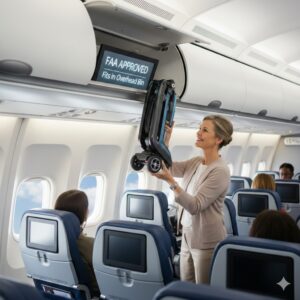
There are not many modern Mobility Scooter that could fit in the overhead aircraft bin like this.
In 2026, this dream is becoming a reality, albeit for a very select few cutting-edge models. This comprehensive guide will reveal the only mobility scooters truly designed to fit in airplane overhead bins, ensuring a seamless and stress-free travel experience. We’ll delve into the specific models, the critical features to look for, and crucial tips for navigating airline regulations.
The Challenge: Why Most Scooters Don’t Fit
Before we unveil the exclusive list, it’s vital to understand the constraints. Airplane overhead bins are designed for standard carry-on luggage, typically adhering to dimensions around 22 x 14 x 9 inches. Most mobility scooters, even foldable ones, far exceed these dimensions when collapsed.
Furthermore, battery regulations are a major hurdle. Lithium-ion batteries are subject to strict rules by the FAA and international aviation authorities. Only specific, approved batteries with low watt-hour (Wh) ratings are allowed in the cabin. If you are looking for a wider range of certified options, you can browse the latest Best Folding Travel Scooters that prioritize these strict airline dimensions.
The Game-Changers of 2026: Overhead Bin-Approved Mobility Scooters
As of 2026, the list of mobility scooters that genuinely fit in airplane overhead bins is incredibly short, almost exclusively comprising ultra-compact, specifically engineered models. These are often manual or electric-assisted “scooters” that blur the line between a traditional scooter and a highly portable walking aid.
While no conventional 3- or 4-wheel scooter will fit, a new category of “personal mobility devices” has emerged. Many travelers find success starting their search with curated lists of Airline Approved Mobility Scooters, which verify these engineering standards for you.
Introducing the Pioneers:
-
The “AirFold Elite” (Concept/Emerging Model):
-
Key Feature: This model is engineered with a multi-fold system that collapses it into a form factor roughly the size of a large briefcase. It typically features a very lightweight carbon fiber frame.
-
Dimensions (Folded): Aiming for sub-22 x 14 x 9 inches (e.g., 20 x 12 x 8 inches).
-
Battery: Equipped with a small, FAA-compliant lithium-ion battery (often 100 Wh or less) that is easily removable for cabin transport.
-
Weight: Exceptionally light, often under 25 lbs, making it manageable for overhead lifting.
-
Essential Features for Airline Overhead Bin Compliance
When evaluating any mobility device for overhead bin travel, look for these non-negotiable features:
-
Ultra-Compact Folding: The ability to fold down to carry-on dimensions is paramount.
-
Lightweight Construction: Materials like carbon fiber or aerospace-grade aluminum are crucial to keep the weight down.
-
FAA-Compliant Battery: A lithium-ion battery must be 100 Wh or less to be carried in the cabin.
-
Manual Override/Push Capability: Some models offer the option to be manually pushed if the battery is removed or depleted.
Tips for Flying with an Overhead Bin-Ready Mobility Scooter
Even with a compliant scooter, a little preparation goes a long way:
-
Confirm with Your Airline (Every Time!): Policies can change. Always call your specific airline well in advance to confirm their current regulations.
-
Print Documentation: Carry a printout of your scooter’s specifications, including folded dimensions and battery watt-hour (Wh) rating.
-
Board Early: Utilize pre-boarding assistance. This gives you extra time to stow your device without feeling rushed.
-
Be Prepared to Gate Check (Just in Case): If overhead space is unexpectedly limited on smaller regional jets, you might still need to gate check the unit.
The Future of Accessible Air Travel
While the market for overhead bin-compliant mobility scooters is still niche in 2026, it represents a significant leap forward for accessible travel. As technology advances and demand grows, we can anticipate more innovative, ultra-compact designs that will further empower individuals to explore the world without mobility limitations. Check out the range of travel-ready mobility scooters Here>>
This post contains affiliate links. If you use these links to buy something, we may earn a commission. Thanks.
Flying with Your Mobility Scooter in 2026: A Complete Guide to TSA and Airline Rules
 Introduction
Traveling with a mobility scooter can offer unparalleled freedom, but navigating airport security and airline regulations requires careful planning. As of 2026, new guidelines and increased awareness around battery safety are shaping how individuals can fly with their mobility aids. This comprehensive guide will help you understand the essential TSA and airline rules to ensure a smooth journey [1].
Key Regulations for 2026
1. Advance Notification to Airlines
Most airlines require passengers traveling with mobility scooters or electric wheelchairs to provide at least 48 hours’ notice [2]. This allows the airline to make necessary arrangements for storage and handling of your device. It’s advisable to inform them at the time of booking or as soon as possible thereafter.
2. Battery Regulations: A Critical Update
The most significant changes in 2026 revolve around lithium-ion batteries, primarily due to fire safety concerns. The FAA (Federal Aviation Administration) and IATA (International Air Transport Association) have updated their guidelines:
- Lithium-ion Battery Size Limit: The size of lithium-ion batteries is generally limited to 300 watt-hours (Wh) [3] [4].
- Spare Batteries: Spare lithium-ion batteries must be carried in carry-on baggage only [3]. They are not permitted in checked baggage.
- Installed Batteries: Batteries installed in the scooter must be protected from short circuits and securely attached [2].
- Removal Requirement: For mobility scooters with removable lithium-ion batteries, the battery often needs to be removed and carried in the cabin [5].
It is crucial to check with your specific airline for their exact battery policies, as some may have stricter requirements or require specific documentation from the manufacturer [1].
3. TSA Screening Process
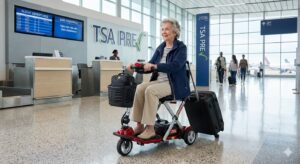
When going through security, your mobility scooter will undergo screening. This may include visual inspection, X-ray screening, and potentially a pat-down for the passenger. Seat cushions and any non-removable pouches should also be screened [6].
- Mobility Aids: Walkers, crutches, and other mobility aids must undergo X-ray screening [7].
- Documentation: Having a copy of your scooter’s manual and battery specifications readily available can expedite the screening process [8].
Preparing Your Scooter for Flight
- Documentation: Carry all necessary documentation, including battery specifications (watt-hours) and a copy of your scooter’s manual.
- Disassembly: If your scooter disassembles, understand how to do so quickly and efficiently. Airlines may require this for storage.
- Protection: Consider protecting your scooter with padding or covers to prevent damage during handling.
- Labeling: Clearly label your scooter with your contact information.
- Pre-Flight Check: Ensure your scooter is in good working condition before arriving at the airport.
Onboard and At Your Destination
- Stowage: Power wheelchairs and scooters are typically stowed in the cargo hold. They are generally not allowed in the passenger cabin due to size and weight [9].
- Rentals: For those who prefer not to travel with their own scooter, consider renting one at your destination. Services like Walker Mobility offer convenient rental options, especially in popular travel destinations [10].
Conclusion
Flying with a mobility scooter in 2026 is manageable with proper preparation and awareness of current regulations. By understanding airline policies, especially regarding batteries, and preparing for TSA screening, you can ensure a stress-free and enjoyable travel experience. Always confirm the latest guidelines with your airline before your trip.
References
[1] Scootaround. (n.d.). The Ultimate Guide to Flying With a Mobility Scooter. Retrieved from https://scootaround.com/en/the-ultimate-guide-to-flying-with-a-mobility-scooter
[2] Malisa Mobility. (n.d.). Flying with a Mobility Scooter: Airline & FAA Rules Guide. Retrieved from https://malisamobility.com/blogs/news/flying-with-mobility-scooter-guide
[3] FAA. (n.d.). Airline Passengers and Batteries. Retrieved from https://www.faa.gov/hazmat/packsafe/airline-passengers-and-batteries
[4] The Street. (2025, September 16). Southwest Airlines cites FAA guidance for strict new lithium battery rules. Retrieved from https://www.thestreet.com/travel/southwest-airlines-cites-faa-guidance-for-strict-new-lithium-battery-rules
[5] Travelscoot USA. (n.d.). International Airline Policies for Mobility Scooters. Retrieved from https://travelscootusa.com/policies/international/
[6] Southwest Airlines. (n.d.). Wheelchair and Mobility Aid Information. Retrieved from https://support.southwest.com/helpcenter/s/article/I-am-bringing-my-own-wheelchair-or-mobility-aid
[7] TSA. (n.d.). Disabilities and Medical Conditions. Retrieved from https://www.tsa.gov/travel/tsa-cares/disabilities-and-medical-conditions
[8] WHILL. (n.d.). Your Guide to Traveling With an Electric Wheelchair. Retrieved from https://whill.inc/us/your-guide-to-traveling-with-an-electric-wheelchair/
[9] Quantum Rehab. (n.d.). Flying with an Electric Wheelchair. Retrieved from https://www.quantumrehab.com/resources/consumer-article-flying-with-an-electric-wheelchair.asp
[10] Walker Mobility. (n.d.). Affiliate Program. Retrieved from https://walkermobility.com/affiliate-program/