How to chose the right mobility scooter and accessories for your needs.
Monthly Mobility Scooter Battery Care Tips
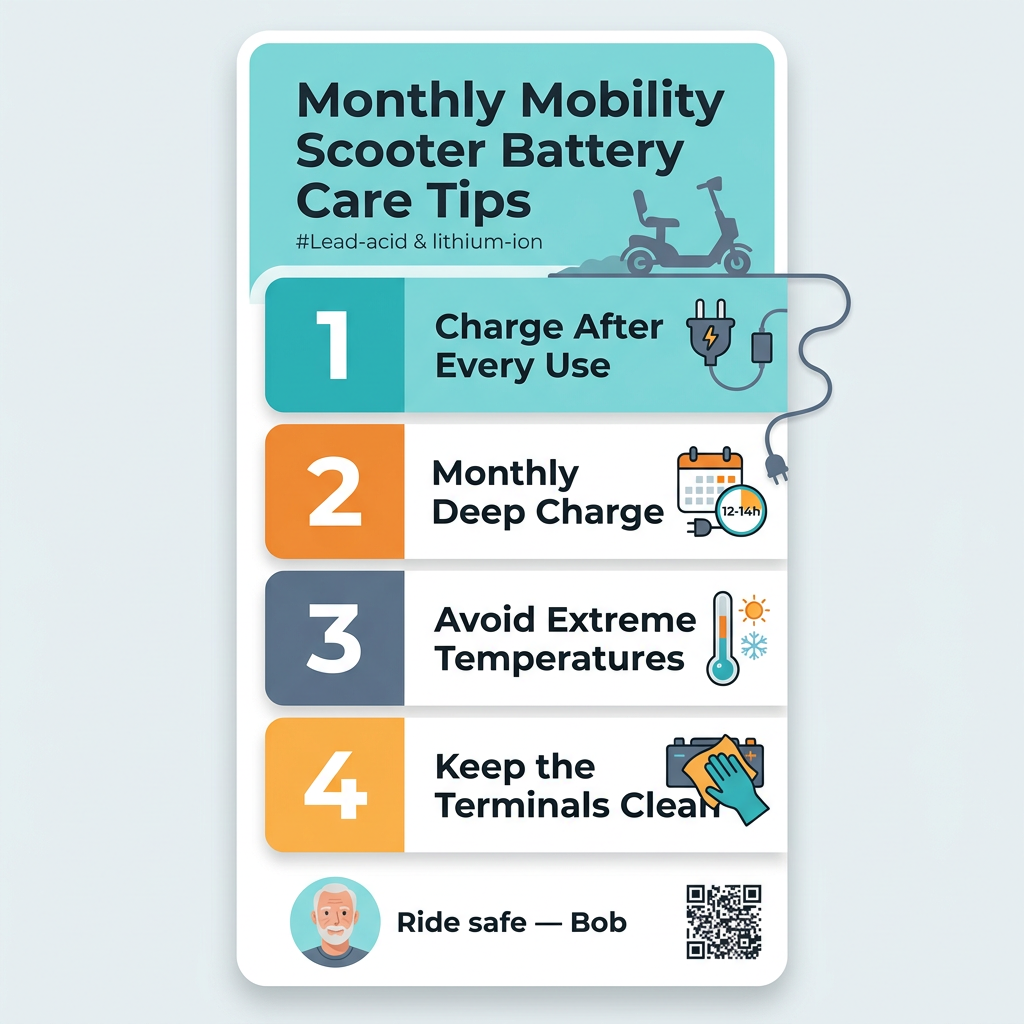
Simple monthly battery care tips to extend the life of your mobility scooter. Covers charging habits, temperature safety, and maintenance for both lead-acid and lithium-ion batteries.
By Bob Daniels | Mobility Scooters For You
Quick answer: The best way to care for a mobility scooter battery is to charge it after each use, avoid letting it sit completely drained, store it away from extreme heat or cold, keep the terminals clean, and check it monthly for weak performance. A few simple habits can add months — sometimes years — to your scooter battery’s life.
Hey everyone, Bob here.
If there’s one thing I’ve learned from years of using and studying mobility scooters, it’s this: a scooter is only as dependable as the battery underneath the seat. You can have the best frame, the comfiest seat, and the fanciest turning radius in the world — but if the battery gives up halfway across the parking lot, your day just got a lot more interesting than you wanted.
So let’s keep this simple. Below is my monthly mobility scooter battery care routine. It works for most seniors using sealed lead-acid batteries, AGM batteries, gel batteries, or lithium mobility scooter batteries. Always check your owner’s manual first, because manufacturers can have slightly different instructions. The manual is not exactly beach reading, but occasionally it earns its keep.
Bob’s Monthly Battery Care Checklist
- Charge your scooter after each day of use.
- Do not let the battery sit completely drained.
- Give stored batteries a maintenance charge each month.
- Keep the scooter away from extreme heat and freezing cold.
- Check terminals for dust, corrosion, or loose connections.
- Watch for reduced range, slow charging, or sudden power drops.
1. Charge Your Mobility Scooter After Every Use
The easiest habit is also the most important: plug your mobility scooter in after you use it for the day. You do not need to run the battery all the way down before charging. In fact, regularly draining a scooter battery too low can shorten its life.
This is especially true for sealed lead-acid batteries, which are common in many mobility scooters. These batteries generally prefer to stay charged rather than sit in a low state. If you use your scooter daily, make charging part of your evening routine — right alongside locking the door and wondering where you left your reading glasses.
Bob’s rule: If the scooter worked for you today, reward it with a charge tonight.
2. Do a Monthly Maintenance Charge
If your scooter is used every day, normal charging may be enough. But if your scooter sits unused for long periods — maybe during winter, travel, illness, or because you have a backup scooter — the battery still needs attention.
Once a month, charge the battery fully according to your scooter manual. Many lead-acid scooter batteries benefit from a full overnight charge, often around 8 to 12 hours depending on the charger and battery type. Some lithium batteries may have different storage instructions, so check your manual carefully.
The key point is this: do not park a scooter for months and expect the battery to wake up cheerful. Batteries are not houseplants, but they do need a little scheduled care.
3. Avoid Extreme Heat and Cold
Temperature matters more than many scooter owners realize. A mobility scooter battery stored in a freezing garage or left in direct summer heat can lose performance faster.
Whenever possible, store your scooter in a dry, moderate-temperature space. A garage is usually fine if it does not get extremely hot or cold. If your scooter has a removable battery pack, consider bringing the battery indoors during long periods of storage, especially in winter.
Try to avoid:
- Leaving the scooter outside in direct sun for long periods
- Storing it in freezing temperatures
- Charging the battery in damp or unsafe areas
- Keeping it near heaters, furnaces, or open flames
4. Keep the Battery Terminals Clean
Once a month, take a quick look at the battery area if it is easy and safe to access. You are looking for dust, corrosion, loose connections, or anything that looks unusual.
If you see white, green, or crusty buildup around the terminals, that may be corrosion. Do not ignore it. Dirty or corroded terminals can interfere with charging and power delivery.
If you are not comfortable checking the battery yourself, ask a family member, local mobility dealer, or repair technician. There is no shame in getting help. There is, however, a small amount of shame in poking around electrical parts with a butter knife. Please do not do that.
5. Know the Signs of a Weak Mobility Scooter Battery
A battery usually gives warning signs before it fails completely. If you catch those signs early, you can avoid getting stranded at the grocery store, pharmacy, church, or halfway down the driveway with the mail in your lap.
Watch for these symptoms:
- Your scooter does not travel as far as it used to
- The battery gauge drops quickly after a full charge
- The scooter feels sluggish on hills or ramps
- The charger takes much longer than normal
- The battery will not hold a charge overnight
- The scooter suddenly cuts out under load
If you notice more than one of these signs, it may be time to test or replace the battery.
6. Use the Right Charger
Always use the charger designed for your mobility scooter or battery pack. Using the wrong charger can damage the battery, reduce battery life, or create a safety hazard.
If your charger is lost, damaged, overheating, or making unusual noises, stop using it and contact the scooter manufacturer, dealer, or a qualified repair shop. A replacement charger is usually cheaper than replacing a battery pack — and considerably cheaper than replacing a garage.
7. Do Not Ignore Storage Instructions
If you plan to store your mobility scooter for several weeks or months, prepare the battery first.
General storage tips:
- Charge the battery before storing the scooter.
- Store the scooter or battery in a cool, dry place.
- Recharge the battery periodically according to the manual.
- Do not leave the battery fully drained during storage.
- Inspect the scooter before using it again after storage.
Different battery types behave differently. Lead-acid batteries, lithium batteries, AGM batteries, and gel batteries may each have slightly different storage recommendations. When in doubt, the manual wins the argument.
How Long Should a Mobility Scooter Battery Last?
Most mobility scooter batteries last somewhere around 1 to 3 years, depending on battery type, scooter size, rider weight, terrain, charging habits, temperature, and how often the scooter is used.
A lightly used travel scooter stored indoors may get longer battery life than a heavy-duty scooter used daily on hills, grass, and rough sidewalks. That does not mean one scooter is better than the other — it simply means the battery is doing different work.
If your scooter is your main transportation, it is smart to budget for battery replacement before the old one fails. I call this the “don’t get stranded fund.” It is less exciting than a vacation fund, but more useful when you are sitting in a Walmart aisle with 3% battery.
Lead-Acid vs Lithium Mobility Scooter Batteries
Many traditional mobility scooters use sealed lead-acid batteries. These are dependable and common, but they are heavier and usually need regular charging habits to stay healthy.
Lithium mobility scooter batteries are often lighter and may charge faster, which makes them popular on newer portable and travel scooters. They can be excellent, but they still need proper care and should be charged and stored according to the manufacturer’s instructions.
| Battery Type | Common Benefit | Care Tip |
|---|---|---|
| Sealed Lead-Acid | Reliable and widely available | Charge after use and avoid deep discharge |
| AGM or Gel | Maintenance-friendly sealed design | Use the correct charger and store properly |
| Lithium | Lighter weight and often longer-lasting | Follow the manufacturer’s charging and storage rules |
Bob’s Simple Monthly Battery Routine
Here is the short version I recommend printing or saving:
- Week 1: Check that the charger is working normally.
- Week 2: Inspect the battery area for dust, corrosion, or loose cables.
- Week 3: Pay attention to range. Is the scooter going as far as usual?
- Week 4: Give stored scooters or spare batteries a proper maintenance charge.
That is it. You do not need to become an electrical engineer. You just need a monthly habit.
Need Help Choosing the Right Scooter?
If battery life, range, portability, or reliability are your biggest concerns, start with our free scooter guide. It helps match your daily routine to the right kind of mobility scooter.
Recommended next step: Get the free Mobility Scooters For You guide and compare travel, portable, and heavy-duty scooter options before you buy.
Related Guides
If you are planning your next scooter purchase or trying to avoid repair surprises, these related guides may help:
- Why I Switched to a 4-Wheel Scooter
- California Cruising: 2026 Baja Raptor Review & New Scooter Laws
- Free Mobility Scooter Matchmaker Guide
Frequently Asked Questions
Should I charge my mobility scooter after every use?
Yes, in most cases you should charge your mobility scooter after each day of use. This helps keep the battery from sitting in a low state and can extend battery life, especially with sealed lead-acid batteries.
Can I leave my mobility scooter charging overnight?
Many mobility scooter chargers are designed for overnight charging, but you should always follow your scooter manufacturer’s instructions. Use only the correct charger and avoid charging in unsafe, damp, or extremely hot areas.
How often should I charge a mobility scooter in storage?
If your scooter is in storage, check the owner’s manual. As a general habit, many scooter owners give stored batteries a full maintenance charge about once a month, but battery type and manufacturer instructions matter.
How do I know when my mobility scooter battery needs replacing?
Common signs include reduced travel range, a battery gauge that drops quickly, sluggish power on hills, slow charging, or a battery that will not hold a charge. If these symptoms appear, have the battery tested.
Are lithium mobility scooter batteries better than lead-acid batteries?
Lithium batteries are usually lighter and may last longer, but they can cost more and need manufacturer-specific care. Lead-acid batteries are common, dependable, and widely available, but they are heavier and should be charged regularly.
Final Thought from Bob
A mobility scooter battery does not need complicated care. It needs consistency. Charge it after use, store it sensibly, keep an eye on performance, and do a monthly check before small problems turn into big ones.
Your scooter is there to keep you moving. A little battery care helps make sure it is ready when you are.
— Bob Daniels, Mobility Scooters For You
 Frank always liked things built tough. After thirty years running a highly successful trucking empire, he expects machinery to handle whatever he throws at it without breaking a sweat, complaining, or stalling out. If it isn’t heavy-duty, Frank isn’t interested.
So, when his good friend Bob—a retired MD with an eagle eye for technical detail and microscopic precision—suggested they push the newest All-Terrain Mobility Scooters to their absolute limits down by the rugged Malibu coastline, Frank didn’t even hesitate. He just grabbed his jacket.
If you’re anything like Frank, you crave the absolute freedom to explore off the beaten path. You refuse to let a little uneven ground stop you. Whether it’s a sandy beach, a muddy forest trail, or navigating the treacherous, rocky Californian coves, an all-terrain mobility scooter is engineered precisely to give you back your power. In 2026, the outdoor mobility scooter market has introduced mind-blowing advancements in suspension and shock absorption, and Bob was eager to analyze every single spec.
## What is the “Secret Sauce” of an All-Terrain Mobility Scooter?
“It’s all in the shock absorption architecture,” Bob noted, methodically checking the undercarriage with total focus. Unlike those flimsy, standard indoor scooters, true all-terrain models are forged with heavy-duty frames and massive pneumatic or solid knobby tires. This allows them to devour uneven surfaces like gravel, dirt, and even hard-packed sand—meaning you never get stuck, you never damage the motor, and you never have to turn back.
## Bob & Frank’s Top 3 Powerhouse Picks for 2026!
### 1. The Trailblazer Heavy Duty: The Coast-Crusher
Equipped with a beastly dual-motor system, this design completely seduced Frank. The scooter absolutely thrives on steep inclines and terrifyingly rocky paths. The independent suspension ensures you won’t feel a single bump, leaving you perfectly comfortable. “It rides smoother than my old rig,” Frank laughed, revving the throttle.
### 2. The Coastline Cruiser: The Sand-Surfer
Perfect for beachgoers who refuse to be stuck on the boardwalk. Bob precisely analyzed the Coastline Cruiser’s specially engineered, ultra-wide tires that completely prevent sinking into deep sand. Even better? Its advanced anti-corrosion coating forms an invisible shield, protecting the essential mechanics from destructive, salty ocean air.
### 3. The Explorer Pro: The Marathon Champion
The Explorer boasts the longest battery range of the entire lineup. This is the absolute ideal choice for epic, full-day excursions along the coast without ever needing a recharge. Unstoppable, unyielding, and incredibly sleek.
## Your Adventure Doesn’t Wait!
Don’t let rough terrain cage you in. Modern 21st-century accessibility means you no longer have to compromise, stay behind, or watch the fun from afar. With a premium all-terrain mobility scooter, you get the ridiculous power and insane durability you need to keep up with the gang.
**Ready to Conquer the Wild?** Browse our exclusive collection at **Mobility Scooters For You** and find the absolute perfect match for your fearless outdoor lifestyle!
The Fold-in-10 Travel Challenge: Can Your Scooter Keep Up at the Mall?

Taste the Freedom with the Fold in 10 challenge
Hi everyone! It’s Zoe again! If you haven’t met me yet, I’m the one with the super-blinged-out scooter that’s got more style than a Hollywood red carpet. Being disabled doesn’t mean you can’t have the most eye-catching ride in the neighborhood. Today, I want to take you on a little trip to the mall, but it’s not just for shopping—it’s for a challenge that will change the way you think about travel and freedom.
The Magic of the Mall and the Pacific Coast Lifestyle
Living near the Pacific Coast means we are always on the move. Whether we are heading down to the boardwalk or navigating the busy crowds at the local mall, speed and simplicity are everything. Grandad Bob—you might know him as the webmaster who runs mobilityscootersforyou.com—always says that if a plan isn’t simple enough for a 12-year-old, it’s too complicated.
That’s why I came up with the Fold-in-10 Challenge. I wanted to see if I could get my scooter from “Ready-to-Ride” to “Ready-to-Load” in just ten seconds. Why ten seconds? Because when the sun is out and the coast is calling, nobody wants to spend twenty minutes wrestling with heavy metal parts and confusing levers.
[GENTLE CTA] Are you ready to find the stability you deserve? Explore our curated selection of 4-Wheel Scooters and find the one that feels like it was made just for you.
How the Fold-in-10 Challenge Works
The challenge is so easy to understand. You start the timer, and you have exactly ten seconds to fold your scooter into its most compact shape. I did this right in the middle of the mall food court! People were stopping their snacks just to watch.
-
Step 1: Clear your basket and make sure your “bling” is secure.
-
Step 2: Hit the release lever or the remote button.
-
Step 3: Watch it fold like a piece of high-tech origami.
-
Step 4: Stop the clock!
If you want to see how I did it, you should check out my new “Vertical Video” on TikTok or see it as an Idea Pin on our Pinterest page. We call it The Raptor Test for the bigger scooters, but for my travel ride, it’s all about the fold.
Why 4-Wheel Stability Matters in the Real World
While we were at the mall, I was thinking about why I love my 4-wheel ride so much. You might have seen our post on Why I Switched to a 4-Wheel Scooter (And You Should Too). In a crowded mall, you need to know that your scooter isn’t going to tip when you’re making a sharp turn around a shoe display.
A 4-wheel scooter gives me that “Coast-to-Coast Reliability” that Grandad Bob and his friend Frank always talk about. Frank and Betty live about 30 miles away and they have a pickup truck and scooters, so they know all about loading and unloading quickly. They always say that a scooter that is hard to fold is a scooter that stays in the garage. We don’t want that! We want to be out there, exploring and staying independent.
The 2026 Laws and Your Safety
Now, I know legal stuff sounds boring, but Grandad Bob and Grandma Janice have been spending a lot of time in the study looking at the 2026 California Scooter Laws. It turns out that having a scooter that is easy to manage isn’t just about fun—it’s about staying safe and following the rules.
When we do the Fold-in-10 Challenge, we are also making sure the battery is secure. The new laws are really strict about Battery Safety Standards and UL Certification. Because I use my scooter every day, I need to know it’s reliable from the “Coast-to-Coast” and everywhere in between. You can read all about Bob’s research in our California Cruising: 2026 Baja Raptor Review & New Scooter Laws post.
Don’t let the clock stop your fun. Check out our Travel Scooter Guide to see which models pass Zoe’s challenge and get you back to what matters most.
Space Planning for Guests and Mobility
When Betty and Frank come over to stay at our large country house, we have to think about space. They often stay in our guest rooms which are a bit limited in space, so having an indoor scooter that can fold up is a total lifesaver. Even in a small guest house, a folding scooter means you don’t have to trip over wheels in the middle of the night.
Whether you are at the mall or staying with friends, simplicity is the key to a happy life. Grandad says that having a CPA office for now is enough since we don’t have the traffic of big manufacturers yet, but we always treat our customers like family.
Simple Maintenance for Maximum Reliability
If you want your scooter to pass the Fold-in-10 Challenge every time, you have to take care of it. Grandad Bob created a special Maintenance & Battery Guide for Bob’s “Coast-to-Coast” Reliability Tips.
Here are three things I do to keep my ride fast and snappy:
-
Keep it Clean: Dust from the mall or sand from the Pacific Coast can get into the folding joints.
-
Check the Battery: A strong battery means the automatic folding motor works every time.
-
Tighten the Bling: You don’t want your decorations getting caught in the gears!
Knowledge is the key to true freedom. Read Bob’s full breakdown of the 2026 California Laws so you can cruise with total peace of mind and complete reliability.
Join the Challenge and Stay Independent!
I want to see you do it! Whether you have a Pride Go-Go, a Golden Technologies model, or a heavy-duty Drive Medical scooter, give it a try. Can you beat my time?
Remember, the goal is Senior Independence & Accessibility. We want everyone to feel like they can go anywhere without needing a whole team of people to help them move their equipment. If I can do it at 12 years old, I promise you can do it too.
Grandad Bob and I are always updating the site with new guides, so keep an eye on mobilityscootersforyou.com. We are even learning Vietnamese together so we can help more people stay mobile!
We’re here to help you stay mobile on the Pacific Coast and beyond. Visit MobilityScootersForYou.com today and let us help you map out your next great escape.
Flying with Your Mobility Scooter in 2026: A Complete Guide to TSA and Airline Rules
 Introduction
Traveling with a mobility scooter can offer unparalleled freedom, but navigating airport security and airline regulations requires careful planning. As of 2026, new guidelines and increased awareness around battery safety are shaping how individuals can fly with their mobility aids. This comprehensive guide will help you understand the essential TSA and airline rules to ensure a smooth journey [1].
Key Regulations for 2026
1. Advance Notification to Airlines
Most airlines require passengers traveling with mobility scooters or electric wheelchairs to provide at least 48 hours’ notice [2]. This allows the airline to make necessary arrangements for storage and handling of your device. It’s advisable to inform them at the time of booking or as soon as possible thereafter.
2. Battery Regulations: A Critical Update
The most significant changes in 2026 revolve around lithium-ion batteries, primarily due to fire safety concerns. The FAA (Federal Aviation Administration) and IATA (International Air Transport Association) have updated their guidelines:
- Lithium-ion Battery Size Limit: The size of lithium-ion batteries is generally limited to 300 watt-hours (Wh) [3] [4].
- Spare Batteries: Spare lithium-ion batteries must be carried in carry-on baggage only [3]. They are not permitted in checked baggage.
- Installed Batteries: Batteries installed in the scooter must be protected from short circuits and securely attached [2].
- Removal Requirement: For mobility scooters with removable lithium-ion batteries, the battery often needs to be removed and carried in the cabin [5].
It is crucial to check with your specific airline for their exact battery policies, as some may have stricter requirements or require specific documentation from the manufacturer [1].
3. TSA Screening Process
When going through security, your mobility scooter will undergo screening. This may include visual inspection, X-ray screening, and potentially a pat-down for the passenger. Seat cushions and any non-removable pouches should also be screened [6].
- Mobility Aids: Walkers, crutches, and other mobility aids must undergo X-ray screening [7].
- Documentation: Having a copy of your scooter’s manual and battery specifications readily available can expedite the screening process [8].
Preparing Your Scooter for Flight
- Documentation: Carry all necessary documentation, including battery specifications (watt-hours) and a copy of your scooter’s manual.
- Disassembly: If your scooter disassembles, understand how to do so quickly and efficiently. Airlines may require this for storage.
- Protection: Consider protecting your scooter with padding or covers to prevent damage during handling.
- Labeling: Clearly label your scooter with your contact information.
- Pre-Flight Check: Ensure your scooter is in good working condition before arriving at the airport.
Onboard and At Your Destination
- Stowage: Power wheelchairs and scooters are typically stowed in the cargo hold. They are generally not allowed in the passenger cabin due to size and weight [9].
- Rentals: For those who prefer not to travel with their own scooter, consider renting one at your destination. Services like Walker Mobility offer convenient rental options, especially in popular travel destinations [10].
Conclusion
Flying with a mobility scooter in 2026 is manageable with proper preparation and awareness of current regulations. By understanding airline policies, especially regarding batteries, and preparing for TSA screening, you can ensure a stress-free and enjoyable travel experience. Always confirm the latest guidelines with your airline before your trip.
References
[1] Scootaround. (n.d.). The Ultimate Guide to Flying With a Mobility Scooter. Retrieved from https://scootaround.com/en/the-ultimate-guide-to-flying-with-a-mobility-scooter
[2] Malisa Mobility. (n.d.). Flying with a Mobility Scooter: Airline & FAA Rules Guide. Retrieved from https://malisamobility.com/blogs/news/flying-with-mobility-scooter-guide
[3] FAA. (n.d.). Airline Passengers and Batteries. Retrieved from https://www.faa.gov/hazmat/packsafe/airline-passengers-and-batteries
[4] The Street. (2025, September 16). Southwest Airlines cites FAA guidance for strict new lithium battery rules. Retrieved from https://www.thestreet.com/travel/southwest-airlines-cites-faa-guidance-for-strict-new-lithium-battery-rules
[5] Travelscoot USA. (n.d.). International Airline Policies for Mobility Scooters. Retrieved from https://travelscootusa.com/policies/international/
[6] Southwest Airlines. (n.d.). Wheelchair and Mobility Aid Information. Retrieved from https://support.southwest.com/helpcenter/s/article/I-am-bringing-my-own-wheelchair-or-mobility-aid
[7] TSA. (n.d.). Disabilities and Medical Conditions. Retrieved from https://www.tsa.gov/travel/tsa-cares/disabilities-and-medical-conditions
[8] WHILL. (n.d.). Your Guide to Traveling With an Electric Wheelchair. Retrieved from https://whill.inc/us/your-guide-to-traveling-with-an-electric-wheelchair/
[9] Quantum Rehab. (n.d.). Flying with an Electric Wheelchair. Retrieved from https://www.quantumrehab.com/resources/consumer-article-flying-with-an-electric-wheelchair.asp
[10] Walker Mobility. (n.d.). Affiliate Program. Retrieved from https://walkermobility.com/affiliate-program/
How to Choose the Best Mobility Scooter for Your Lifestyle

We chose the right Mobility Scooters for our needs.
### 1. Pride Go-Go: The Compact Companion
For those who value agility and ease of transport, the Pride Go-Go stands unparalleled. It is the quintessential choice for navigating tight indoor spaces. Its feather-touch disassembly ensures your journey is never hindered.
[Pride Go-Go – Best USA Price]
Manufacturer: Pride
[BUTTON: CHECK AVAILABILITY]
Regain Your Freedom: Finding the Perfect Mobility Scooter for You
Choosing a mobility scooter is a big step towards regaining independence and enjoying life to the fullest. Whether you’re looking for a way to navigate your home more easily, explore the outdoors, or travel with confidence, there’s a perfect scooter out there for you. This guide will help you understand the different types of scooters and what to consider when making your choice.
Understanding Different Types of Mobility Scooters
Mobility scooters come in various designs, each suited for different needs and environments. Knowing the main categories can help you narrow down your options.
1. Travel Scooters (Portable and Lightweight)
Ideal for: Individuals who need a scooter for occasional use, shopping trips, or travel. They are designed for easy disassembly and transport in a car trunk or on public transport.
Key Features:
- Lightweight: Often made with lighter materials for easy lifting.
- Disassembles: Breaks down into several smaller, manageable pieces.
- Compact: Designed to fit into tight spaces.
- Speed: Typically slower, focusing on maneuverability.
2. 3-Wheel Scooters (Maneuverability)
Ideal for: Indoor use or navigating tight spaces. The single front wheel allows for a tighter turning radius.
Key Features:
- High Maneuverability: Excellent for navigating hallways, stores, and crowded areas.
- Legroom: Often provides more legroom than 4-wheel models.
- Stability: Generally less stable than 4-wheel scooters, especially at higher speeds or on uneven terrain.
3. 4-Wheel Scooters (Stability and Outdoor Use)
24
Ideal for: Outdoor adventures, longer distances, and individuals who prioritize stability. They offer a more robust and stable ride.
Key Features:
- Superior Stability: Provides a secure ride on various terrains.
- Higher Weight Capacity: Often designed to support heavier users.
- Larger Batteries: Allows for longer travel ranges.
- Less Maneuverable: Wider turning radius compared to 3-wheel scooters.
4. Heavy-Duty Scooters (Power and Durability)
Ideal for: Larger individuals, rough terrain, or those who need a scooter for all-day use. These are the most powerful and durable options.
Key Features:
- High Weight Capacity: Built to support significant weight.
- Powerful Motors: Can handle inclines and rough surfaces with ease.
- Large Batteries: Extended range for all-day use.
- Robust Construction: Designed for maximum durability.
Your Mobility Scooter Checklist: What to Consider
To ensure you choose the best scooter for your unique needs, consider the following factors:
- Where will you use it most? (Indoors, outdoors, or both?)
- How far do you need to travel on a single charge? (Check battery range.)
- What is your weight? (Ensure the scooter’s weight capacity is sufficient.)
- Do you need to transport it? (Consider a travel scooter if you plan to put it in a car.)
- What kind of terrain will you encounter? (Smooth floors, sidewalks, grass, gravel?)
- Do you need extra features? (Storage, lights, adjustable seating, armrests?)
- What is your budget? (Scooters vary widely in price.)
Regain Your Independence Today!
Choosing the right mobility scooter can truly transform your daily life, offering renewed freedom and confidence. Take your time, consider your needs, and don’t hesitate to reach out if you have any questions. Your perfect ride is waiting!
The Best Mobility Scooters for People With Back or Joint Pain

Living with back pain, arthritis, or joint issues often means renegotiating how you move around the world. For many, long walks, errands, or social visits become endurance exercises — sometimes painful endurance. In such circumstances, a mobility scooter can be more than a convenience; it becomes a gateway to independence, comfort, and continued quality of life. But not all mobility scooters are created equal — for those with back or joint pain, the right scooter can make the difference between “bearable” mobility and “pain-inducing” mobility. This guide walks you through why, how, and which types of scooters excel for pain-sensitive riders.
Why Choosing the Right Scooter Matters — Beyond “Just Getting Around”
When your spine, hips, knees, or joints protest even routine movement, mobility isn’t just about distance — it’s about how your body endures the journey. A standard scooter might get you from point A to B, but it may jolt every time you hit an uneven sidewalk, press on your joints when you sit down, or aggravate lower back pain if the seat lacks proper support.
A “pain-friendly” mobility scooter — one built for ergonomic support, shock absorption, and adaptive comfort — can:
- Limit jarring and vibration, which often travel up from wheels into the spine or joints.
- Support proper posture and spinal alignment through adjustable, cushioned seating with back/lumbar support.
- Ease entry and exit, with swivel or height-adjustable seats and armrests that fold up — reducing strain on hips, knees, and lower back.
- Reduce fatigue from walking, so you can conserve energy for activities that strengthen muscles without overdoing it.
In short: the right scooter doesn’t just move you — it protects your body as you move.
Key Features to Look For When You Have Back or Joint Pain
Not all mobility scooters are equally suitable for pain-sensitive users. When evaluating scooters for yourself or a loved one with back or joint issues, prioritize models that combine ergonomic comfort, shock absorption, and ease of use. Here are the essential features to consider:
- Comfortable, well-padded seats with back support — Ideally, adjustable seats, swivel or foldable, with lumbar/backrest cushioning.
- Suspension or shock-absorbing systems — These soften the ride over uneven surfaces, reducing impact to the spine and joints.
- Swivel or adjustable seats with adjustable armrests — Make boarding and alighting easier and less painful.
- Stability (4-wheel or wide wheelbase) or good turning radius (3-wheel) — Depending on use: 4-wheel for stability outdoors; 3-wheel for maneuverability indoors.
- Appropriate size and weight capacity — Scooter must accommodate the user comfortably without overloading.
- Range, battery life, and terrain capability — Important if you plan to travel outdoors or for longer distances.
- Ease of controls and handling — For users with hand joint pain or limited strength, intuitive, gentle controls matter.
- Accessibility and portability (if needed) — For indoor use or frequent transport, a compact or foldable model can be ideal.
Top Mobility Scooters for Back or Joint Pain — Recommended Picks
Here’s a curated list of mobility scooters that tend to perform exceptionally well for people with back pain, arthritis, or other joint issues. These combine ergonomic seating, smooth ride quality, and user-friendly design — hallmarks of “pain-friendly” scooters.
Why These Scooters Stand Out
- Golden Technologies Buzzaround EX Mobility Scooter — Often praised for its cushioned, stadium-style seat and smooth ride. Its ergonomic seating and suspension system help reduce jolts — ideal if back or spine issues flare with impact.
- Afiscooter Breeze S4 Mobility Scooter — A heavy-duty, outdoor-ready scooter with excellent suspension and adjustable seating — suited if you frequently traverse uneven terrain or go on longer outings.
- EWheels EW-M41 Mobility Scooter — Balanced heavy-duty build with comfort and stability, ideal for heavier users or those needing a robust, reliable scooter for daily use.
- Vive 4-Wheel Mobility Scooter — A more budget-friendly 4-wheel scooter that still addresses comfort and stability — suitable for daily errands without overspending.
- Golden Technologies Companion 3-Wheel Full-Size Scooter — Offers generous legroom and comfortable seating; a good balance between scooter size and ergonomic support.
- Vive 3-Wheel Electric Mobility Scooter — Lightweight and budget-friendly option for indoor/light outdoor use; a viable pick if you prioritize maneuverability and ease of storage.
- Go-Go Folding Scooter by Pride Mobility — Excellent for those needing portability — folds or disassembles easily, especially useful if storage space is limited or you frequently travel.
- Shoprider Echo 3 Mobility Scooter — Entry-level scooter for those new to mobility aids; lighter weight, easy controls, and simple operation — though less powerful, still useful for light mobility needs.
Matching Scooter Type to Your Needs: A Quick Decision Framework
Your ideal mobility scooter depends heavily on how and where you’ll use it — as well as the specific pain or mobility constraints you face. Here’s a rough decision matrix:
| Your Situation / Need | Best Scooter Type / Features |
| You spend most of your time indoors or in small spaces (home, mall) | 3-wheel scooter (tight turning radius), swivel seat, lightweight, compact |
| You travel outdoors — sidewalks, parks, errands — regularly | 4-wheel or heavy-duty scooter with suspension, wide wheelbase, and good battery range |
| You have severe back or spinal pain, need a smooth ride & seat comfort | Padded seat with back support, suspension, adjustable armrests, and swivel seat |
| You’re on a budget or want something simple | Basic 3- or 4-wheel with minimal but adequate comfort; prioritize ease of use over fancy extras |
| You have limited storage space or need to transport the scooter | Folding or disassemblable scooter, lightweight frame, easy to carry |
| You’re heavier or carry items often (groceries, cane/walker) | Scooter with high weight capacity, sturdy frame, spacious footboard/legroom |
Common Mistakes to Avoid — Especially When You Have Back / Joint Issues
When looking for a scooter, many buyers focus on battery life or speed — but those aren’t the priorities if pain relief and comfort are your main goals. Here are some pitfalls to avoid:
- Prioritizing portability over comfort. A lightweight “travel scooter” might fold easily — but often sacrifices seat padding, shock absorption, and stability. For pain-prone users, that trade-off can worsen discomfort.
- Skimping on seat ergonomics. Cheap scooters often feature hard or flat seats with minimal back support—a recipe for back strain.
- Ignoring suspension or terrain needs. A scooter that behaves like a pogo stick on uneven pavements can aggravate spine or joint pain.
- Overlooking turning radius or space constraints. A bulky, heavy-duty scooter may be fine outdoors, but unwieldy indoors — leading to awkward transfers or increased strain.
- Overloading the scooter. Exceeding the weight capacity or adding heavy cargo can strain the motor — causing jerky starts/stops that impact comfort.
How to Select the Right One — A Step-by-Step Buying Checklist (for Pain-Sensitive Users)
- Evaluate your daily needs and routine. Will the scooter be used indoors? Outdoors? Long errands? Short trips? Carefully map out typical use cases.
- Measure your space and home layout. Doorways, hallway widths, storage — ensuring scooter will fit where needed.
- Test for comfort and ergonomics. Try before you buy: sit down, check seat padding/back support, test turning, ease of getting on/off. If that’s not possible, examine the specs —adjustable seat height, swivel seat, lumbar support.
- Check suspension and ride smoothness (especially for outdoor use). If you expect rough terrain, choose models with shock absorbers or suspension systems.
- Verify weight capacity and stability. Ensure the scooter supports your body weight plus a margin for any items you might carry.
- Consider portability vs. permanence. If you frequently travel or have limited space, pick a foldable or travel scooter — but only if it still offers adequate comfort.
- Read reviews, ideally from users with similar needs. Look especially for feedback related to comfort over long periods, ride smoothness, ease of transfer, and seat support.
- Consult a healthcare professional if needed. Especially for chronic back or joint conditions, a medical professional can offer insight on posture, seating angle, and what to avoid.
Why the “Pain-Focused” Scooter is More Than a Device — It’s Mobility Therapy
Using a well-designed mobility scooter isn’t simply about sidestepping pain or making errands easier. For many with chronic back or joint issues, it’s about reclaiming autonomy. A scooter that cushions shocks, supports posture, and reduces strain turns mobility from a burdensome chore into an act of self-care.
Indeed, some pain-friendly scooters effectively become part of a broader pain-management strategy: preserving energy for physical therapy or gentle exercise; avoiding inflammation exacerbation; and enabling social outings and mental stimulation without risking a pain flare-up.
In that sense, choosing the right scooter is akin to choosing a walking aid —a posture support—an aid that preserves dignity, independence, and quality of life.
How to Maintain Your Mobility Scooter for Long-Term Comfort
A mobility scooter isn’t just a device you purchase and forget about, especially when you rely on it to protect sensitive joints or an already delicate spine. Proper maintenance ensures not only longevity but also ride quality, which directly affects how much impact your body absorbs. Even the most ergonomic scooter can start to feel rough if it isn’t cared for, so a little routine attention goes a long way.
Check Tire Pressure and Tire Condition Regularly
Underinflated or worn tires can make the ride feel bumpier and harsher, transmitting unnecessary vibration into your lower back and hips. Keeping tires properly inflated ensures smoother rolling and better shock absorption, especially outdoors.
Keep the Seat and Suspension in Peak Condition
If your scooter has adjustable suspension, inspect it periodically for stiffness or sagging. Meanwhile, clean the seat cushions, tighten loose screws, and ensure the backrest stays supportive — a wobbly seat equals a wobbly spine.
Charge the Battery Properly
A weak battery can cause jerky acceleration or sudden lurching, both of which can worsen back or joint pain. Charge consistently, avoid draining it to zero, and replace old batteries when they start losing range.
Inspect the Brakes and Steering Column
Smooth braking and responsive steering matter more than you might think — they prevent abrupt stops or sudden twists that strain your neck, shoulders, and wrists. Quick yearly servicing can keep everything gliding comfortably.
Clean and Lubricate Moving Parts
Dust and debris can interfere with wheels, joints, and the tiller. A little lubrication and cleaning help maintain fluid motion, ensuring your scooter remains a gentle extension of your body rather than a mechanical irritant.
Schedule Regular Professional Tune-Ups
Even with routine self-maintenance, a trained technician can catch issues early—misalignment, worn suspension, or motor problems—preventing discomfort and preserving a silky, pain-free ride.
FAQs
What features make a mobility scooter good for back or joint pain?
Look for cushioned, adjustable seating, good back support, suspension or shock absorption, and easy-to-use controls.
Are 3-wheel scooters safe for people with pain issues?
Yes — they’re great for indoor use and maneuverability. But for outdoor stability and uneven terrain, 4-wheel models are usually better.
Can mobility scooters help reduce chronic pain?
Indirectly, yes. They reduce strain on joints and prevent repeated pressure on the spine, helping minimize flare-ups from walking long distances.
Are travel scooters comfortable enough for people with back pain?
Some are, but many have smaller seats and limited suspension. If comfort is a priority, choose a model with enhanced padding and support.
How do I know which scooter is right for me?
Consider where you’ll use it (indoors/outdoors), your pain level, weight capacity needs, terrain, and the comfort of the seat and suspension system.
Are heavy-duty scooters better for joint pain?
They can be. Heavy-duty models often offer superior suspension, stability, and more supportive seating.
Should I test a scooter before buying?
If possible, yes. Test how easy it is to sit, get off, steer, and ride—comfort can vary widely by model.
Conclusion
If you or a loved one is dealing with back pain, arthritis, or chronic joint discomfort, don’t settle for the “first mobility scooter available.” What you need is a scooter that understands pain, not just mobility. One that cushions when pavements are harsh. One that swaddles your spine when you sit. One that turns ergonomics into freedom.
With careful selection, attention to comfort and ergonomics, and a bit of hands-on testing or research, you can find a mobility scooter that doesn’t just transport you: it protects you. It preserves your posture, your joints, your dignity. And, ultimately, your independence.
So take your time. Evaluate realistically. Prioritize comfort and support. And choose a mobility solution that doesn’t just move you—but moves you forward.